








India’s metal packaging industry faces a BIS sourcing squeeze

Find your next multibaggerBe a Pro Investor
Research stocks and track your picks on the go. Download the app.
Key highlights
- India imported 11.76 million metric tonnes of ferrous scrap in 2023, exposing metal supply chains to global availability and price movements.
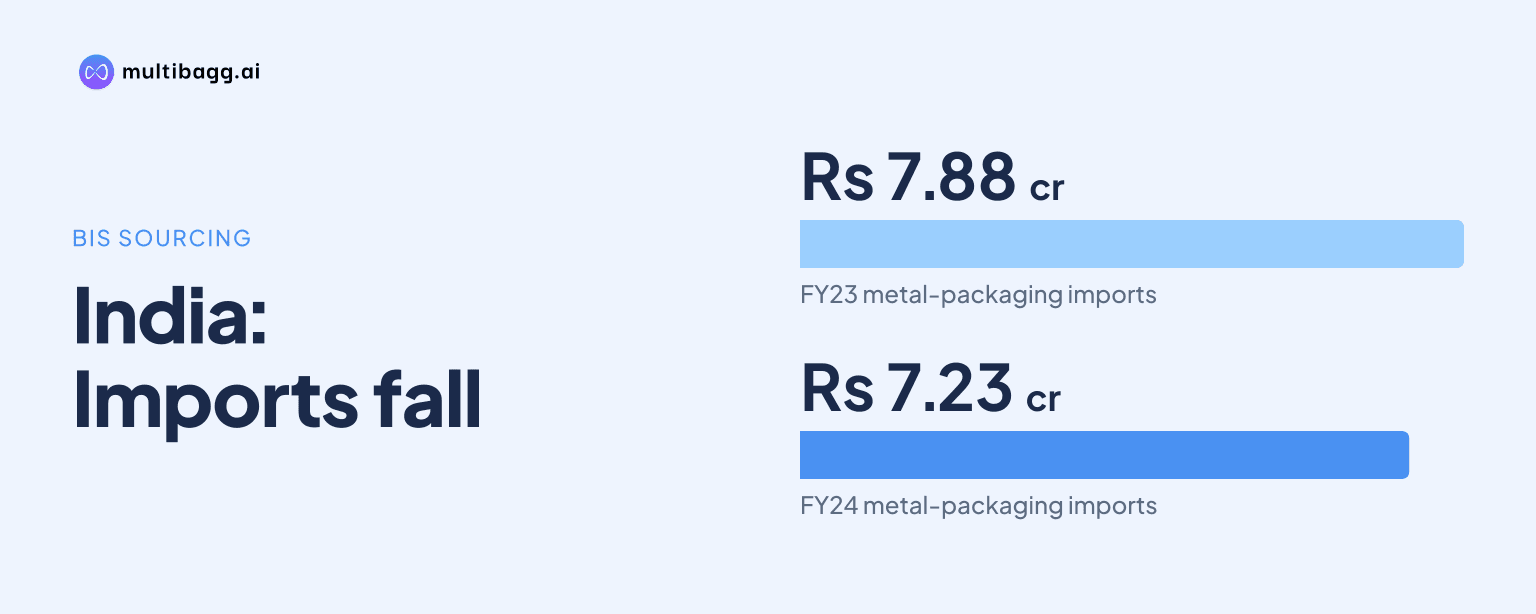
- Metal packaging-product imports declined 8.2% to Rs 7.23 crore in 2023-24 from Rs 7.88 crore in 2022-23.
- China supplied Rs 2.55 crore, or about 35.2%, of reported metal packaging-product imports in 2023-24.
- Metal packaging-product exports rose from Rs 5.23 crore in 2020-21 to Rs 8.19 crore in 2023-24.
powered by IRIS
India’s metal packaging industry faces a BIS sourcing squeeze because the Quality Control Order requires Bureau of Indian Standards-approved tinplate and tin-free steel for imported specialised closures, while India imported 11.76 million metric tonnes of ferrous scrap in 2023. The requirement can limit component availability, delay output and raise procurement costs if compliant overseas supply is unavailable.
Why does the metal packaging industry face a BIS sourcing squeeze?
The metal packaging industry faces a BIS sourcing squeeze because the Quality Control Order, or QCO, mandates BIS-approved tinplate and tin-free steel for easy-open ends, peel-off ends, domes, cones and other closures. The source says these components are imported in multiple sizes and specifications from suppliers across countries and continents, making a single certified supply route difficult to establish.
The constraint is not the quality standard alone. The QCO requires overseas tinplate suppliers to use BIS-certified material and requires product manufacturers in India to obtain BIS licensing. If a supplier or manufacturer does not meet these conditions, a can maker may not be able to procure a component required to complete its product, creating risks of non-availability, production delays, increased costs and market shortages.
Which imported inputs matter most to the metal packaging industry?
The metal packaging industry relies on imports of tinplate, particular coating and lining compounds, and specialised closure components, while also exporting finished products including flattened cans, printed sheets, crown corks and lug caps. Tinplate is steel coated with tin, while tin-free steel is coated steel used in packaging; both are relevant inputs for food-contact containers and closures.
India’s 11.76 million metric tonnes of ferrous-scrap imports in 2023 quantify wider raw-material exposure. Ferrous scrap is not a measure of packaging-component imports, but the figure shows dependence on global metal supply conditions. Continued access to imported inputs depends on overseas supply, shipping routes, port operations, trade restrictions, tariffs and suppliers’ ability to comply with certification requirements.
Domestic production is limited for specialised ends and closures. The source states that easy-open ends, peel-off ends and related components are not widely manufactured in India because specialised plant and machinery require high capital investment and existing domestic demand does not justify such large-scale investment. The risk would reduce if domestic capacity becomes viable or qualified imported material can continue to enter the supply chain.
How have metal packaging-product imports changed and where do they come from?
Metal packaging-product imports increased from Rs 5.92 crore in 2020-21 to Rs 7.88 crore in 2022-23, then declined 8.2% to Rs 7.23 crore in 2023-24. Imports totalled Rs 4.73 crore in April-December 2024-25, a nine-month period that cannot be compared directly with full-year totals.
China was the largest reported source in 2023-24 at Rs 2.55 crore, equivalent to about 35.2% of the Rs 7.23 crore total. Thailand supplied Rs 1.28 crore, Indonesia Rs 0.56 crore, the United States Rs 0.47 crore and Malaysia Rs 0.37 crore. Together, these five countries accounted for about 72.3% of 2023-24 imports, indicating that reported sourcing was diversified but concentrated in a small group of markets.
China’s reported import value rose from Rs 1.39 crore in 2020-21 to Rs 2.55 crore in 2023-24, while the United States figure declined from Rs 0.57 crore to Rs 0.47 crore. A supply disruption at China, the largest reported origin, could therefore affect procurement more than an equivalent disruption at a smaller origin. The source does not identify the product mix supplied by each country.
Got a follow-up? Ask IRIS
How do food-contact quality rules affect metal packaging?
Food-contact metal packaging must comply with the Food Safety and Standards (Packaging) Regulations, 2018, which took effect on July 1, 2019, as well as applicable Indian Standards. The regulations cover metals and metal alloys, prohibit rusty containers, chipped enamelled containers and improperly tinned copper or brass containers, and impose migration limits for iron, copper and zinc.
BIS specifications add product and testing requirements. IS 10325:2000 sets specifications for square tins used for ghee, vanaspati, edible oils and bakery shortenings, while IS 2471:1963 sets testing procedures for metal containers. The QCO issue arises because inputs and components needed to meet these requirements can be sourced from international supply chains that may not already have BIS approvals.
The source presents a defined policy trade-off: the QCO aims to standardise quality, but its implementation may not account for globally dispersed sourcing. Compliance without disruption requires imported tinplate, tin-free steel and specialised components to be certified and licensed in time, or domestic output to become commercially viable at the required specifications.
Does demand growth offset the metal packaging industry’s sourcing risk?
Demand growth does not remove the sourcing risk because rising output from metal-packaging end markets increases the importance of timely component availability. India’s overall packaging market was projected to increase from USD 50.5 billion in 2019 to USD 204.8 billion in 2025, representing a stated compound annual growth rate, or CAGR, of 26.7%.
Metal packaging serves ready-to-eat food, canned beverages, pharmaceuticals, aerosol products, paints and chemicals, where barrier protection, contamination resistance or shelf life are relevant. The source also projects India’s food-processing market to increase from USD 307.2 billion in 2022 to USD 470 billion by 2028, at a 9.5% CAGR from 2023 to 2028. These demand projections do not ensure input availability or stable procurement costs.
Exports demonstrate that the sector supplies overseas markets while retaining imported-input exposure. Metal packaging-product exports rose from Rs 5.23 crore in 2020-21 to Rs 8.19 crore in 2023-24, while imports were Rs 7.23 crore in 2023-24. In April-December 2024-25, exports were Rs 5.47 crore and imports were Rs 4.73 crore; neither partial-year number establishes a full-year trade result.
Conclusion
The metal packaging industry’s sourcing constraint lies at the intersection of imported inputs and BIS-linked QCO compliance. Its need for tinplate, tin-free steel, coating and lining compounds, and specialised closures must be managed alongside food-safety standards covering material grades, testing and metal migration. The decline in product imports to Rs 7.23 crore in 2023-24 from Rs 7.88 crore in 2022-23 does not establish that domestic substitution has resolved this dependency.
The next issue to watch is whether BIS licensing for imported tinplate and tin-free steel is streamlined, as the source proposes, or whether investment develops domestic production of easy-open ends, peel-off ends and closures. The source also proposes a QCO review that accommodates global sourcing realities, trade facilitation and investment in recyclable, lightweight and high-performance packaging materials.

