








Ajay Agarwal faces pending Rs 3.29 crore decree execution

Find your next multibaggerBe a Pro Investor
Research stocks and track your picks on the go. Download the app.
Key highlights
- Ajay Agarwal’s pending execution case cites a Rs 3.29 crore money decree.
- The decree provides future interest of 36% per annum on a Rs 70.14 lakh principal sum.
- The Hyderabad court allowed the commercial execution petition on August 31, 2021.
- Agarwal’s request to file a rejoinder was dismissed on March 10, 2023.
powered by IRIS
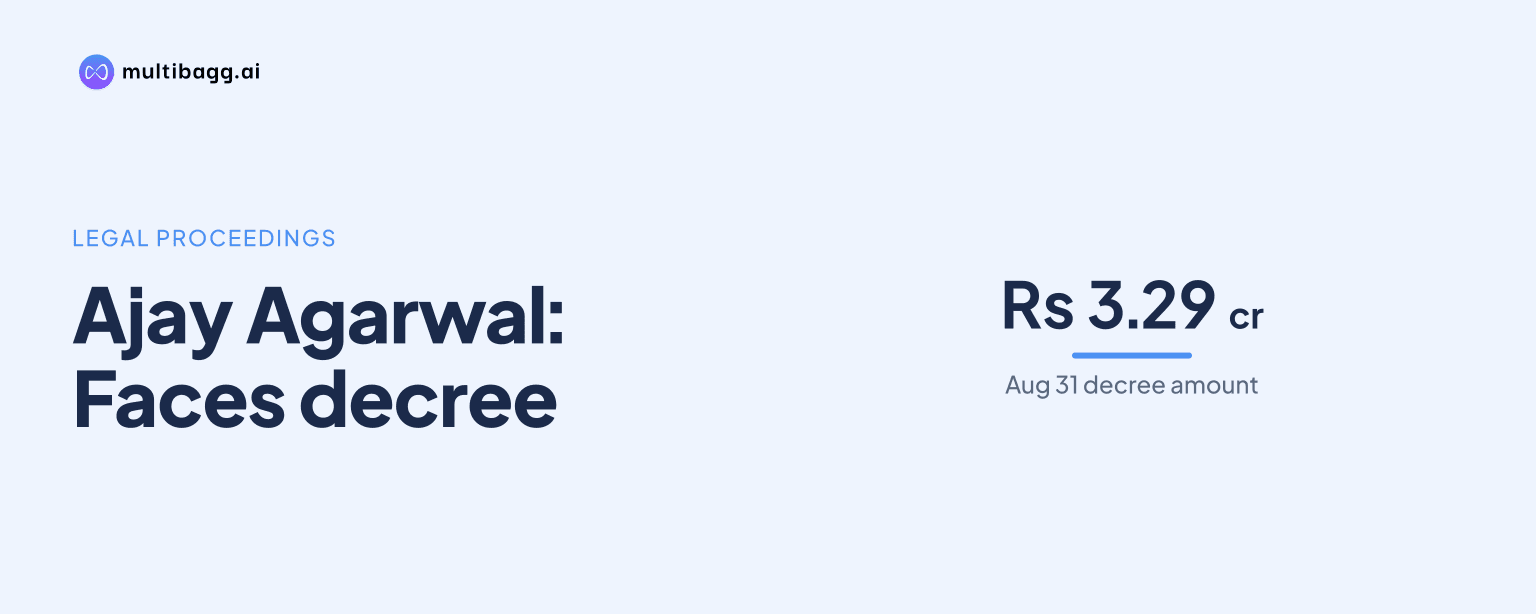
Ajay Agarwal faces a pending commercial execution petition over a Rs 3.29 crore money decree, with future interest at 36% a year on a Rs 70.14 lakh principal sum, according to the company’s litigation disclosure. The matter concerns Agarwal’s disclosed role as guarantor and remains before the Commercial Court-Cum XXIV Additional Chief Judge, City Civil Court, Hyderabad.
What is Ajay Agarwal’s pending Rs 3.29 crore execution case?
Ajay Agarwal is disclosed as a director against whom Integrated Finance Company Limited filed Commercial Execution Petition No. 47 of 2017, also described as EP No. 12 of 2018, before the Commercial Court-Cum XXIV Additional Chief Judge, City Civil Court, Hyderabad. The petition seeks execution of a money decree that the disclosure says was passed by the High Court of Madras in C.S. No. 588 of 2020.
The decree directs the defendants, including Agarwal, to pay Rs 3.29 crore, together with future interest of 36% per annum on a principal sum of Rs 70.14 lakh. An execution petition is a proceeding in which a decree holder seeks to enforce a court decree rather than obtain a fresh decision on the underlying monetary claim. The disclosure states that Agarwal was liable to discharge the debt because he was a guarantor.
The Rs 3.29 crore decree amount and the Rs 70.14 lakh principal sum are separate figures in the disclosure. The document does not provide a break-up showing how the decree amount was calculated, the date from which future interest runs, the amount of interest accumulated to date, or the value of any recovery, if any. Those unresolved details mean the disclosed Rs 3.29 crore should not be treated as a final current payment figure.
How has the execution proceeding progressed since 2021?
The Hyderabad court allowed the commercial execution petition on August 31, 2021, according to the litigation disclosure. The document says the execution petition was filed to transfer the case from the High Court of Madras, while also recording that the decree holder had not paid the stated amount; it does not explain that latter statement or state its procedural effect.
The parties subsequently filed pleadings, written statements and a rejoinder. On April 1, 2022, the court allowed the decree holder to file a rejoinder because the judgment debtor had raised a new contention in its reply. A judgment debtor is the party against whom a decree is being enforced, while a rejoinder is a response to a later pleading.
On March 10, 2023, the court dismissed a petition filed by Agarwal seeking permission to file a rejoinder. The disclosure does not specify the grounds for that dismissal, whether it was challenged, or any hearing date after March 2023. It nevertheless expressly records that the commercial execution matter remains pending, rather than identifying it as resolved, withdrawn or settled.
How does this matter differ from Ajay Agarwal’s other disclosed case?
Agarwal’s execution proceeding is distinct from a separate appeal involving Bharat Metal Box Company Limited and its directors, including a person named in the disclosure as Ajay Agrawal. In CCCA No. 180 of 2009, the High Court of Telangana granted an absolute stay on November 26, 2009 against execution of a September 2, 2009 decree in Original Suit No. 285 of 2002.
The two matters differ in claimant, court history and disclosed procedural position. The Bharat Metal Box appeal arose from a money-recovery suit filed by GK Strips Private Limited, whereas the pending commercial execution petition was filed by Integrated Finance Company Limited and concerns a decree cited as originating from the High Court of Madras. The disclosure identifies the August 31, 2021 execution petition as pending, but does not state that an equivalent stay applies to it.
The distinction is material because an appeal with an absolute stay is not the same procedural position as a pending execution petition. The disclosure provides no consolidated monetary exposure for Agarwal across both cases, and it does not state whether the 2009 appeal has been finally decided. Readers therefore need to assess each proceeding by its separately disclosed court number, claimant and status.
Got a follow-up? Ask IRIS
Is the execution petition a company liability or a personal guarantor matter?
The commercial execution petition is disclosed under litigation against the company’s promoters, and the document says Agarwal was liable because he was a guarantor. That description presents the matter as a disclosed personal litigation exposure tied to a guarantee, rather than as one of the company’s own listed litigation matters.
The company’s separate tax disputes have different parties and mechanisms. For example, the company disclosed a pending Hyderabad goods and services tax appeal relating to a confirmed demand of Rs 1.10 crore under an Order-in-Original dated December 29, 2025, while the Ajay Agarwal matter concerns enforcement of a civil money decree. Goods and services tax, or GST, is an indirect tax; it is not part of the commercial execution petition.
The promoter litigation disclosure also reports no actions by regulatory or statutory authorities against promoters and no Securities and Exchange Board of India or stock-exchange disciplinary action against promoters in the last five financial years. Separately, the tax-deduction-at-source table records Rs 45,506 of prior-years default and Rs 3,000 for 2025-26 under Ajay Agarwal, but those entries do not alter the stated pending status or terms of the Rs 3.29 crore execution petition.
What could change the disclosed exposure?
The reported exposure could change through an enforcement order, a payment, a settlement, a challenge to execution, or a decision affecting the guarantee, but the disclosure does not report any of those outcomes after the March 10, 2023 order. The immediate disclosed facts are limited to a pending proceeding, the Rs 3.29 crore decree amount, and future interest at 36% per annum on Rs 70.14 lakh.
The 36% annual interest term matters because the disclosure specifies that it applies to the principal sum rather than providing a current total interest amount. Continued accrual, if applicable under the decree, would depend on the operative court terms and the relevant period, neither of which is quantified in the document. Any final liability would also depend on court proceedings and the guarantor’s obligations, which the disclosure does not quantify further.
Conclusion
Ajay Agarwal’s disclosed legal exposure is a pending Hyderabad execution proceeding connected with a Rs 3.29 crore money decree and a 36% annual future-interest clause on Rs 70.14 lakh. It is procedurally different from the company’s GST matters and from the separate Bharat Metal Box appeal, where the disclosure records an absolute stay on execution against directors in November 2009.
The next point to watch is a court update in CEP No. 47/2017, EP No. 12/2018, particularly any order on enforcement, a quantified interest claim, settlement, payment or change in Agarwal’s asserted guarantor liability. The disclosure gives no future hearing date or estimated financial outcome, so the pending status remains the clearest reported indicator.

