










Crystal capacity use was below 50% at eight sites
Key highlights
- Crystal reported utilisation below 50% at eight of nine listed facilities in the six months ended September 30, 2025.
- Crystal’s Bengaluru Seed Processing Unit recorded 5.40% utilisation, processing 93 MT against 1,722 MT of available capacity.
- Crystal’s Gujarat Formulation Unit was the only listed facility above 50% utilisation, at 57.27%.
- Crystal proposes an automated Gujarat plant on 125,714.60 square metres of industrial land transferred provisionally on November 11, 2025.
powered by IRIS
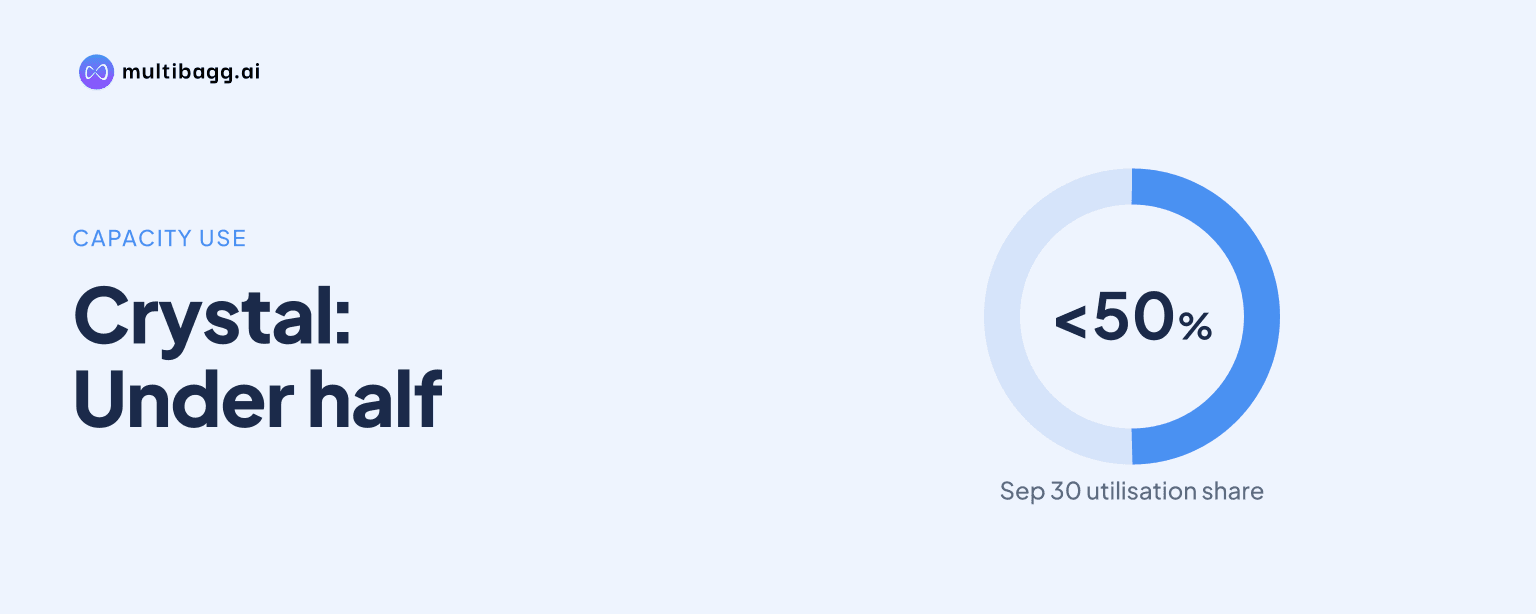
Crystal Crop Protection Limited reported capacity use below 50% at eight of its nine disclosed manufacturing and seed-processing facilities in the six months ended September 30, 2025, with Bengaluru Seed Processing Unit at 5.40%. Crystal’s Gujarat Formulation Unit was the only listed site above that level, at 57.27% utilisation.
How much of Crystal capacity was used in September 2025?
Crystal used less than half of available capacity at eight of nine listed sites in the six months ended September 30, 2025. The rates ranged from 5.40% at the Bengaluru Seed Processing Unit to 57.27% at the Gujarat Formulation Unit, based on actual production divided by available capacity.
Crystal’s disclosure separates products measured in metric tonnes, or MT, from liquids measured in kilolitres, or KL. It therefore does not provide one comparable physical-output total for all nine facilities, but it does provide utilisation rates for each site and its reported product mix.
Crystal’s available capacity can be lower than installed capacity because its calculations account for operational constraints. At the Haryana Formulation Unit, for example, installed capacity was 36,180 MT/KL and available capacity was 28,300 MT/KL in the September 2025 half-year; actual production was 11,389.02 MT/KL.
Which Crystal facilities had the most spare capacity?
Crystal’s Bengaluru Seed Processing Unit had the lowest reported utilisation at 5.40% in the September 2025 half-year. The unit processed 93 MT against 1,722 MT of available capacity, compared with 11.03% utilisation and 190 MT of output in FY2025.
The three seed-processing facilities all operated below 28% utilisation. Sumathi Seeds in Telangana processed 7,549.08 MT against 33,476 MT of available capacity, or 22.55%, while Pimaka Agro in Telangana processed 2,034.02 MT against 7,522 MT, or 27.04%.
Among formulation sites, Jammu Unit 2 had the lowest rate at 21.59%, producing 1,782.01 MT/KL against 8,254 MT/KL of available capacity. Haryana operated at 40.24% and Jammu Unit 1 at 45.72%, while Gujarat Formulation Unit produced 4,123.57 MT/KL against 7,200 MT/KL and reached 57.27%.
Crystal’s two listed technical facilities were also below 50%. The Maharashtra Technical Unit produced 639.65 MT against 2,024 MT of available capacity, or 31.62%, and the Jammu Technical Unit produced 536.01 MT against 1,432 MT, or 37.43%. Technicals are active ingredients used to manufacture agrochemical formulations, while formulations are prepared, blended and packaged crop-protection products.
How did Crystal capacity use compare with FY2025?
Crystal’s September 2025 half-year utilisation was lower than FY2025 at eight of the nine disclosed facilities. Gujarat Formulation Unit declined to 57.27% from 88.85%, Haryana fell to 40.24% from 63.00%, and Jammu Unit 1 declined to 45.72% from 72.49%.
The September 2025 production data are unannualised and cover six months, whereas FY2025 covers the year ended March 31, 2025. The comparison therefore shows reported production relative to available capacity in each stated period, rather than a full-year forecast based on the September half-year.
The Sumathi Seeds processing unit was the only site with a higher utilisation rate, rising to 22.55% from 21.05% in FY2025. Its available capacity, however, was lower at 33,476 MT in the September 2025 half-year than 46,866 MT in FY2025, so the rate increase occurred alongside a reduction in stated capacity.
Capacity trends also differed among seed units. Sumathi Seeds’ installed capacity fell from 53,561 MT in FY2023 to 33,476 MT in the September 2025 half-year, while Pimaka Agro’s installed capacity moved from 13,831 MT to 7,522 MT over the same reported periods. Bengaluru’s installed capacity remained 1,722 MT in each disclosed period from FY2023 through September 2025.
Got a follow-up? Ask IRIS
How does Crystal calculate capacity utilisation?
Crystal calculates utilisation by dividing actual production by available capacity, and actual production includes semi-finished products. Installed capacity represents the maximum achievable output under its stated assumptions and may not equal actual output in a particular year.
Crystal says output depends on demand and production scheduling, raw-material availability, unscheduled breakdowns and expected operating efficiencies. Its facilities can also experience quarterly and annual fluctuations because the business is seasonal and depends on high-volume orders with stipulated timelines.
For technical and formulation manufacturing, Crystal assumes 300 working days in a financial year, 25 working days a month and three shifts a day. For seed processing, it assumes 287 working days annually, 24 working days monthly and one shift a day, creating a different operating basis for seed plants.
Crystal uses bottleneck analysis under the theory of constraints, which identifies the machine that constrains output in a production flow. It adopts the lower of formulation or packing capacity and adjusts for stock keeping unit, or SKU, pack-size changes and changeover times; as of September 30, 2025, Crystal offered more than 957 formulation SKUs and 54 technical SKUs.
Why is Crystal planning a Gujarat plant despite spare capacity?
Crystal proposes to establish the Proposed Gujarat Plant on 125,714.60 square metres of land in Gujarat Industrial Development Corporation. The land was acquired under a provisional transfer order dated November 11, 2025, and the proposed plant is intended to use automated machinery to support employee safety.
Crystal has not disclosed the proposed Gujarat plant’s capacity, capital expenditure, construction timetable or commissioning date. The disclosure also does not state whether the project would add capacity, replace existing equipment, consolidate manufacturing activity or serve a product category not currently detailed.
As of September 30, 2025, Crystal stated that its four primary formulation units had aggregate installed capacity of 75,962 MT and its two technical manufacturing units had aggregate installed capacity of 3,456 MT. The capacity-utilisation table separately identifies Maharashtra and Jammu technical units, while the manufacturing-facility description identifies Gujarat and Maharashtra technical units; the disclosure does not explain this location-label difference.
Crystal also operates a Technical Pilot Unit in Sonipat, Haryana, with a built-up area of about 950 square metres for small-scale trials, process testing and quality evaluation before commercial manufacturing. The pilot function differs from the proposed Gujarat plant, whose disclosed rationale is automated machinery and employee safety.
Conclusion
Crystal’s September 2025 disclosure indicates substantial reported spare capacity across formulations, technicals and seed processing, with eight of nine listed facilities below 50% utilisation. The lowest rates were in seed processing, where Bengaluru operated at 5.40%, while the Gujarat Formulation Unit was the only listed site above 50%, at 57.27%.
The next disclosed development to watch is the Proposed Gujarat Plant on 125,714.60 square metres of Gujarat industrial land. Crystal has identified an automation and employee-safety objective, but capacity, capital spending, commissioning timing and the plant’s relationship with its existing network remain unresolved in the disclosure.