










Crystal Crop Protection innovation revenue reached 23.89%
Key highlights
- Crystal Crop Protection generated Rs 166.46 crore from four-year product launches in the six months ended September 30, 2025.
- Crystal Crop Protection’s branded formulation innovation rate rose to 23.89% from 18.03% in Fiscal 2025.
- Crystal Crop Protection had 21 Section 9(3) registered branded formulation products as of September 30, 2025.
- Crystal Crop Protection reported a 59% gross margin for its Section 9(3) branded formulation portfolio in the September 2025 half-year.
powered by IRIS
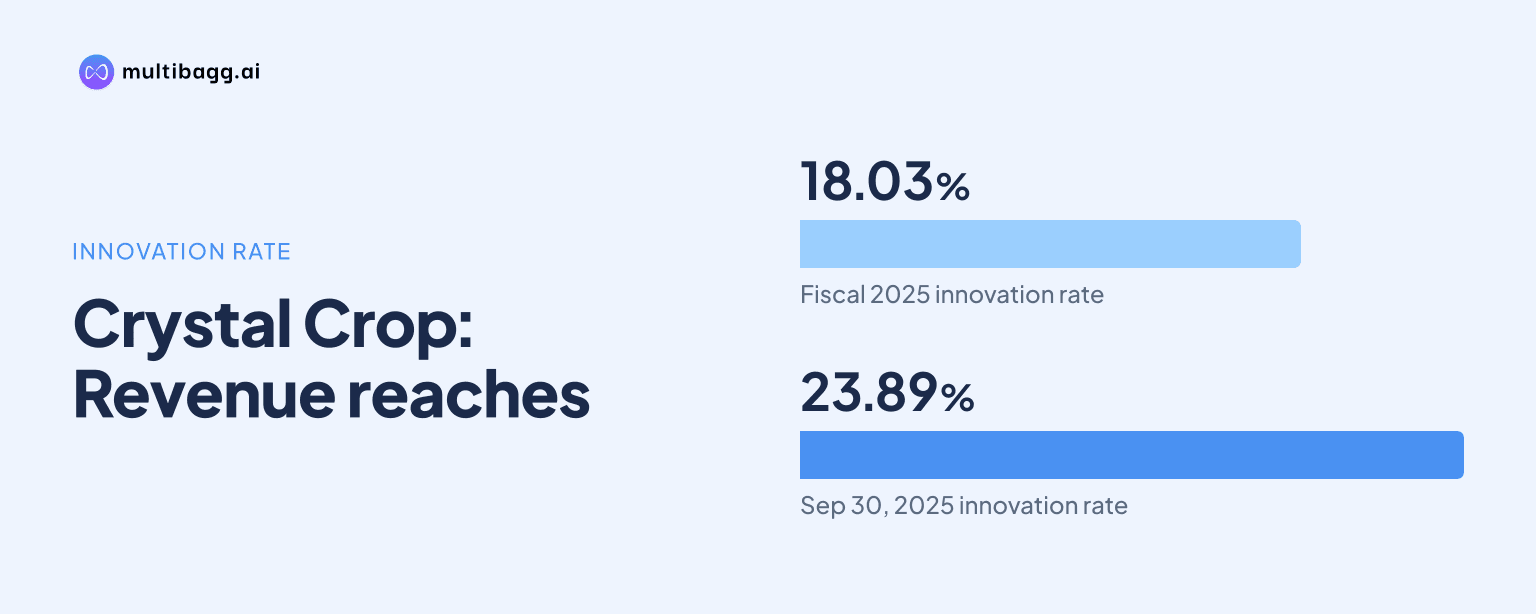
Crystal Crop Protection generated Rs 166.46 crore from products launched in the preceding four years during the six months ended September 30, 2025, equal to 23.89% of its Rs 696.783 crore Crystal-branded formulation revenue. The rate increased from 18.03% in Fiscal 2025, while 21 first-time Section 9(3) registered products supported a stated 59% gross margin.
How did Crystal Crop Protection reach a 23.89% innovation rate?
Crystal Crop Protection reached a 23.89% innovation rate by generating Rs 166.46 crore from products introduced during the preceding four years against Rs 696.783 crore of Crystal-branded formulation revenue in the six months ended September 30, 2025. Crystal Crop Protection defines the innovation rate as revenue from products launched in the last four years divided by total revenue of the Crystal Crop Protection branded formulation business in the relevant period. It is therefore a revenue-mix measure rather than a count of launches, patents or registrations.
Revenue from qualifying launches was Rs 204.905 crore in Fiscal 2025, Rs 151.61 crore in Fiscal 2024 and Rs 163.902 crore in Fiscal 2023. The corresponding innovation rates were 18.03%, 16.02% and 15.45%, respectively. The September 2025 half-year rate was 5.86 percentage points above Fiscal 2025, meaning newer products formed a larger share of Crystal-branded formulation revenue than in the preceding full year.
What products and registrations support Crystal Crop Protection innovation revenue?
Crystal Crop Protection’s innovation revenue is supported by formulation launches and 21 products in its Crystal Crop Protection branded formulation business registered under Section 9(3) of the Insecticides Act, 1968, as of September 30, 2025. Section 9(3) registrations are original, first-time product approvals granted after required safety and efficacy evaluation. The 21-product portfolio includes patented products and supported a disclosed gross margin of 59% in the six months ended September 30, 2025.
Crystal Crop Protection launched two products in its branded formulation business in the six months ended September 30, 2025, after 14 launches in Fiscal 2025 and five launches in each of Fiscal 2024 and Fiscal 2023. The half-year launch count does not by itself determine the 23.89% innovation rate because the calculation includes sales from all qualifying products launched over four years. Continued contribution depends on adoption and repeat sales from that four-year cohort, not only additions in a single period.
The disclosed recent product set includes Amora, a soybean herbicide; Sikosa, a paddy herbicide combining pretilachlor and bensulfuron; Kollar and Proclaim Xtra insecticides; Mentor fungicide; and Crystal Marvell WP, a biofertilizer containing vesicular arbuscular mycorrhiza. Crystal Crop Protection’s current research pipeline targets sugarcane weeds, stem borer, downy mildew in grapes, nematodes and thrips. Those targets identify the crop, pest, disease and weed-management needs that formulation development must address before sales can arise.
Got a follow-up? Ask IRIS
What research capability underpins Crystal Crop Protection formulation launches?
Crystal Crop Protection’s formulation launches are underpinned by its Key Research Development Centre, or KRDC, in Sonipat, Haryana, established in 2016, and nine field research stations. KRDC had 56 employees as of September 30, 2025, held Good Laboratory Practice compliance certification and was recognised by the Department of Science and Technology, Ministry of Science and Technology. Its work includes process development for technical-grade active ingredients, formulation design and studies required for regulatory submissions.
Crystal Crop Protection reported 28 patent applications globally, of which 18 had been granted in India and two outside India. Eleven of the 28 patents had been commercialised as of September 30, 2025. The portfolio also included two applications pending in India, two pending outside India and four refused applications that Crystal Crop Protection said it was contesting; patent status alone does not determine product revenue, whereas commercialisation connects research with marketed products.
Crystal Crop Protection also held 152 domestic registrations for technicals, 583 domestic formulation registrations and 158 export registrations for technicals and formulations as of September 30, 2025. Technicals are active ingredients used in agrochemical formulations. Four formulation units had combined installed capacity of 75,962 metric tonnes, while two technical manufacturing facilities had 3,456 metric tonnes of capacity, providing the manufacturing base for approved products.
How material is Crystal Crop Protection branded revenue within wider revenue?
Crystal Crop Protection’s domestic Crystal crop-protection and natural-crop-solutions revenue of Rs 696.783 crore represented 54.91% of domestic branded crop-protection and seed revenue in the six months ended September 30, 2025. Saffire contributed Rs 190.173 crore, while domestic branded seeds contributed Rs 382.153 crore. The 23.89% innovation rate is calculated only against the Crystal-branded formulation business, so it is not a share of consolidated revenue, Saffire revenue or seed revenue.
Crystal Crop Protection reported Rs 1,978.045 crore of revenue from operations in the September 2025 half-year. Crop protection products and natural crop solutions generated Rs 1,515.614 crore, or 77.82%, while seeds generated Rs 420.454 crore, or 21.59%. In Fiscal 2025, crop protection and natural crop solutions accounted for 81.74% of revenue from operations and seeds accounted for 17.45%, showing that seeds gained 4.14 percentage points in the reported revenue mix while crop protection remained the larger category.
Distribution and field execution affect whether newly launched products can retain revenue contribution. Crystal Crop Protection had 13,285 independent distributors and 36 distribution centres across 23 states and four union territories as of September 30, 2025. Its Crystal crop-protection network had 6,982 distributors and 460 sales and marketing executives, meaning product availability through the dedicated channel and performance in local farming conditions remain relevant to sales from the four-year launch cohort.
Conclusion
Crystal Crop Protection’s 23.89% innovation rate in the September 2025 half-year means Rs 166.46 crore of Crystal-branded formulation revenue came from products introduced within the preceding four years, compared with 18.03% in Fiscal 2025 and 15.45% in Fiscal 2023. The 21 Section 9(3) products and their disclosed 59% gross margin link the revenue metric to a portfolio of first-time registered formulations.
The next measure to watch is whether Crystal Crop Protection converts research into commercial sales as it pursues products for sugarcane weeds, stem borer, grape downy mildew, nematodes and thrips. Crystal Crop Protection launched two branded formulations in the six months ended September 30, 2025 after 14 in Fiscal 2025, and had commercialised 11 of 28 patent applications as of September 30, 2025.