










Herbicide market leads India's crop-protection growth outlook
Key highlights
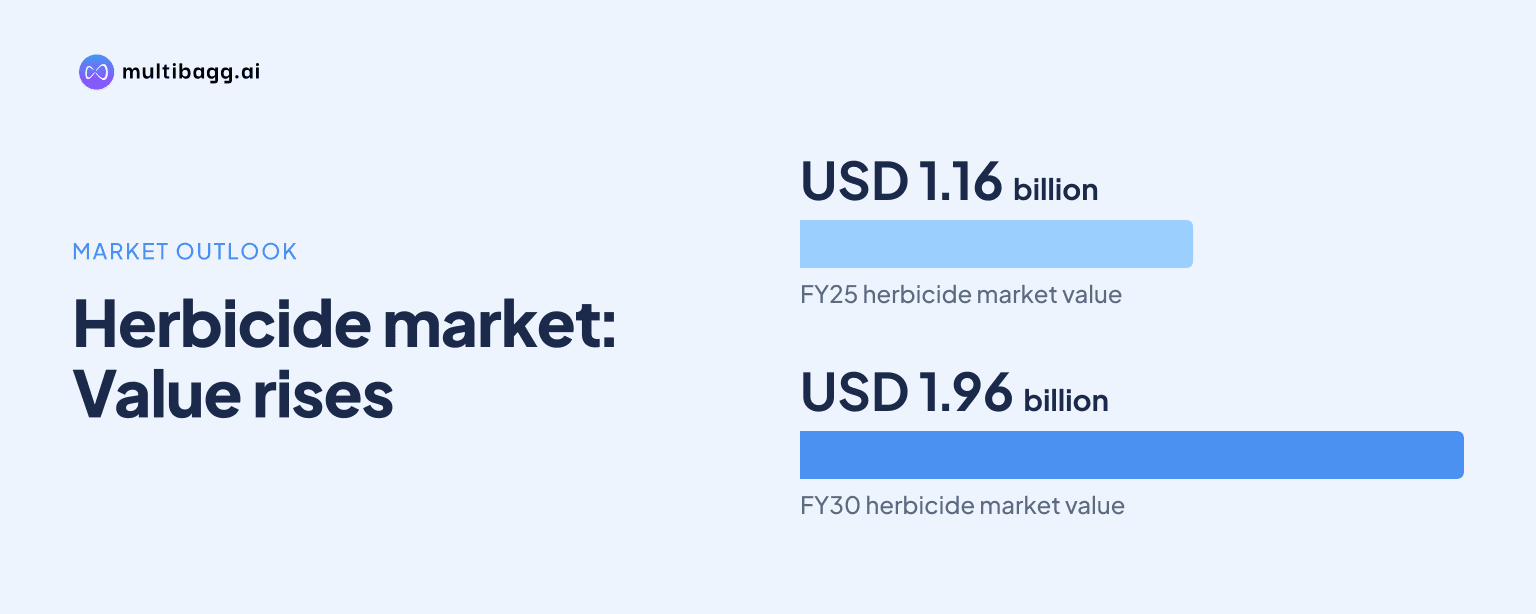
- Herbicide market value is forecast to rise from USD 1.16 billion in FY25 to USD 1.96 billion in FY30.
- Herbicide market CAGR of 11.05% exceeds fungicides at 8.04% and insecticides at 6.94%.
- Herbicide value share rose from 16.2% in FY21 to 21% in FY25.
- FY24 herbicide realisation averaged Rs 2,776.41 per kg or litre, versus Rs 2,055.81 for insecticides.
powered by IRIS
India’s branded formulation herbicide market, referred to here as the herbicide market, is forecast to grow at an 11.05% compound annual growth rate from FY25 to FY30, faster than fungicides at 8.04% and insecticides at 6.94%. The herbicide market’s value share also rose from 16.2% in FY21 to 21% in FY25.
Why is the herbicide market India’s fastest-growing crop-protection category?
The herbicide market is projected to expand from USD 1.16 billion in FY25 to USD 1.96 billion in FY30, producing an 11.05% compound annual growth rate, or CAGR. This forecast is ahead of the insecticide market, which is projected to grow from USD 2.38 billion to USD 3.32 billion at 6.94%, and the fungicide market, projected to increase from USD 1.22 billion to USD 1.79 billion at 8.04%.
The faster herbicide market outlook reflects a change in farm operations rather than a uniform rise in all crop-protection products. The industry analysis identifies rising farm wages, tighter sowing windows and adoption of zero-tillage wheat and direct-seeded rice, or DSR, as demand drivers. The 11.05% forecast therefore depends on farmers continuing to use chemical weed control where manual weeding is costly or difficult to schedule.
How has the herbicide market changed India’s crop-protection mix?
The herbicide market increased its share of Indian branded formulation consumption by value by 4.8 percentage points, to 21% in FY25 from 16.2% in FY21. Insecticides remained the largest category but declined to 43% from 44.1%, while fungicides declined to 22% from 29.3%; other products rose to 14% from 10.4%.
The FY21-FY25 comparison shows that herbicides gained value share while insecticides and fungicides lost share. The source links herbicide demand to labour shortages, weed resistance and use across cereals, soybean and cotton. “Others”, which includes rodenticides, bio-pesticides and plant growth regulators, gained 3.6 percentage points, showing that the shift was broader than herbicides alone.
The FY25 category split is an estimate based on volume and pricing data, FY25 first estimates, historical data and primary interviews, rather than a final published consumption measure. Changes in official FY25 data or pricing assumptions could therefore alter the 21% herbicide market share. The calculation nevertheless places herbicides only 1 percentage point below fungicides in FY25 value share.
Why do labour scarcity and weed resistance increase herbicide market spending?
The herbicide market benefits when chemical weed control replaces labour-intensive manual weeding during short planting and replanting periods. The source describes greater use of pre-emergent and post-emergent herbicide programmes, which apply products before and after weeds emerge. Selective, crop-safe formulations matched to soil and water conditions can raise spending even when physical volume growth remains moderate.
Herbicides also carried the highest average branded-formulation realisation in FY24 at Rs 2,776.41 per kg or litre, compared with Rs 2,055.81 for insecticides and Rs 1,981.69 for fungicides. The Rs 794.72 difference between herbicide and fungicide realisation helps explain why herbicides can approach fungicides in total value despite accounting for less than 20% of volume share.
Average herbicide pricing rose from Rs 2,112 per kg or litre in FY20 to Rs 2,776.41 in FY24. Over the same period, insecticide pricing increased from Rs 1,359 to Rs 2,056, and fungicide pricing rose from Rs 1,348 to Rs 1,982. Continued higher value growth requires adoption of differentiated weed-control programmes and sustained farmer spending on selective chemistry.
Got a follow-up? Ask IRIS
Which molecules concentrate the herbicide market?
Four active molecules accounted for 37.26% of FY25 herbicide market value: 2,4-D Amine Salt at 9.93%, Pretilachlor at 9.73%, Glyphosate at 9.15% and Chlodinafop-Propargyl at 8.45%. This means more than one-third of branded herbicide value was concentrated in four chemistries, while Metsulfuron Methyl contributed another 5.68%.
Pretilachlor illustrates the connection between weed-control products and farm labour. The source identifies it as the highest-volume herbicide in FY25 transplanted paddy systems, particularly in West Bengal, Bihar, Odisha and Assam, where turnaround time between harvest and replanting is short. Its price of Rs 586 per litre was stable, and it retained an approximately 10% top-three value position despite flat year-on-year volume growth.
The concentration creates exposure to molecule-specific pricing, regulation and crop conditions. Global price corrections in key molecules and tighter regulatory oversight in selected states contributed to the herbicide category’s FY24 correction. The market’s growth path therefore depends both on the availability of leading molecules and on demand broadening across selective chemistries.
What interrupted herbicide market growth from FY23 to FY24?
The herbicide market corrected from FY23 to FY24 as uneven and delayed monsoons affected major rice and soybean regions, channel inventories stayed elevated and farm-gate prices softened. Delayed sowing also compressed the spraying window, while global price corrections and state-level regulatory oversight further reduced category value.
FY25 is described as a recovery period, with industry estimates placing herbicide category growth between 8% and 12% as inventories normalise and demand stabilises. That range shows that the 11.05% FY25-FY30 CAGR does not imply identical annual growth. Monsoon timing, crop planting schedules, farm incomes, distributor inventories and molecule prices remain variables for the forecast.
The source reports that Crystal Crop grew its herbicide business by approximately 32% to 34% over FY24, above the broader category’s estimated FY25 growth range. It attributes this company-specific result to a balanced herbicide portfolio, adoption of selective chemistries and execution in core cropping markets. That outcome does not establish that other suppliers will achieve the same growth rate.
Conclusion
The herbicide market leads the branded crop-protection growth outlook because its value share rose from 16.2% in FY21 to 21% in FY25 and its FY25-FY30 CAGR forecast of 11.05% exceeds the 8.04% fungicide and 6.94% insecticide forecasts. Higher FY24 realisation of Rs 2,776.41 per kg or litre, labour constraints and multi-stage weed-control programmes underpin the change.
The next measure to watch is whether the herbicide market advances from USD 1.16 billion in FY25 toward the USD 1.96 billion FY30 forecast. The source identifies monsoon timing, channel inventories, farm-gate prices, global molecule price movements and regulatory oversight in selected states as unresolved factors that can affect that trajectory.