










India crop-protection exports forecast to reach 1.06m tonnes
Key highlights
- Exports are forecast to rise from 858 thousand tonnes in 2024–25 to 1.06 million tonnes in 2028–29.
- Technical-grade capacity is projected to increase from 451 thousand tonnes in 2024–25 to 550 thousand tonnes in 2028–29.
- Brazil and the United States represented 45.5% of India’s 2024 pesticide-export value.
- Seventeen active ingredients expired or are scheduled to expire between 2023 and 2029.
powered by IRIS
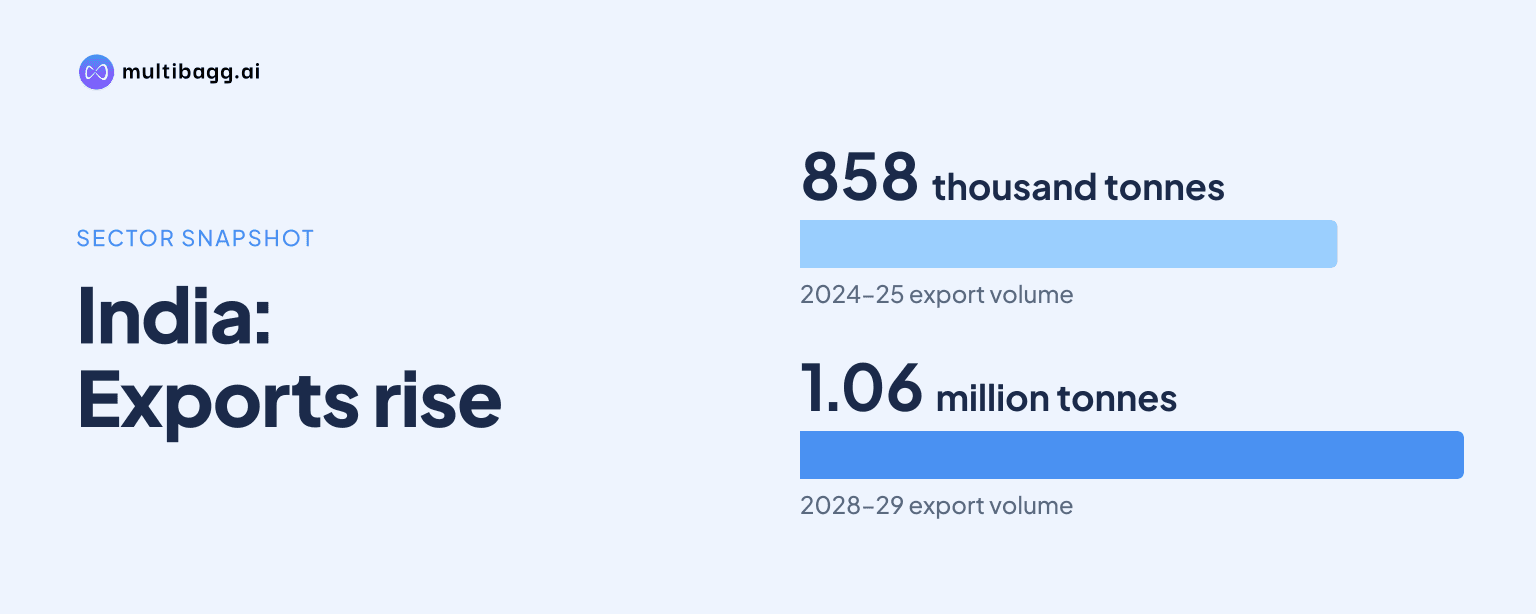
India crop-protection exports are forecast to reach 1.06 million tonnes in 2028–29, rising from 858 thousand tonnes in 2024–25, supported by technical-grade capacity projected at 550 thousand tonnes and 17 active-ingredient patent expiries between 2023 and 2029. The export measure includes both technical products and formulations.
How fast are exports projected to grow?
Exports are projected to grow at a 5.4% compound annual growth rate from 858 thousand tonnes in 2024–25 to 1.06 million tonnes in 2028–29. The forecast follows an increase from 405 thousand tonnes in 2018–19, which means outbound volumes would more than double over the decade. Export volumes include technical-grade products and formulations, while the domestic production data covers technical-grade material only.
The forecast relies on cost-competitive manufacturing, process-chemistry capability and compliance with destination-market requirements. The source identifies Latin America, North America and Africa as key markets for compliant production routes, while formulation exports can expand access to Africa, Southeast Asia and Latin America. Formulations are finished crop-protection products in which an active ingredient is combined with other components for agricultural use.
What production base supports exports?
Exports are supported by technical-grade capacity forecast to rise by 99 thousand tonnes, from 451 thousand tonnes in 2024–25 to 550 thousand tonnes in 2028–29. Technical-grade material is the active chemical ingredient before it is converted into a formulation. Technical-grade production is projected to increase from 306 thousand tonnes to 360 thousand tonnes over the same period, with capacity concentrated in Gujarat, Maharashtra and Andhra Pradesh.
The gap between projected 2028–29 capacity of 550 thousand tonnes and production of 360 thousand tonnes shows that plant additions alone will not determine export supply. New manufacturing lines must stabilise, and companies must bring more multi-step synthesis in-house while securing intermediates and raw materials. Imports are also forecast to rise from 71 thousand tonnes in 2024–25 to 81 thousand tonnes in 2028–29, indicating continuing dependence on imported inputs.
Contract development and manufacturing organisation, or CDMO, activity provides another channel for overseas supply. A CDMO develops or manufactures products under contract for another company, and the Indian agrochemical CDMO market is projected to expand at a 9.97% compound annual growth rate from FY20 to FY25. The source attributes this growth to long-term contracts, high-performance molecules and research-and-development collaboration with global innovators.
Which destinations matter most for exports?
Brazil and the United States are the two largest destinations, representing 23.5% and 22.0%, respectively, of India’s 2024 pesticide-export value. Their combined 45.5% share concentrates almost half of reported export value in two markets and links demand to soybean, maize and cotton cultivation in Latin America and North America. Japan accounted for 5.3%, Belgium 4.1%, China 3.0% and Vietnam 2.8% in 2024.
The destination mix gives exporters access to regulated and semi-regulated markets, but it also makes the outlook dependent on demand and market access in Brazil and the United States. France, the Netherlands and the United Kingdom formed part of a European Union bloc share of more than 12%, while the 23.5% “Others” category indicates a broader customer base. Argentina accounted for 2.2%, Indonesia 1.9%, and Bangladesh and Colombia each accounted for 1.7%.
Exports depend on producers combining lower-cost synthesis with registrations and manufacturing standards required by overseas buyers. Backward integration, meaning internal production of upstream raw materials or intermediates, can reduce reliance on external suppliers. The source links India’s overseas presence to process-chemistry expertise, backward integration and the availability of post-patent active ingredients.
Got a follow-up? Ask IRIS
How do patent expiries expand exports?
Patent expiries can expand exports by allowing generic manufacturers to produce previously protected active ingredients after exclusivity lapses, subject to registrations and regulatory approvals. The source identifies 17 active ingredients that expired or are due to expire from 2023 to 2029. Fourteen entries have a 2023 expiry year, followed by chlorantraniliprole in 2024, cyantraniliprole in 2026 and fluopyrauxifen-benzyl in 2029.
The patent-expiry list covers fungicides, insecticides and herbicides, widening the range of products that manufacturers can seek to supply. Chlorantraniliprole controls chewing insects across crops including rice, cotton, maize, soybean and sugarcane, while cyantraniliprole targets lepidopteran larvae, thrips and aphids. Pinoxaden, pyroxsulam and saflufenacil are among the listed herbicides for grass or broadleaf weed control in cereals, soybean, maize and sugarcane.
The commercial opportunity requires viable synthesis routes, technical-grade capacity, intermediates and registrations in each destination. Chlorantraniliprole illustrates the potential value of a post-patent active: it accounted for 13.2% of India’s FY25 branded-formulation insecticide market value despite representing less than 2% of physical volumes. The source cites an average price of Rs 7,500 per litre for chlorantraniliprole formulations.
What could limit exports and generic expansion?
Registration timelines and compliance requirements could limit exports even as the generic molecule pipeline broadens. A new active ingredient typically takes four to six years to obtain approval in India, compared with two to three years in major export markets. The Insecticides Act, 1968 is the core regulatory framework, while the pending Pesticide Management Bill creates uncertainty around data protection, renewals and new-molecule registration timelines.
Product planning can also be affected by restrictions on specific chemistries and the phase-out of highly hazardous pesticides. The source cites state-level restrictions involving paraquat, monocrotophos and glyphosate, and states that monocrotophos 36% soluble liquid has been banned. These measures can shift portfolios toward lower-toxicity molecules but require producers to revise registrations, documentation and manufacturing plans.
Export procedures have been designed to shorten some approval steps. Revised export-registration guidelines use categories from A-I to B-IV, with most categories not requiring full toxicology or chemistry data, and certificates of registration are mandated within 15 days. Star Export Houses have a fast-track route of five working days, but the pace of commercial shipments will still depend on destination-country rules and compliance requirements.
Conclusion
Exports are forecast to pass 1 million tonnes in 2028–29 because rising technical-grade capacity, contract manufacturing and newly post-patent active ingredients are developing together. The 1.06 million-tonne forecast includes formulations and technical products, whereas the 360-thousand-tonne production forecast applies only to technical-grade output. Brazil and the United States, which accounted for 45.5% of 2024 export value, remain central to the result.
The next disclosed markers are capacity reaching 550 thousand tonnes in 2028–29, cyantraniliprole’s 2026 patent expiry and fluopyrauxifen-benzyl’s scheduled 2029 expiry. The outcome also depends on producers increasing multi-step synthesis, obtaining registrations and using the stated 15-day export-certificate process while meeting overseas compliance requirements.