








India's natural-rubber output met 62% of FY25 consumption

Find your next multibaggerBe a Pro Investor
Research stocks and track your picks on the go. Download the app.
Key highlights
- India produced 8,75,000 tonnes of natural rubber in FY2024-25 against consumption of 14,10,000 tonnes.
- India’s FY2024-25 natural-rubber shortfall was 5,35,000 tonnes, with domestic output covering 62.1% of consumption.
- Natural-rubber imports increased to 5,50,918 tonnes in FY2024-25 from 4,42,130 tonnes in FY2014-15.
- India’s rubber area reached 9,39,300 hectares in FY2024-25, while average yield was 1,500 kg per hectare.
powered by IRIS
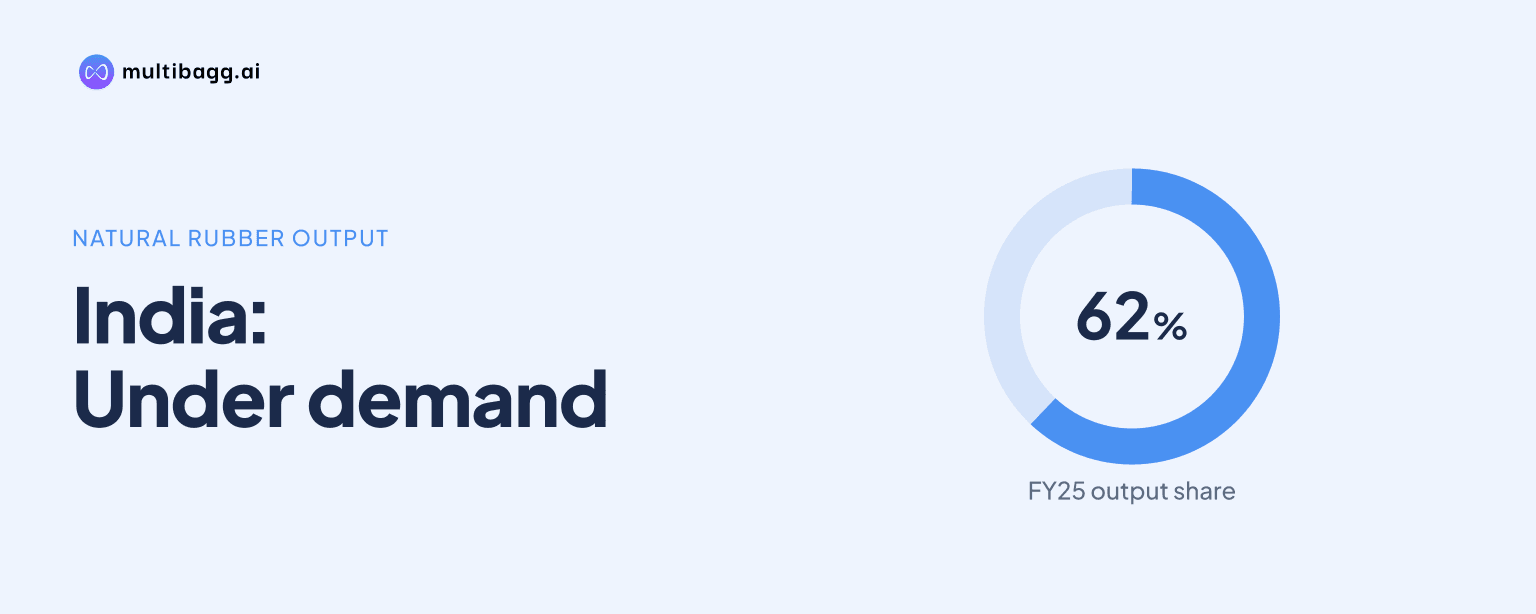
India’s natural-rubber output covered 62.1% of consumption in FY2024-25, as production of 8,75,000 tonnes trailed consumption of 14,10,000 tonnes by 5,35,000 tonnes. The gap persisted despite a 35.7% increase in output since FY2014-15, leaving tyre and rubber-product makers dependent on imported natural rubber.
Why did India’s natural-rubber output meet only 62% of FY25 consumption?
India’s FY2024-25 natural-rubber supply gap arose because consumption grew faster than domestic production over the preceding decade. Production increased from 6,45,000 tonnes in FY2014-15 to 8,75,000 tonnes in FY2024-25, or 35.7%, while consumption rose 38.1% from 10,20,910 tonnes to 14,10,000 tonnes. Consequently, domestic output coverage declined from 63.2% to 62.1% of consumption.
The FY2024-25 shortfall of 5,35,000 tonnes was larger than the 3,75,910-tonne gap in FY2014-15. Natural rubber demand is principally linked to tyre manufacturing across passenger vehicles, commercial vehicles and two-wheelers, as well as retreading and other rubber products. Replacement demand also supports consumption because tyres, tubes, flaps and retreading materials are replaced over their operating lives.
The annual pattern was not uninterrupted. Production fell to 5,62,000 tonnes in FY2015-16 and 6,51,000 tonnes in FY2018-19 before rising to 8,39,000 tonnes in FY2022-23, 8,57,000 tonnes in FY2023-24 and 8,75,000 tonnes in FY2024-25. Consumption, meanwhile, rose from 13,50,000 tonnes in FY2022-23 to 14,16,000 tonnes in FY2023-24 before easing to 14,10,000 tonnes in FY2024-25.
How has India expanded natural-rubber production and acreage?
India expanded total rubber area by 18.1% to 9,39,300 hectares in FY2024-25 from 7,95,135 hectares in FY2014-15, while tappable area increased 41.7% to 7,56,110 hectares. Tappable area is plantation area mature enough for latex extraction, and its 3.55% compound annual growth rate exceeded the 1.68% rate for total area over the period.
Output depended on more than added area. Average yield increased from 1,443 kg per hectare in FY2014-15 to 1,500 kg per hectare in FY2024-25, a 0.39% compound annual growth rate, and remained below the 1,553 kg per hectare recorded in FY2016-17. The difference shows that expansion of plantation and tappable area did not translate into proportionate yield growth.
The FY2024-25 increase of 18,000 tonnes in production from FY2023-24 coincided with total rubber area rising by 50,900 hectares from 8,88,400 hectares. Consumption declined by 6,000 tonnes in the same comparison, from 14,16,000 tonnes to 14,10,000 tonnes. Even with those two movements, domestic production remained 5,35,000 tonnes below consumption in FY2024-25.
The supplied provisional FY2025-26 figures report production of 9,05,000 tonnes, up 3.4%, and consumption of 14,27,000 tonnes, up 1.2%. That narrowed the gap to 5,22,000 tonnes and lifted domestic coverage to 63.4%, but consumption still exceeded output by more than half a million tonnes. Sustained narrowing would require productive plantation development and higher yield as well as controlled consumption growth.
Got a follow-up? Ask IRIS
How important are imports to India’s natural-rubber supply?
Imports are an essential component of India’s natural-rubber supply because domestic consumption exceeded production in every year from FY2014-15 through FY2024-25. India imported 5,50,918 tonnes in FY2024-25, compared with 4,42,130 tonnes in FY2014-15, an increase of 24.6%. The FY2024-25 import volume was broadly comparable with the 5,35,000-tonne production-consumption shortfall, although annual trade and supply balances can also reflect inventory and other factors.
India’s exports were much smaller, at 4,839 tonnes in FY2024-25 compared with 1,002 tonnes in FY2014-15. FY2024-25 imports were about 114 times exports, identifying India as a consumption-led natural-rubber market rather than a surplus exporter. Import availability can therefore be affected by overseas supply conditions, freight, currency movements, trade policies and global natural-rubber prices.
Domestic natural-rubber cultivation is concentrated in Kerala, with supply also originating from Karnataka, Tamil Nadu and northeastern states. Weather conditions, plantation productivity and tapping cycles affect domestic availability, while cited initiatives include plantation expansion, replanting support and productivity-improvement measures. No quantified domestic-supply target or completion date is disclosed for those initiatives.
What does the natural-rubber supply gap mean for tyre manufacturers and prices?
The natural-rubber supply gap leaves tyre manufacturers, tube makers, retreaders and other rubber-product participants exposed to movements in a key compounding input. Natural rubber provides elasticity, resilience and abrasion resistance, while synthetic rubber, carbon black, steel reinforcement, nylon, chemicals and fillers also influence manufacturing costs and inventory values.
Auto tyre manufacturers used 9,07,956 tonnes of natural rubber in April 2025 to March 2026, out of total natural-rubber consumption of 14,27,000 tonnes. In April-June 2026, tyre manufacturers consumed 2,31,637 tonnes, or 67.9%, of total natural-rubber consumption of 3,41,000 tonnes. Their quarterly consumption increased 1.8% from 2,27,579 tonnes even as overall natural-rubber consumption fell 6.1% from 3,63,000 tonnes.
Natural-rubber pricing also changed materially over the period. The average Ribbed Smoked Sheet grade 4, or RSS-4, price at Kottayam increased from Rs 13,257 per 100 kg in FY2014-15 to Rs 19,985 per 100 kg in FY2024-25, a 50.8% increase. The provisional FY2025-26 average was Rs 19,732 per 100 kg, 1.3% below FY2024-25, while the domestic RSS-4 price rose from Rs 19,690 per 100 kg in August 2025 to Rs 27,888 per 100 kg in August 2026.
Synthetic-rubber trends show that natural rubber is only one part of the input equation. Synthetic-rubber consumption increased 8.3% to 2,37,500 tonnes in April-June 2026 from 2,19,200 tonnes a year earlier, while combined natural-rubber and synthetic-rubber consumption declined 0.6% to 5,78,500 tonnes. Combined consumption by auto tyre manufacturers nevertheless increased 5.9% to 3,99,868 tonnes in that quarter.
Conclusion
India’s FY2024-25 figures show that growth in rubber area, tappable area and production did not eliminate the natural-rubber supply gap because consumption reached 14,10,000 tonnes against output of 8,75,000 tonnes. The 62.1% domestic coverage ratio, 5,50,918 tonnes of imports and 5,35,000-tonne shortfall together indicate that imported supply and movements in rubber prices remain operational factors for domestic rubber users.
The next disclosed measure to watch is the provisional FY2025-26 production-consumption balance, in which output reached 9,05,000 tonnes and consumption reached 14,27,000 tonnes. The 5,22,000-tonne gap was narrower than in FY2024-25, but its persistence will depend on plantation productivity, tapping conditions, replanting and expansion measures, alongside tyre and replacement-market consumption.

