










Matangi Rubber Limited’s tyre line ran at 39% utilisation
Key highlights
- Matangi Rubber’s two- and three-wheeler tyre line ran at 39% utilisation for the period ended June 30, 2026.
- Matangi Rubber reported 90% tyre-flap utilisation for the period ended June 30, 2026, 51 percentage points above its tyre line.
- Matangi Rubber produced 3,405,187 tyre flaps in fiscal 2026, up 373,251 units from fiscal 2025.
- Matangi Rubber’s tyre-flap capacity was 4,320,000 units in each of fiscal 2024, fiscal 2025 and fiscal 2026.
powered by IRIS
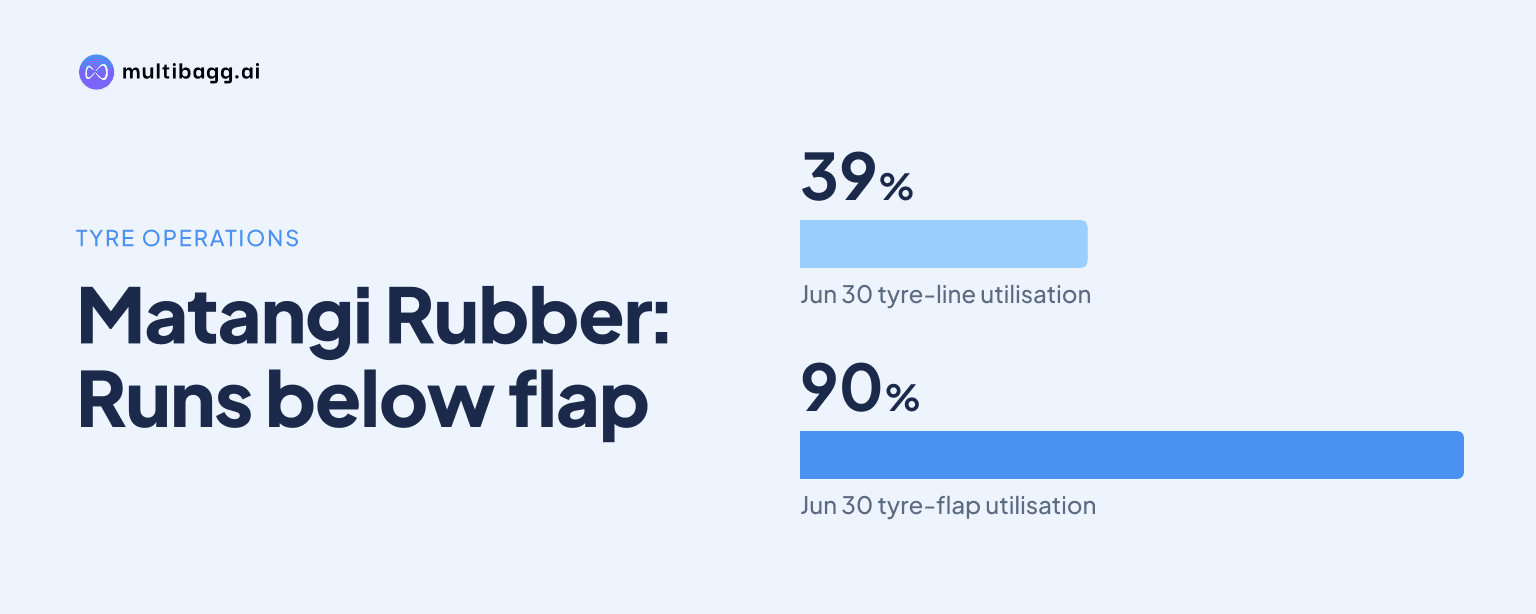
For the period ended June 30, 2026, Matangi Rubber Limited’s two- and three-wheeler tyre line operated at 39% capacity utilisation, compared with 90% for tyre flaps. The 51-percentage-point gap shows that finished-tyre production was at an earlier ramp-up stage than Matangi Rubber’s established tyre-component operations.
Why did Matangi Rubber’s tyre line run at 39% utilisation?
Matangi Rubber’s two- and three-wheeler tyre line ran at 39% utilisation, while tyre flaps ran at 90% for the period ended June 30, 2026. The disclosed difference of 51 percentage points identifies substantially more unused capacity in finished tyres than in the flap operation, which is part of Matangi Rubber’s established portfolio of tyre components and rubber products.
Matangi Rubber operates as a business-to-business manufacturer, rather than as a branded retail-led tyre producer. Its model includes contract manufacturing and job work, under which it uses either internally sourced materials and its own production infrastructure or customer-supplied materials for conversion charges. Higher tyre-line utilisation would therefore depend on sustained orders, production planning and customer acceptance rather than capacity alone.
The source identifies product validation, quality testing, technical approvals and commercial reliability as relevant requirements for automotive original equipment manufacturers, or OEMs, fleet operators and institutional customers. These requirements can involve trial orders and longer evaluation periods, particularly in commercial and industrial applications, meaning a rise from 39% utilisation would need to be supported by repeat demand and consistent manufacturing output.
What does 39% tyre utilisation mean for Matangi Rubber’s diversification?
The 39% utilisation figure means Matangi Rubber had entered finished two- and three-wheeler tyres but had not yet operated that category at the same intensity as tyre flaps. The product move broadens Matangi Rubber’s activities beyond tyre flaps, butyl inner tubes and rubber compounds used in tube-type tyre applications into finished tyres.
Matangi Rubber has manufacturing capabilities covering compound mixing, laboratory testing, product development, curing, vulcanisation and finished-product manufacturing. These processes support its component businesses as well as tyre production, but the June 2026 utilisation figures show that the newer finished-tyre activity had not matched the operating level of flaps.
The company’s approximately 190,000 square feet of covered manufacturing area spans facilities in Uttarakhand, Tamil Nadu and Madhya Pradesh. This North, South and Central India footprint supports regional manufacturing and supply access, although the disclosed material does not state tyre-line sales volumes, customer names, revenue contribution or the reasons for the 39% utilisation level.
How did Matangi Rubber’s tyre-flap production change?
Matangi Rubber’s tyre-flap production rose to 3,405,187 units in fiscal 2026 from 3,031,936 units in fiscal 2025, while annual capacity remained 4,320,000 units in both years. Production therefore increased by 373,251 units, or about 12%, on an unchanged capacity base.
Fiscal 2026 flap production was also 103,113 units above fiscal 2024 production of 3,302,074 units. Based on the disclosed fiscal 2026 capacity and output, flap production was about 79% of annual capacity, whereas production of 973,593 units against 1,080,000 units of capacity for the period ended June 30, 2026 produced the reported 90% utilisation figure.
The contrast between 90% flap utilisation and 39% tyre utilisation should be read as a comparison of product categories in the June 2026 period, not as evidence that the businesses have the same capacity, sales mix or customer base. The source provides tyre-flap capacities and production volumes, but does not provide corresponding tyre-line capacity or production volumes in the supplied disclosure.
Got a follow-up? Ask IRIS
What operating conditions could lift Matangi Rubber’s tyre utilisation?
Matangi Rubber’s tyre utilisation could rise if customer orders, product qualification and supply reliability support a sustained increase in output above the 39% level. The industry discussion identifies manufacturing consistency, distribution reach, OEM relationships and replacement-market access as determinants of volumes across tyres and allied rubber products.
Raw-material management is also material because the sector uses natural rubber, synthetic rubber, carbon black, steel and rubber chemicals. The source states that domestic natural-rubber production remains below overall industry consumption, creating import dependence for part of the sector’s requirements; changes in input availability or prices can therefore affect manufacturing planning and working capital.
Capacity utilisation affects cost absorption because fixed manufacturing and distribution costs can be spread across more production units when output rises. For Matangi Rubber, moving the tyre line above 39% would require quality and delivery consistency to hold as volumes increase, while continued lower utilisation would leave more available tyre capacity unabsorbed than in the 90% flap line.
How does the tyre industry affect Matangi Rubber’s ramp-up?
Matangi Rubber’s tyre ramp-up operates in an Indian market where replacement demand is described as the largest demand segment and where dealer relationships, inventory availability and regional distribution affect recurring volumes. The company’s multi-location operations across three states can support servicing industrial and automotive markets, but the source does not quantify its dealer network or finished-tyre distribution reach.
The source identifies CEAT Limited and TVS Srichakra Limited as broader tyre-manufacturing reference companies, while Tolins Tyres Limited is a closer product comparison because it makes precured tread rubber, tyres, flaps and tubes. Tolins reported that tread rubber contributed 67.75% of operational revenue in Q1 FY2027 and tyres contributed 32.25%, illustrating how finished tyres can operate beside a larger rubber-products portfolio.
Environmental compliance is another industry condition. Extended Producer Responsibility, or EPR, is the waste-tyre management framework administered through the Central Pollution Control Board, requiring producers, recyclers and retreaders to maintain portal-based registration, reporting and certificate tracking. Matangi Rubber has indicated expansion initiatives in rubber recycling and solid-tyre manufacturing, but the disclosure gives no capacity target, investment amount or completion timetable.
Conclusion
Matangi Rubber’s 39% utilisation in two- and three-wheeler tyres, compared with 90% in tyre flaps for the period ended June 30, 2026, indicates that finished tyres were still at an earlier operating stage. Its flap business provides the more established benchmark: production reached 3,405,187 units in fiscal 2026 on annual capacity of 4,320,000 units, after output had declined in fiscal 2025.
The next point to watch is whether Matangi Rubber can increase tyre output while meeting customer qualification, quality, input-sourcing and working-capital requirements. Investors should also monitor future disclosures on the indicated rubber-recycling and solid-tyre initiatives, because the supplied material does not disclose their capacity, spending or schedule.