










Matangi Rubber job-work mix reached 21% in fiscal 2026
Key highlights
- Matangi Rubber reported Rs 27.54 crore of job-work revenue in fiscal 2026, up 155.78% from Rs 10.77 crore in fiscal 2025.
- Job work represented 20.83% of Matangi Rubber’s fiscal 2026 total income, compared with 3.04% in fiscal 2024.
- Tyre-tube job work reached Rs 20.08 crore in fiscal 2026, versus Rs 7.70 crore in fiscal 2025.
- The Gwalior plant, operational from December 27, 2025, added Rs 4.22 crore of fiscal 2026 revenue.
powered by IRIS
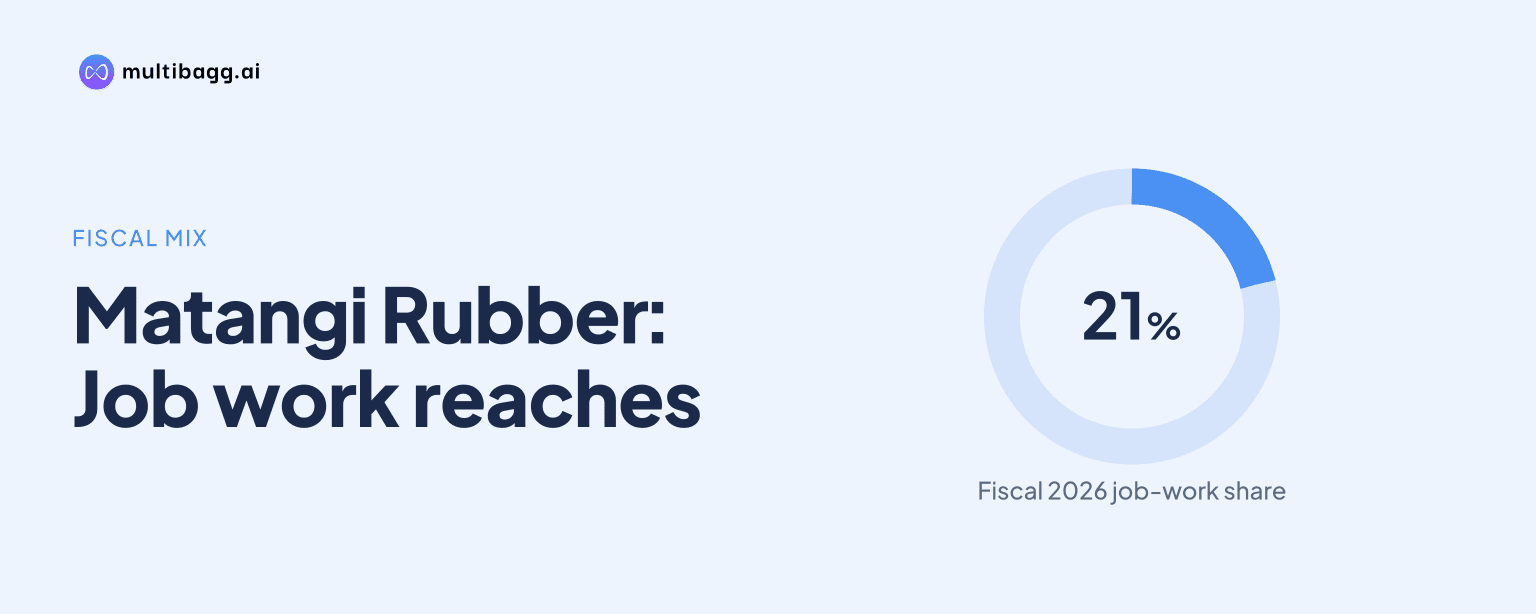
Matangi Rubber Limited reported Rs 27.54 crore of job-work revenue in fiscal 2026, equal to 20.83% of total income, compared with Rs 2.77 crore and 3.04% in fiscal 2024. The increase shows that customer-supplied-material processing became a materially larger source of Matangi Rubber’s reported operating revenue alongside product sales.
How did Matangi Rubber’s job-work revenue mix reach 21%?
Matangi Rubber’s job-work revenue increased from Rs 2.77 crore in fiscal 2024 to Rs 10.77 crore in fiscal 2025 and Rs 27.54 crore in fiscal 2026. The company’s disclosed mix percentage rose from 3.04% in fiscal 2024 to 10.13% in fiscal 2025 and 20.83% in fiscal 2026, a 17.79-percentage-point increase over two years.
Job work is a processing arrangement in which a principal company supplies raw materials and Matangi Rubber converts them into tyre flaps or tubes using its manufacturing facilities. Matangi Rubber receives conversion charges under agreed terms and recognises job-work revenue when the processing service is completed. This differs from its manufacturing-and-selling model, under which Matangi Rubber procures materials, manufactures products and sells finished goods through its sales network.
The movement in product sales illustrates the change in revenue composition. Product revenue increased by Rs 12.20 crore between fiscal 2024 and fiscal 2026, but its disclosed share of total income declined by 20.06 percentage points, from 94.55% to 74.49%. Revenue from operations rose 44.44% over the same period, while job-work revenue increased 892.54% from the reported fiscal 2024 base.
What drove Matangi Rubber’s fiscal 2026 job-work growth?
Matangi Rubber’s job-work revenue rose 155.78% in fiscal 2026 to Rs 27.54 crore from Rs 10.77 crore in fiscal 2025, principally because tyre-tube job work reached Rs 20.08 crore from Rs 7.70 crore. Matangi Rubber attributed the increase in tube revenue to higher demand from JK Tyres, making continued tube-processing demand relevant to the fiscal 2026 revenue level.
The Gwalior two-wheeler and three-wheeler tyre plant was the second disclosed contributor, adding Rs 4.22 crore of revenue in fiscal 2026 after production started on December 27, 2025. That amount represented 15.34% of fiscal 2026 job-work revenue. Because production began late in the fiscal year, the plant did not contribute for the full 12-month period.
Fiscal 2025 had already marked a substantial shift, with job-work revenue rising 288.04% from fiscal 2024. The fiscal 2025 amount included Rs 3.07 crore from tyre-flap processing and Rs 7.70 crore from tyre-tube processing. Fiscal 2024 was reported on a standalone basis, while fiscal 2025 and fiscal 2026 were consolidated after Matangi Rubber acquired 64.23% of M G Industries Limited on October 31, 2024 and another 33.51% on December 29, 2024; this reporting-basis change limits direct comparability across the three years.
Got a follow-up? Ask IRIS
How has the larger job-work mix changed Matangi Rubber’s revenue profile?
Matangi Rubber remained primarily a product seller in fiscal 2026, although job work became its second-largest disclosed operating revenue stream at Rs 27.54 crore. Product sales were Rs 98.49 crore, or 74.49% of total income, while sale of services was Rs 3 crore, or 2.27%, and scrap and other sales were Rs 72.69 lakh, or 0.55%.
Product revenue increased 12.03% in fiscal 2026, compared with the 155.78% increase in job-work revenue. Contract manufacturing of tyre flaps accounted for Rs 95.28 crore of fiscal 2026 product revenue, and Matangi Rubber sold 26 lakh tyre-flap units, compared with 24.17 lakh units in fiscal 2025. Average realisation per tyre flap increased to Rs 366 in fiscal 2026 from Rs 361 in fiscal 2025.
The two models have different raw-material responsibilities. In contract manufacturing, Matangi Rubber procures materials and produces client-branded tyre flaps for sale to the customer. In job work, the principal supplies raw materials and Matangi Rubber performs conversion. The job-work mix would depend on processing volumes, customer demand and capacity utilisation at the tube and Gwalior facilities continuing at levels that support fiscal 2026 revenue.
What do costs and margins indicate alongside the revenue-mix shift?
Matangi Rubber’s cost of materials consumed was Rs 49.62 crore in fiscal 2026, or 37.53% of total income, compared with Rs 44.55 crore, or 41.91%, in fiscal 2025. The company said it had moved to ready-made premix raw materials for tyre flaps and tubes instead of procuring individual components for mixing at its facilities. The disclosure does not separately quantify job-work costs or job-work margins.
Profit after tax rose 11.50% to Rs 22.33 crore in fiscal 2026 from Rs 20.03 crore in fiscal 2025, while the profit-after-tax margin declined to 16.89% from 18.84%. Employee-benefit expense increased 61.78% to Rs 22.75 crore and other expenses increased 31.41% to Rs 22.14 crore. Matangi Rubber attributed margin pressure partly to lower capacity utilisation at its newly started tyre and tyre-tube plants, where fixed operating costs were spread across lower production volumes.
Depreciation and amortisation fell 85.33% to Rs 45.29 lakh in fiscal 2026 after Matangi Rubber changed its depreciation method from the written-down-value method to the straight-line method, applied prospectively. The company stated that fiscal 2026 depreciation was lower by Rs 2.45 crore because of the change. Fiscal 2026 profit therefore reflects both operating developments and the disclosed accounting-method effect.
Conclusion
Matangi Rubber’s fiscal 2026 revenue growth was not solely driven by product sales: job work generated Rs 27.54 crore and represented 20.83% of total income, compared with Rs 2.77 crore and 3.04% in fiscal 2024. Higher tyre-tube processing demand linked to JK Tyres and revenue from the Gwalior plant were the disclosed drivers, while product sales remained the largest revenue stream at Rs 98.49 crore.
The next reported periods will indicate whether the Gwalior plant, which started production on December 27, 2025, contributes through a full year and whether the newer tyre and tube plants improve utilisation. Matangi Rubber’s future mix will also depend on job-work volumes, including tyre-tube demand, while employee expense of Rs 22.75 crore and other expenses of Rs 22.14 crore in fiscal 2026 remain relevant to reported margins.