










Matangi Rubber’s SBI term loans use promoter property
Key highlights
- Matangi Rubber reported Rs 49.31 crore of SBI project and working-capital term loans at 30 June 2026.
- The SBI collateral package includes three director-owned residential properties, a group-owned factory and Qualimax Electronics Private Limited’s industrial property.
- SBI holds a Rs 50 lakh lien on Matangi Rubber mutual funds in addition to property security and asset charges.
- Mohit Gupta, Manju Gupta and Radhika Gupta provided personal guarantees, while Qualimax Electronics Private Limited provided a corporate guarantee.
powered by IRIS
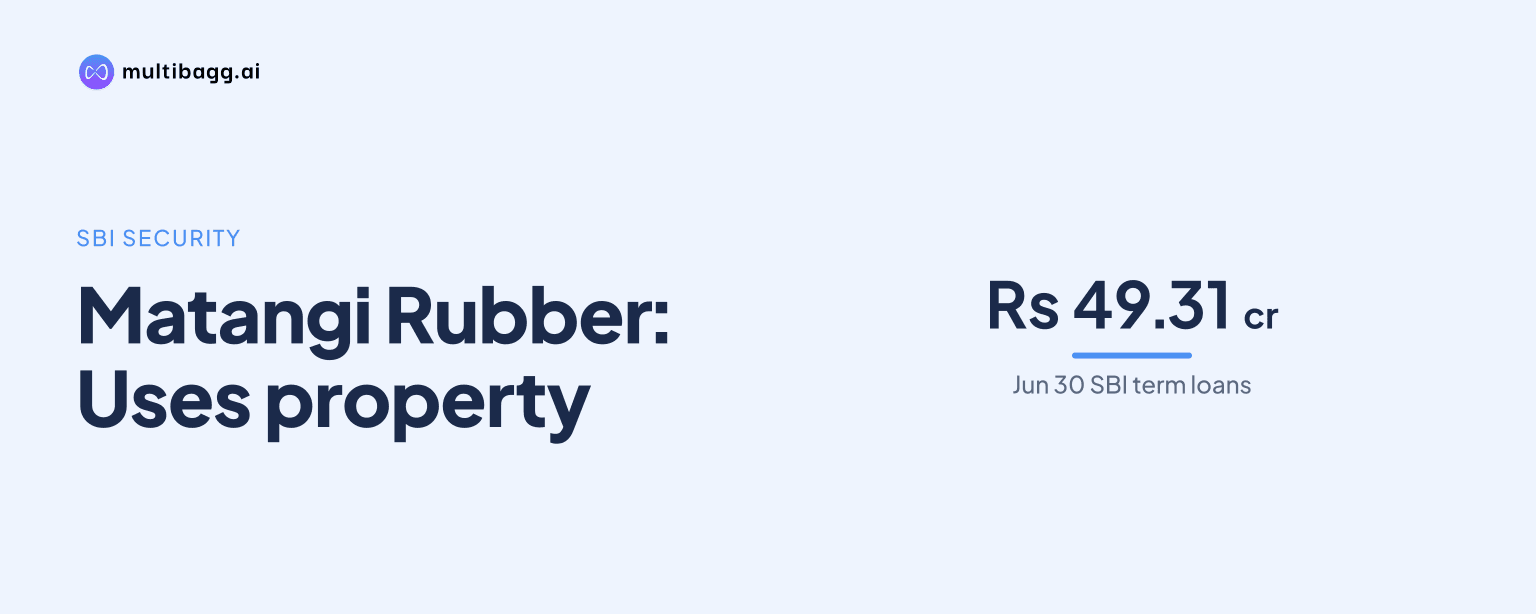
Matangi Rubber reported Rs 49.31 crore of State Bank of India Limited, or SBI, project and working-capital term loans at 30 June 2026, secured by company assets, three director-owned residential properties, a group-owned factory and Qualimax Electronics Private Limited’s industrial property, alongside personal and corporate guarantees.
What secures Matangi Rubber’s SBI term loans?
Matangi Rubber’s SBI facilities are secured by operating assets, identified real-estate collateral, a Rs 50 lakh mutual-fund lien and guarantees. Hypothecation gives a lender a charge over movable assets while the borrower retains possession; the disclosed SBI security includes all present and future plant, machinery and fixed assets, as well as Matangi Rubber’s leasehold factory land and building at Malanpur Industrial Area, Bhind, measuring 16,682 square metres.
The disclosures also list equitable mortgages, meaning mortgages created through deposit of property title documents, over specified properties and property interests. The collateral includes a group-owned Selaqui factory, three director-owned residential properties, two Matangi Rubber industrial properties, Qualimax Electronics Private Limited’s Sahibabad industrial property and a Matangi Rubber Selaqui plot subject to a first charge. The disclosures do not provide property valuations or allocate collateral values among SBI facilities, so coverage against the Rs 49.31 crore reported SBI term-loan balance cannot be calculated.
How large are Matangi Rubber’s SBI term loans?
Matangi Rubber reported Rs 49.31 crore in SBI project and working-capital term loans at 30 June 2026, equal to 81.37% of the Rs 60.60 crore secured bank-loan balance reported on that date. The SBI amount comprised a Rs 44.84 crore project term loan and a Rs 4.47 crore working-capital term loan under the Emergency Credit Line Guarantee scheme. These balances are shown before the separate Rs 7.42 crore deduction for current maturities in the long-term-borrowings statement.
The composition changed between 31 March 2025 and 30 June 2026. The Rs 39.47 crore foreign-currency demand loan and Rs 7.52 crore project term loan reported in March 2025 were no longer shown, while the Rs 44.84 crore project term loan and Rs 4.47 crore Emergency Credit Line Guarantee working-capital term loan were reported. Separately, Matangi Rubber had Rs 36.96 crore of secured working-capital loans at 30 June 2026, but the disclosure does not isolate the SBI share of that total.
Which promoter and group properties are pledged to SBI?
Matangi Rubber’s SBI collateral includes two freehold residential properties owned by Mohit Gupta, a director: a 335.12-square-metre Rajpur Road property in Dehradun and a 396.93-square-metre plot in Sushant Lok III, Gurugram. It also includes Manju Gupta’s 80-square-metre DDA SFS Category II flat in Dwarka, New Delhi. A further 328.60-square-metre freehold residential property owned by Manju Gupta at Anand Lok, New Delhi, separately secures the Rs 4.60 crore Yes Bank Limited business loan reported at 30 June 2026.
The SBI list also covers a 4,515-square-metre group-owned factory at Selaqui, Dehradun, and a 2,159.70-square-metre Sahibabad industrial property owned by Qualimax Electronics Private Limited. Matangi Rubber-owned collateral comprises a 0.235-acre industrial property at Gumidipoondi, Chennai, and a 1,947.91-square-metre freehold industrial plot at Selaqui. The security therefore extends beyond property directly owned by Matangi Rubber to assets provided by directors, a group owner and Qualimax Electronics Private Limited.
Got a follow-up? Ask IRIS
How do guarantees and repayment terms affect Matangi Rubber’s debt obligations?
Matangi Rubber’s SBI facilities carry personal guarantees from Mohit Gupta, Manju Gupta and Radhika Gupta, plus a corporate guarantee from Qualimax Electronics Private Limited. A personal guarantee makes the named guarantor responsible to the lender under the guarantee terms if the borrower does not meet its obligations, while a corporate guarantee performs that role through another company. The SBI working-capital facility is also backed by hypothecation of all current assets, including inventory, book debts and other present and future current assets, and carries a floating interest rate of about 10.05% a year.
The Rs 44.84 crore SBI project term loan has a 132-month tenure that includes a 31-month principal-repayment moratorium from first disbursement. After that period, Matangi Rubber is scheduled to pay 19 equated monthly instalments, or EMIs, of Rs 37 lakh each, 81 EMIs of Rs 50 lakh each and a final Rs 47 lakh EMI; its disclosed floating rate is about 9.00% a year. The Rs 4.47 crore SBI working-capital term loan has a 60-month tenure, a 12-month principal moratorium and 48 EMIs of Rs 12.48 lakh each at a floating rate of about 8.65% a year.
Promoter and promoter-group ownership was concentrated at 30 June 2026. Radhika Gupta held 43.15%, Mohit Gupta held 14.02%, Manju Gupta held 12.01% and Vandana Rubber and Chemicals Private Limited held 11.93%, together representing 81.11% of Matangi Rubber’s equity. That ownership concentration does not establish the value of guarantees, but it identifies shareholders connected with the disclosed personal-property security and guarantee structure.
Conclusion
Matangi Rubber’s disclosed SBI debt structure combines operating-asset charges with collateral outside its direct property base. At 30 June 2026, the Rs 49.31 crore reported SBI term-loan balance was linked to Matangi Rubber sites, a group-owned factory, Qualimax Electronics Private Limited’s industrial property, three director-owned residential properties, a Rs 50 lakh mutual-fund lien and named guarantees. The collateral scope means repayment performance is connected to assets and guarantors beyond Matangi Rubber’s direct ownership.
The next item to watch is the transition from the stated moratorium periods to scheduled principal repayments. The project facility requires 19 EMIs of Rs 37 lakh, then 81 EMIs of Rs 50 lakh, while the working-capital term loan requires 48 EMIs of Rs 12.48 lakh after its 12-month moratorium. Changes in reported SBI balances, floating interest rates, current maturities, pledged assets or guarantee arrangements would indicate whether this security and repayment structure remains in place.