










Matangi Rubber’s top five supplied 91.61% FY26 revenue
Key highlights
- Matangi Rubber’s five largest customers generated Rs 118.87 crore, or 91.61%, of Fiscal 2026 consolidated revenue.
- The top-five customer share was 98.17% in Fiscal 2025 and 92.31% in Fiscal 2024.
- Contract-manufactured tyre flaps generated Rs 95.28 crore, or 73.43%, of Fiscal 2026 revenue.
- Matangi Rubber’s five largest suppliers accounted for 59.62% of Fiscal 2026 purchases.
powered by IRIS
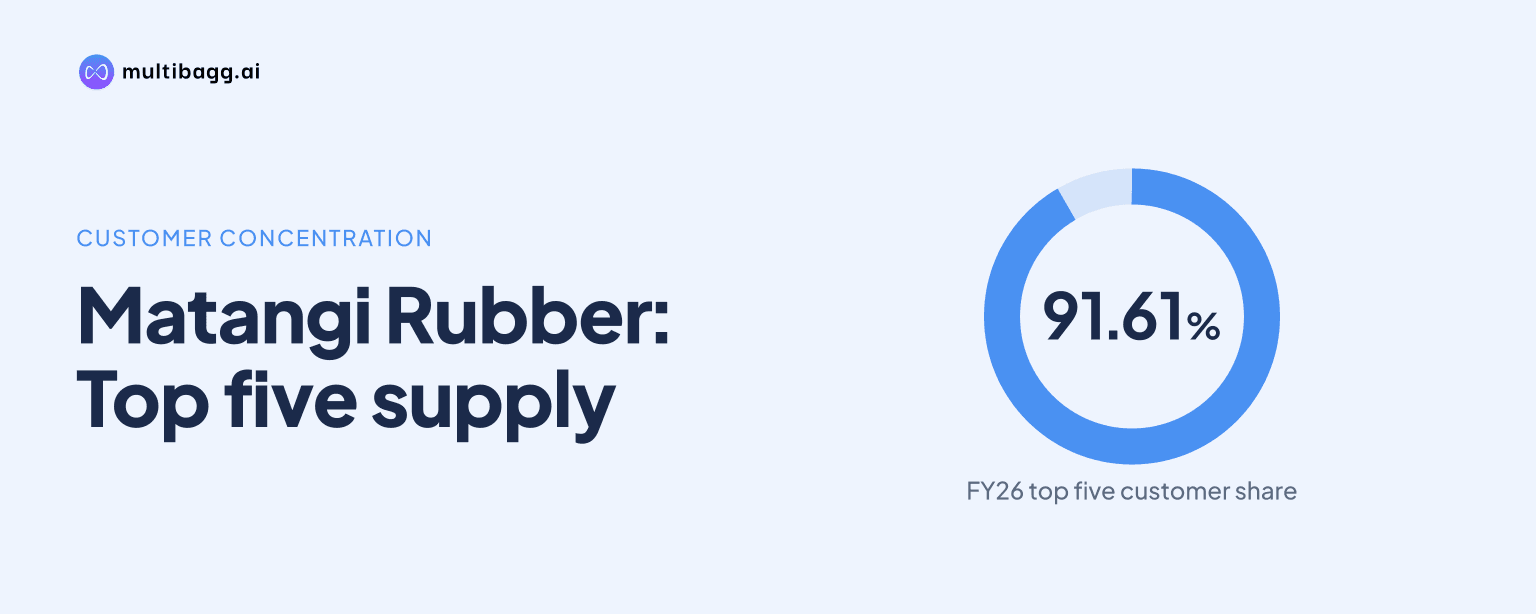
Matangi Rubber Limited derived Rs 118.87 crore, or 91.61% of consolidated revenue from operations, from its five largest customers in Fiscal 2026; Matangi Rubber’s total revenue was Rs 129.76 crore. The ratio declined from 98.17% in Fiscal 2025 but remained above 90% in each reported full fiscal year.
How concentrated was Matangi Rubber’s FY26 customer revenue?
Matangi Rubber’s five largest customers generated Rs 118.87 crore of its Rs 129.76 crore Fiscal 2026 consolidated revenue from operations, leaving Rs 10.89 crore, or 8.39%, from all other customers. Customer concentration measures the proportion of sales attributable to a limited group, and the disclosed five-customer group accounted for more than nine-tenths of Matangi Rubber’s annual revenue.
The concentration persisted across every period disclosed, although the Fiscal 2026 share was below Fiscal 2025. The top five generated Rs 99.46 crore, or 98.17%, of Fiscal 2025 consolidated revenue and Rs 83.18 crore, or 92.31%, of Fiscal 2024 standalone revenue. Fiscal 2026’s 91.61% share was 6.56 percentage points below Fiscal 2025 but 0.70 percentage points above Fiscal 2024.
For the period ended June 30, 2026, the top five customers contributed Rs 46.81 crore of Rs 47.74 crore in consolidated revenue, leaving Rs 92.79 lakh outside that group. The prospectus does not identify the five customers or disclose each customer’s individual revenue contribution.
What business mix supports Matangi Rubber’s customer dependence?
Matangi Rubber’s Fiscal 2026 revenue mix was led by contract manufacturing of tyre flaps, which generated Rs 95.28 crore, or 73.43% of revenue from operations. Under contract manufacturing, Matangi Rubber uses its facilities and materials procured for the work to make tyre flaps customised with the client’s logo before selling the finished product to that customer.
Job work services generated Rs 27.54 crore, or 21.22%, in Fiscal 2026, compared with Rs 10.77 crore, or 10.63%, in Fiscal 2025. In job work, the principal provides the raw material and Matangi Rubber converts it into tyres, tyre flaps or tubes for conversion charges. The company identifies JK Tyre & Industries Limited, referred to as JK Tyre, as a primary customer for tyre-flap contract manufacturing and specified job work.
Contract manufacturing and job work together accounted for Rs 122.82 crore, or 94.65%, of Fiscal 2026 revenue. Manufacturing and selling, including rubber compound, tubes and 2/3-wheeler tyres, contributed Rs 3.22 crore, or 2.48%, while other operating revenue contributed Rs 3.73 crore, or 2.87%.
Got a follow-up? Ask IRIS
Did revenue growth reduce Matangi Rubber’s exposure to major customers?
Matangi Rubber’s revenue growth reduced the top-five customer share in Fiscal 2026, but did not take it below the 90% level. Total revenue rose by Rs 28.44 crore, or 28.07%, from Rs 101.32 crore in Fiscal 2025 to Rs 129.76 crore in Fiscal 2026, while top-five customer revenue rose by Rs 19.41 crore to Rs 118.87 crore.
The product mix changed alongside the lower concentration ratio. Job-work revenue increased by Rs 16.77 crore in Fiscal 2026, with tyre-tube job work rising to Rs 20.08 crore from Rs 7.70 crore and 2/3-wheeler tyre job work adding Rs 4.22 crore after no reported Fiscal 2025 revenue. Contract-manufactured tyre flaps nevertheless increased by Rs 7.91 crore to Rs 95.28 crore.
Fiscal 2024 is reported on a standalone basis, whereas Fiscal 2025, Fiscal 2026 and the period ended June 30, 2026 are consolidated. Matangi Rubber acquired a 97.74% stake in MG Industries Limited on October 31, 2024, so the Fiscal 2024 comparison is not on the same consolidated basis as the later reported periods.
How does Matangi Rubber’s supplier concentration compare with customer concentration?
Matangi Rubber’s five largest suppliers accounted for 59.62% of Fiscal 2026 purchases, materially below the 91.61% of revenue generated by its five largest customers. Purchases from the five suppliers were Rs 41.86 crore in Fiscal 2026, and the remaining suppliers represented 40.38% of purchases by percentage.
The top-five supplier share was 52.35% in Fiscal 2025, 59.42% in Fiscal 2024 and 57.56% in the period ended June 30, 2026. Separately, Uttarakhand, Rajasthan and Madhya Pradesh represented 39.08%, 25.05% and 21.36% of Fiscal 2026 revenue respectively, or 85.49% combined; state-level revenue does not establish the number of customers in each state.
What must change for Matangi Rubber’s customer concentration to decline?
Matangi Rubber’s revenue outside its five largest accounts must grow faster than revenue from those accounts for the concentration ratio to decline. The starting point in Fiscal 2026 was Rs 10.89 crore of non-top-five revenue against Rs 118.87 crore from the top five, meaning a change in mix would require expansion beyond the 8.39% currently generated outside the group.
Matangi Rubber has commenced manufacturing and selling tyre tubes under its own brand, with the stated objective of expanding its customer base, and sells rubber compound to customers other than JK Tyre. That route was small in Fiscal 2026: manufacturing and selling generated Rs 3.22 crore, compared with Rs 122.82 crore from contract manufacturing and job work. The disclosed mix can become less concentrated only if those other-customer and own-brand sales rise relative to customer-specific manufacturing revenue.
Conclusion
Matangi Rubber’s Fiscal 2026 revenue growth reduced the share supplied by its five largest customers from 98.17% in Fiscal 2025 to 91.61%, but revenue remained highly concentrated in every reported full fiscal year. Contract-manufactured tyre flaps provided 73.43% of Fiscal 2026 revenue, and job work provided another 21.22%, tying most sales to customer-led manufacturing arrangements.
The next indicators are whether own-brand tube and other manufacturing-and-selling revenue grows beyond its Fiscal 2026 level of Rs 3.22 crore, and whether the top-five customer percentage changes in subsequent results. Matangi Rubber also lists proposed solid-tyre and rubber-recycling plants at Malanpur, Bhind, while the scale, timing and customer contribution from those proposed plants remain undisclosed in the provided material.