








Monomark Engineering disclosed 544 statutory payment delays

Find your next multibaggerBe a Pro Investor
Research stocks and track your picks on the go. Download the app.
Key highlights
- Monomark Engineering disclosed 544 delayed statutory-payment instances through the period ended June 30, 2026.
- GST accounted for 294 delayed instances and Rs 191.87 crore of delayed amounts across four reported periods.
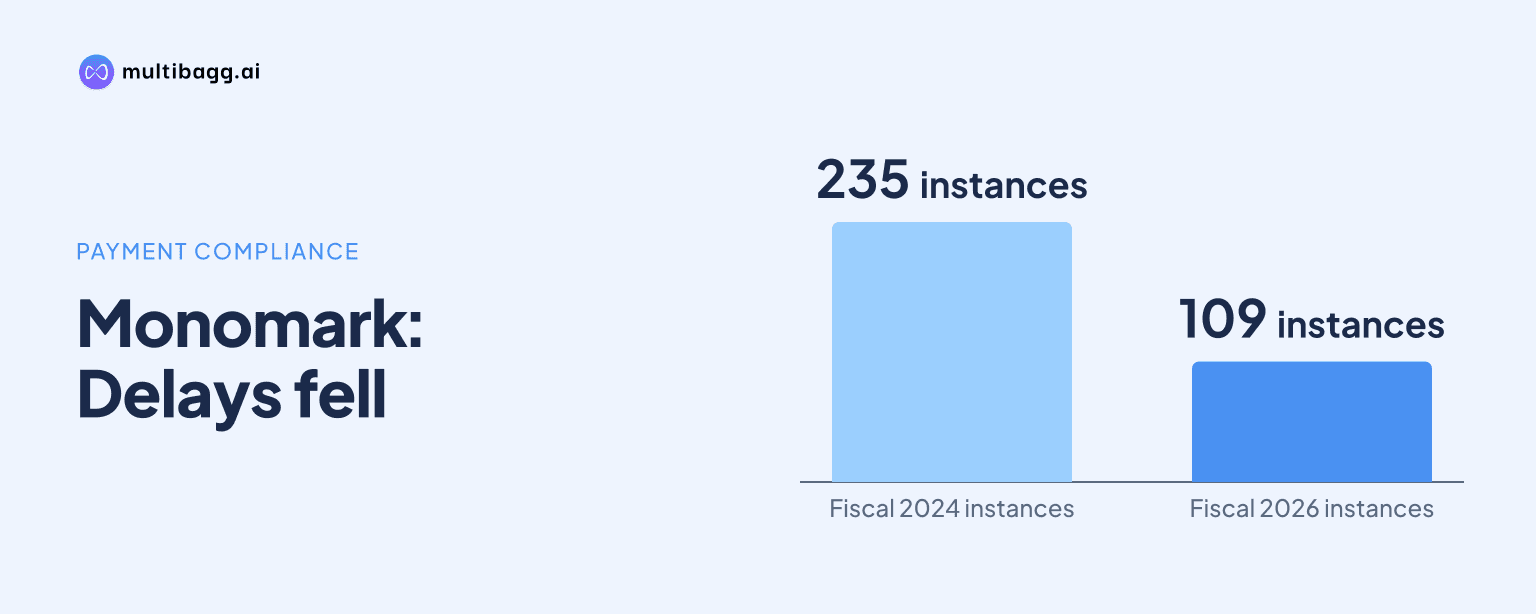
- Total delayed-payment instances fell from 235 in fiscal 2024 to 109 in fiscal 2026.
- Monomark Engineering reported a workforce of 7,608 employees as of September 30, 2026.
powered by IRIS
Monomark Engineering (India) Limited disclosed 544 delayed statutory-payment instances across fiscal 2024, fiscal 2025, fiscal 2026 and the period ended June 30, 2026; delayed Goods and Services Tax, or GST, payments in the three full fiscal years involved Rs 187.28 crore. Monomark Engineering said all such dues had been deposited with the relevant authorities by the Red Herring Prospectus date.
How many statutory payment delays did Monomark Engineering disclose?
Monomark Engineering disclosed 544 delayed statutory-payment instances over the four reported periods, comprising 235 in fiscal 2024, 184 in fiscal 2025, 109 in fiscal 2026 and 16 in the period ended June 30, 2026. The three full fiscal years accounted for 528 instances, meaning the stated total includes the June 2026 stub period.
The aggregate delayed amount was Rs 201.44 crore across those four periods, based on the amounts reported against each category of dues. Fiscal 2025 had the highest delayed amount at Rs 84.88 crore despite recording fewer instances than fiscal 2024, when the reported amount was Rs 63.47 crore across 235 instances.
The reported instance count fell by 126, or 53.62%, from fiscal 2024 to fiscal 2026, while the delayed amount declined by Rs 15 crore over the same comparison. The disclosure covers delays involving provident fund, Employees’ State Insurance Corporation, or ESIC, professional tax, tax deducted at source, or TDS, GST and the Labour Welfare Fund; it does not quantify any regulatory penalty or demand arising from the instances.
Which statutory dues accounted for Monomark Engineering’s delays?
GST accounted for 294 of Monomark Engineering’s 544 disclosed instances and Rs 191.87 crore of the Rs 201.44 crore total delayed amount through June 30, 2026. GST therefore represented 54.04% of all reported instances and 95.25% of the delayed amount across the four disclosed periods.
GST delays totalled Rs 187.28 crore in fiscal 2024, fiscal 2025 and fiscal 2026, comprising Rs 61.72 crore, Rs 78.27 crore and Rs 47.28 crore, respectively. The June 2026 period added seven GST instances involving Rs 4.60 crore. Monomark Engineering stated that GST late-payment amounts exclude interest and late-filing fees.
Professional tax was the second-largest category by frequency, with 168 delayed instances across the four periods, but the corresponding aggregate amount was Rs 33.99 lakh. Provident fund delays under the Employees’ Provident Fund and Miscellaneous Provisions Act, 1952 comprised 39 instances and Rs 8.37 crore, including Rs 6 crore in fiscal 2025.
ESIC had 22 instances and delayed amounts of Rs 43.10 lakh, while TDS on salary had seven instances involving Rs 35.77 lakh. The fiscal 2024 ESIC amount includes Rs 475 of employee contribution that appears as Rs 0.00 lakh in the filing because the table is rounded in lakh units.
Got a follow-up? Ask IRIS
Why did Monomark Engineering report statutory payment delays?
Monomark Engineering attributed delays in TDS returns, ESIC and GST to increased transaction volumes, late receipt of invoices, technical portal issues, and resulting delays in reconciliation and return filing. The company also cited inadvertent oversight and procedural delays in verifying and submitting required filings during the last three fiscal years.
For provident fund deposits, Monomark Engineering said a large workforce and multiple project locations delayed the collection, collation, verification and submission of employee data. The company reported employee counts of 6,013 in fiscal 2024, 7,348 in fiscal 2025, 6,339 in fiscal 2026 and 6,823 in the period ended June 30, 2026.
Monomark Engineering had 7,608 employees as of September 30, 2026, including 6,650 project-specific employees and 958 fixed employees. Its Industrial Operations and Maintenance, or O&M, services generated 80.14% of fiscal 2026 revenue from operations, and the company said these activities require workforce deployment across client facilities, creating a dispersed payroll-documentation process.
The workforce explanation identifies an operating mechanism behind some delays, but it does not change the statutory due dates applicable to payments and filings. For recurrence to fall, the company’s data collection, invoice reconciliation, portal filing and compliance review processes would need to operate within prescribed timelines across its project locations.
What has Monomark Engineering done to address statutory payment delays?
Monomark Engineering said it has appointed dedicated personnel for compliance, regulatory reporting and statutory filings, while adding internal processes and reporting structures to track, escalate and complete regulatory requirements. It also said every delayed statutory due disclosed in the risk factor had been deposited with the relevant authority by the Red Herring Prospectus date.
For provident fund compliance, Monomark Engineering purchased human-resources software that was under implementation when it made the disclosure. The company said the system is intended to make workforce-data collection and collation more efficient so that filings can be completed on time after implementation, but it did not disclose a completion date or a numerical reduction target.
Monomark Engineering separately reported past delays in filings with the Registrar of Companies, or RoC, including two MSME Form 1 instances delayed between 923 and 1,107 days. The company said those matters were regularised through filing the requisite forms and paying applicable additional fees; they are distinct from the 544 statutory-payment instances.
The company identified warnings, financial penalties and reputational risk as possible outcomes if future statutory requirements are not met on time. As of March 31, 2026, Monomark Engineering reported a working-capital gap of Rs 104.86 crore, of which Rs 60.92 crore, or 58.09%, was financed by working-capital bank and financial-institution limits; the filing does not state that compliance delays caused that funding requirement.
Conclusion
Monomark Engineering’s disclosure records a recurring compliance issue across four reported periods rather than one isolated late filing. Total instances dropped from 235 in fiscal 2024 to 109 in fiscal 2026, but GST remained the central exposure, accounting for Rs 187.28 crore of delayed amounts across the three full fiscal years and Rs 191.87 crore including the June 2026 period.
The next issue to watch is whether Monomark Engineering completes its human-resources software implementation and whether dedicated compliance personnel reduce delays in provident fund, GST, ESIC, professional tax and TDS obligations. The company has disclosed no implementation deadline or quantified compliance target, while stating that future delays or lapses may still occur despite its remedial measures.

