








Monomark Engineering funding constraints cut fabrication margins

Find your next multibaggerBe a Pro Investor
Research stocks and track your picks on the go. Download the app.
Key highlights
- Monomark's metal-fabrication revenue fell to Rs 13.05 crore in Fiscal 2026 from Rs 32.13 crore in Fiscal 2025.
- Monomark's fabrication gross margin declined to 5.32% in Fiscal 2026 from 6.07% in Fiscal 2025.
- Monomark's raw-material holding period rose to 511 days in Fiscal 2026 from 264 days in Fiscal 2025.
- Monomark proposes to deploy Rs 120 crore of IPO proceeds toward incremental working-capital requirements.
powered by IRIS
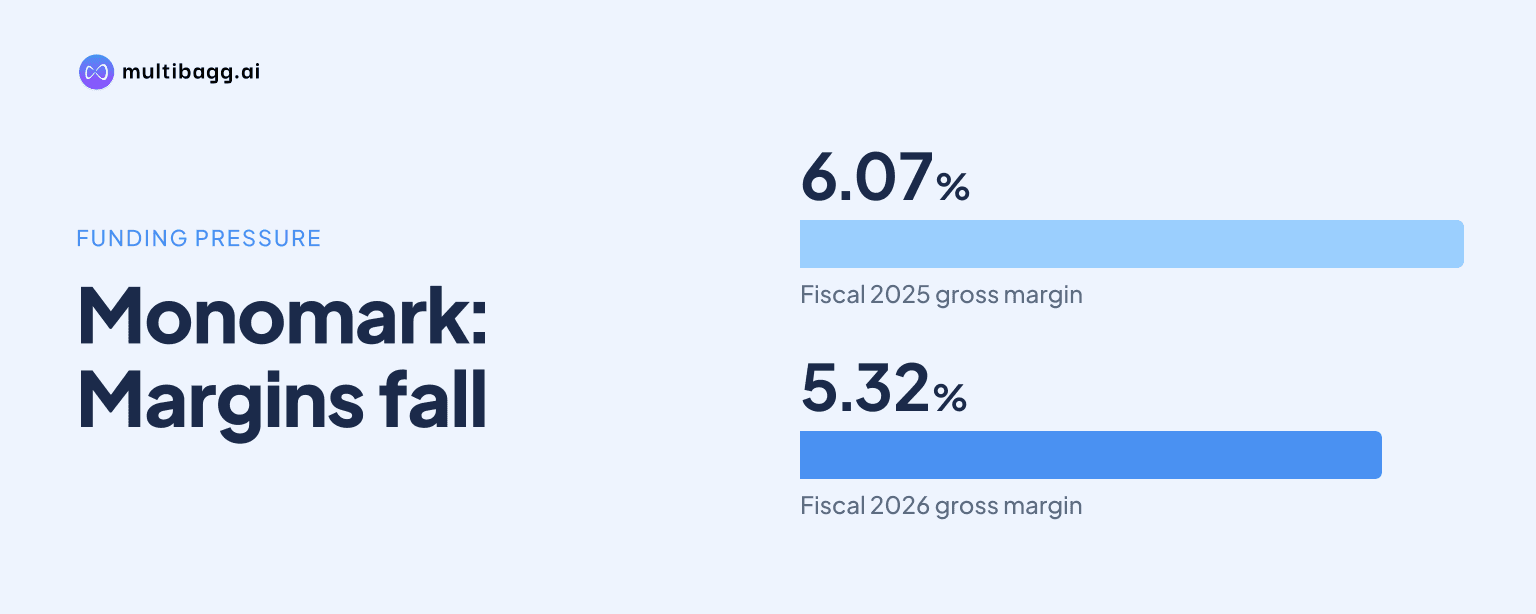
Monomark said working-capital constraints led it to accept customer-supplied-material fabrication contracts in Fiscal 2026, cutting metal-fabrication revenue to Rs 13.05 crore from Rs 32.13 crore in Fiscal 2025 and reducing gross margin to 5.32% from 6.07%. Monomark plans to use initial public offering (IPO) proceeds to fund contracts in which it procures raw material itself.
Why did Monomark shift to customer-supplied-material fabrication?
Monomark shifted to contracts without raw material in Fiscal 2026 because of working-capital constraints. Under these arrangements, customers supplied steel plates, structural components and other materials required for fabrication, rather than Monomark buying those inputs. This reduced the immediate cash needed to procure inventory, but it also changed the value of work billed by the company.
The working-capital backdrop was material: Monomark's working-capital gap rose from Rs 84.06 crore at March 31, 2025 to Rs 104.86 crore at March 31, 2026. A working-capital gap is the excess of current assets over current liabilities, and Monomark said its business requires funding for raw materials, consumables, manpower and equipment before collection under periodic or milestone-based contracts.
Monomark's raw-material consumption shows the effect of the contract shift. Consumption fell from Rs 21.64 crore in Fiscal 2024 to Rs 14.41 crore in Fiscal 2025 and then Rs 7.64 crore in Fiscal 2026. Lower consumption followed lower company procurement under customer-supplied-material contracts, rather than raw material no longer being required for fabrication.
How much did Monomark's fabrication revenue and margin decline?
Monomark's metal-fabrication revenue declined 59.4% to Rs 13.05 crore in Fiscal 2026 from Rs 32.13 crore in Fiscal 2025. The segment's share of total revenue also fell to 2.35% in Fiscal 2026 from 6.90% in Fiscal 2025, showing that the reduction affected both reported revenue and the company's revenue mix.
The margin movement was not limited to the Fiscal 2026 comparison. Metal-fabrication gross margin increased from 5.06% in Fiscal 2024 to 6.07% in Fiscal 2025, before declining to 5.32% in Fiscal 2026; the period ended June 30, 2026 showed 2.68%. Monomark identifies contracts in which it procures and supplies raw materials as higher-margin fabrication work, so the planned recovery depends on sufficient cash to resume that model.
Why did Monomark's raw-material holding days rise to 511 days?
Monomark's raw-material holding period rose to 511 days in Fiscal 2026 from 264 days in Fiscal 2025 because the shift to customer-supplied-material contracts reduced consumption of stock already held. The company retained specific grades of inventory for orders where raw-material procurement was included in the scope, while using less of that stock as metal-fabrication activity moved to without-raw-material contracts.
The holding period had been 146 days in Fiscal 2024 before rising to 264 days in Fiscal 2025 and 511 days in Fiscal 2026. For the period ended June 30, 2026, Monomark reported 1,05,795 raw-material holding days, which it said was not comparable because fabrication activity was low while it retained average closing raw-material inventory of Rs 10.44 crore from Fiscal 2024 through Fiscal 2026.
The holding measure is affected by both the inventory balance and the rate of consumption. If material purchases and consumption recover under company-supplied contracts, the retained raw-material stock can move more quickly through fabrication. Monomark projects raw-material inventory of Rs 10.50 crore at March 31, 2027 and Rs 15.10 crore at March 31, 2028, with holding days normalising to 260 days in each year.
Got a follow-up? Ask IRIS
How will IPO proceeds support Monomark's fabrication plans?
Monomark proposes to deploy Rs 120 crore of net IPO proceeds for incremental working-capital requirements, including higher-margin metal-fabrication contracts where it procures raw materials. The board approved the projected requirements on September 23, 2026, and the stated use is funding working capital rather than bidding for new projects; bidding is to be financed through internal accruals.
The plan assumes that IPO-funded liquidity will allow Monomark to procure materials, use raw-material inventory already held and reduce dependence on customer advances. Customer advances help fund mobilisation, but Monomark says they can involve lower pricing or relatively less favourable commercial terms. The projected advance-from-customers balance is Rs 6.50 crore at both March 31, 2027 and March 31, 2028.
What other working-capital demands could affect the plan?
Monomark's projected working-capital requirement is driven by more than fabrication inventory. Its confirmed unexecuted order book was Rs 1,761.92 crore as of September 30, 2026, comprising Rs 1,696.47 crore of operations and maintenance (O&M) services and Rs 65.45 crore of industrial projects. Executing these orders requires manpower, equipment mobilisation, consumables, spares and credit extended until billing and collection.
Trade receivables are projected to rise from Rs 85.63 crore in Fiscal 2026 to Rs 86 crore in Fiscal 2027 and Rs 132.50 crore in Fiscal 2028, based on projected activity and billing cycles. Monomark estimates receivable holding periods of 45 days in Fiscal 2027 and 47 days in Fiscal 2028, compared with 45 days in Fiscal 2026. These assumptions must hold for the forecast working-capital plan to operate as presented.
Monomark also expects to reduce trade-payable holding days to 84 days in Fiscal 2027 and Fiscal 2028 from 137 days in Fiscal 2026. The company says stronger liquidity could permit earlier payments to suppliers, subcontractors and vendors, potentially enabling discounts. That approach changes supplier-payment timing but requires cash availability while receivables and unbilled revenue remain outstanding.
Conclusion
Monomark's Fiscal 2026 fabrication decline arose from a stated financing trade-off: accepting customer-supplied-material contracts reduced the cash needed for procurement but coincided with metal-fabrication revenue falling to Rs 13.05 crore and gross margin declining to 5.32%. The 511-day raw-material holding period reflected reduced consumption against retained stock, linking the contract mix to both segment performance and inventory movement.
The next measure to watch is execution of the Rs 120 crore proposed IPO allocation across Fiscal 2027 and Fiscal 2028. Monomark projects raw-material holding days of 260, working-capital requirements of Rs 216.06 crore and Rs 292.86 crore, and a return to company-procured fabrication contracts; these targets depend on procurement, order execution, collections and the availability of planned funding.

