








Monomark promoters retain 91.37% before the proposed issue

Find your next multibaggerBe a Pro Investor
Research stocks and track your picks on the go. Download the app.
Key highlights
- Monomark promoters held 6,30,88,200 shares, or 91.37% of 6,90,41,200 shares, on November 13, 2026.
- Narendra Chordia and Meena Chordia held 45.62% and 30.42% of Monomark’s pre-issue capital, respectively.
- Nitesh Chordia’s initial 5,684 shares and Gaurav Chordia’s initial 4,400 shares came through nil-price gifts on March 31, 2016.
- A July 2, 2025 private placement raised Rs 22.62 crore and reduced promoter ownership from 100.00% to 91.37%.
powered by IRIS
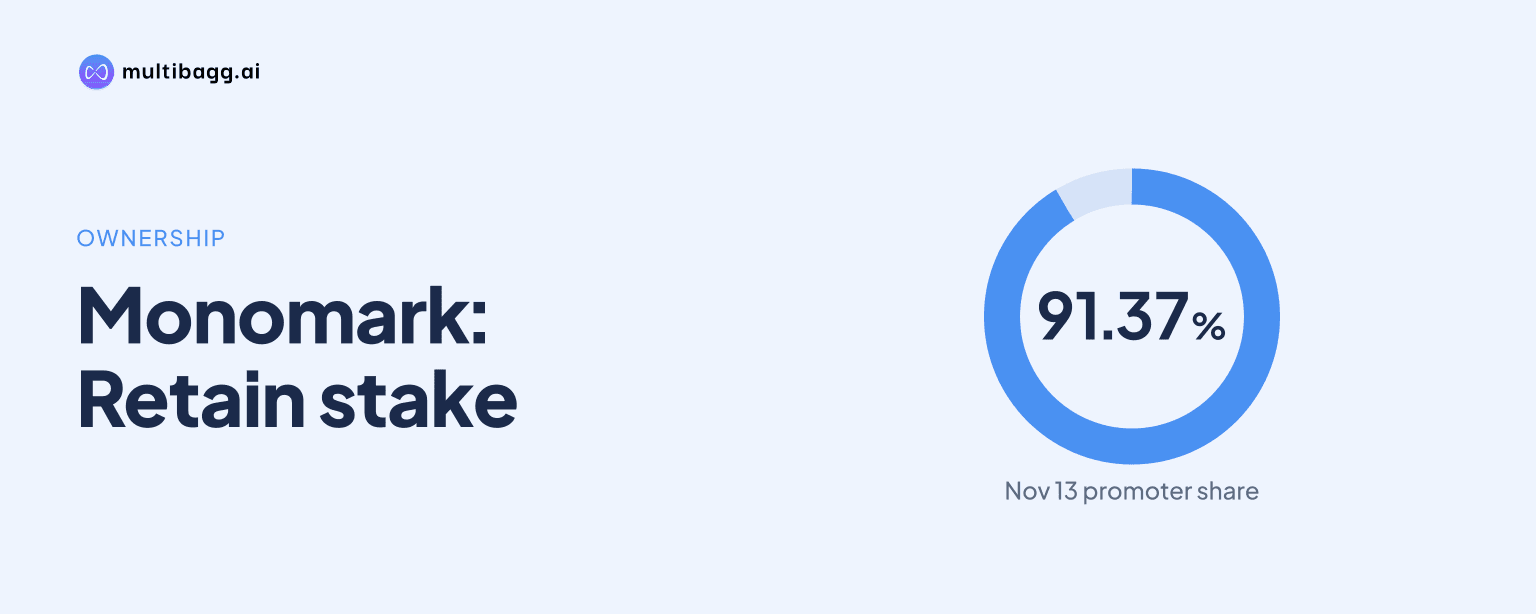
Monomark Engineering’s four shareholding promoters held 6,30,88,200 equity shares, or 91.37% of pre-issue capital, on November 13, 2026. Narendra, Meena, Nitesh and Gaurav Chordia controlled the shares, while Nitesh and Gaurav built their original holdings through nil-price gift deeds dated March 31, 2016, followed by bonus allotments.
How concentrated is Monomark promoter ownership before the proposed issue?
Monomark’s promoters held 91.37% of its 6,90,41,200 outstanding equity shares before the proposed issue, while public shareholders held 8.63%, according to the shareholding pattern as of November 13, 2026. The company had 41 shareholders, comprising four shareholding promoters and 37 public shareholders. Each equity share carried one vote, so the promoters also held 91.37% of voting rights.
Narendra Chordia was the largest holder with 3,15,00,000 shares, or 45.62% of pre-issue capital, followed by Meena Chordia with 2,10,00,000 shares, or 30.42%. Nitesh Chordia held 59,68,200 shares, or 8.64%, and Gaurav Chordia held 46,20,000 shares, or 6.69%. Kirti is identified as a promoter but held no shares, and the separately defined promoter group also held no equity shares.
The promoter percentage was 100.00% two years before the Red Herring Prospectus date, when the four named shareholders held all 90,12,600 shares. The change to 91.37% arose after a July 2, 2025 private placement of 59,53,000 shares to 31 non-promoter persons and entities. That cash issue created the public shareholding recorded across 37 shareholders as of November 13, 2026.
How did Nitesh and Gaurav Chordia obtain their original Monomark shares?
Nitesh Chordia acquired his first 5,684 Monomark shares through four nil-price gift-deed transfers on March 31, 2016. The transfers comprised 1,200 shares from Laxmi Jain, 2,400 from Dinesh Kumar Jain, 1,200 from M N Prashant and 884 from Rekha Rankha. Each transfer was classified as consideration other than cash, with a Rs 10 face value per share and a nil transfer price.
Gaurav Chordia acquired his first 4,400 shares through five nil-price gift-deed transfers on the same date. Sunil Kumar Jain transferred 1,200 shares, while Pista Jain, Arvind Kothari and Anil Jain transferred 800 shares each, with Anil Jain making two 800-share transfers. The prospectus records the shares as fully paid, with Rs 10 face value and no cash consideration.
The subsequent expansion in both holdings came through bonus issues rather than later disclosed cash purchases. Nitesh received 8,46,916 bonus shares on March 29, 2017 and 51,15,600 on May 26, 2025, reaching 59,68,200 shares. Gaurav received 6,55,600 shares in the 2017 bonus issue and 39,60,000 in the 2025 issue, reaching 46,20,000 shares.
Got a follow-up? Ask IRIS
What changed in Monomark’s share capital and promoter percentage?
Monomark’s outstanding shares rose from 90,12,600 to 6,30,88,200 through a May 2025 bonus issue in a 6:1 ratio, then increased to 6,90,41,200 after the July 2025 private placement. A bonus issue allocates additional shares to existing shareholders by capitalising reserves and surplus rather than raising fresh cash. The May 2025 bonus therefore preserved the then-existing shareholders’ percentage ownership.
The May 26, 2025 bonus issue added 5,40,75,600 shares with a Rs 10 face value. Narendra received 2,70,00,000 shares, Meena received 1,80,00,000, Nitesh received 51,15,600 and Gaurav received 39,60,000. Paid-up equity capital rose from Rs 9.01 crore to Rs 63.09 crore, while book value per equity share declined from Rs 81.28 to Rs 11.61 after the bonus issue.
The earlier March 29, 2017 bonus issue used a 149:1 ratio and added 89,52,516 shares from reserves and surplus. By contrast, the July 2, 2025 private placement involved cash consideration at Rs 38 per share and raised Rs 22.62 crore for general corporate purposes. The placement, made at a price determined using a May 31, 2025 valuation report, diluted the four shareholding promoters from 100.00% to 91.37%.
What lock-ins and capital changes does Monomark disclose?
Monomark states that at least 20% of its fully diluted post-issue capital held by promoters will be designated as minimum promoters’ contribution and locked in for 18 months from allotment. The requirement is under the Securities and Exchange Board of India’s Issue of Capital and Disclosure Requirements regulations. Promoter holdings exceeding that 20% minimum will be locked in for six months from allotment.
The precise number of shares designated for the 18-month minimum promoters’ contribution was left for update at the prospectus stage. Monomark also states that its entire pre-issue equity capital will be locked in for six months from allotment in the initial public offering. None of the promoters’ existing shares were pledged as of the Red Herring Prospectus date, and all promoter shares were held in dematerialised form.
Except for shares issued under the proposed issue, Monomark says it does not presently intend to alter its capital structure for six months from the bid or issue opening date through a split, consolidation, bonus issue, rights issue, preferential allotment or further public issue. The company also discloses that it may consider additional capital, subject to approvals, if it enters an acquisition, joint venture or another arrangement requiring funding or share consideration.
Conclusion
Monomark’s ownership remains concentrated because four shareholding promoters control 6,30,88,200 shares and 91.37% of voting rights. Narendra and Meena together account for 76.04% of pre-issue capital, while Nitesh and Gaurav account for a further 15.33%. The 2025 private placement, not either bonus issue, caused the reduction from the promoters’ earlier 100.00% ownership.
The next disclosed point to watch is allotment in the proposed issue, because the post-issue promoter percentages and the specific shares constituting minimum promoters’ contribution remain pending update. Monomark’s stated six-month restriction on capital-structure changes after the bid or issue opening date, subject to its disclosed acquisition or joint-venture exception, will also determine whether further dilution is considered.

