








Monomark plans Rs 120 crore as FY28 gap reaches Rs 292.86 crore

Find your next multibaggerBe a Pro Investor
Research stocks and track your picks on the go. Download the app.
Key highlights
- Monomark plans to allocate Rs 120 crore of net IPO proceeds to incremental working capital.
- Monomark projects working-capital requirements of Rs 292.86 crore in FY28, against Rs 104.86 crore in FY26.
- Monomark reported an unexecuted confirmed order book of Rs 1,761.92 crore as of September 30, 2026.
- Monomark projects Rs 186.36 crore of other borrowings in FY28 alongside Rs 69 crore of bank working-capital limits.
powered by IRIS
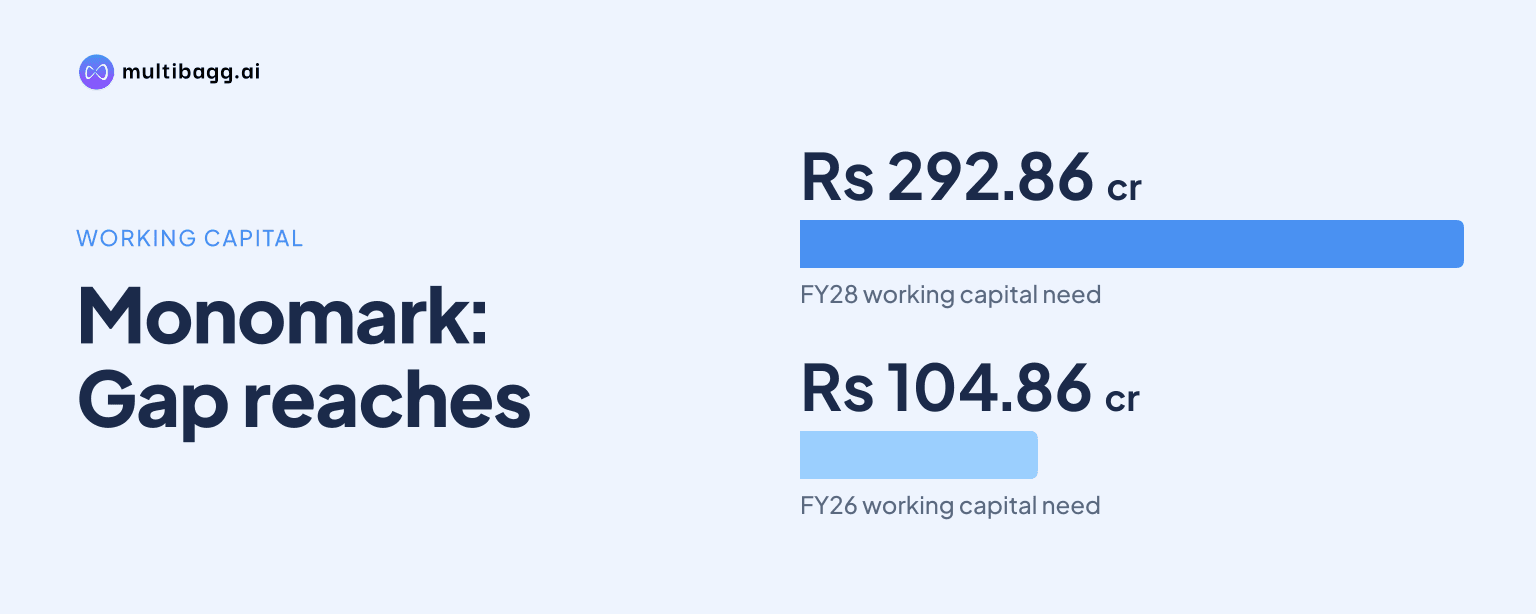
Monomark Engineering plans to use Rs 120 crore of net IPO proceeds for working capital as its requirement is projected to reach Rs 292.86 crore at March 31, 2028, from Rs 104.86 crore at March 31, 2026. The forecast combines rising current assets, lower projected current liabilities and additional borrowing.
Why is Monomark raising Rs 120 crore for working capital?
Monomark is raising Rs 120 crore for incremental working-capital requirements, making this the specifically quantified use of IPO proceeds in its objects of the issue. The board approved the proposed use on September 23, 2026, alongside a general-corporate-purpose allocation that will be finalised after the issue price is determined and cannot exceed 25% of gross proceeds under Securities and Exchange Board of India (SEBI) Issue of Capital and Disclosure Requirements Regulations.
Monomark defines the requirement as the difference between current assets and current liabilities, after excluding liquid and freely available cash, cash equivalents and bank balances, except fixed deposits earmarked against bank-guarantee limits. At March 31, 2026, its working-capital gap was Rs 104.86 crore, funded by Rs 60.92 crore of bank working-capital limits and Rs 43.95 crore of net worth. The proposed IPO funding is therefore intended to supplement existing banking facilities.
The planned deployment is Rs 82.50 crore in FY27 and Rs 37.50 crore in FY28. Monomark says the schedule is based on its business plan, internal management estimates, market conditions and commercial considerations, and has not been appraised by an external agency, bank or financial institution. If proceeds are not used within the stated period, the company may deploy the balance in FY29 in accordance with applicable law.
How does Monomark's working-capital gap nearly triple by FY28?
Monomark projects the working-capital gap to rise from Rs 104.86 crore in FY26 to Rs 216.06 crore in FY27 and Rs 292.86 crore in FY28. The FY28 projection is Rs 188 crore above the FY26 reported figure, equivalent to an increase of about 179%, and is a management estimate rather than a historical result.
The funding pattern allocates Rs 82.50 crore of IPO proceeds in FY27, equal to 38.2% of that year's projected requirement, and the full Rs 120 crore by FY28, equal to 41.0% of the FY28 requirement. Other borrowings are projected to increase from Rs 66.06 crore in FY27 to Rs 186.36 crore in FY28, while bank working-capital limits rise by Rs 1.50 crore. The FY28 plan consequently depends on the availability of the projected other borrowings.
Historical figures show a smaller but continuing increase before the forecast period. The working-capital gap rose from Rs 72.77 crore at March 31, 2024, to Rs 84.06 crore at March 31, 2025, and Rs 104.86 crore at March 31, 2026. Revenue from operations increased to Rs 554.58 crore in FY26 from Rs 465.52 crore in FY25, while trade receivables rose to Rs 85.63 crore from Rs 51.17 crore.
Got a follow-up? Ask IRIS
What is driving Monomark's projected funding requirement?
Monomark attributes the projected increase principally to the scale and timing of its industrial operations and maintenance (O&M) services, industrial projects and metal-fabrication work. It reported confirmed unexecuted orders of Rs 1,761.92 crore as of September 30, 2026, comprising Rs 1,696.47 crore in O&M services and Rs 65.45 crore in industrial projects.
Trade receivables are projected to rise from Rs 85.63 crore in FY26 to Rs 86 crore in FY27 and Rs 132.50 crore in FY28. The company assumes receivables holding periods of 45 days in FY27 and 47 days in FY28, versus 45 days in FY26. These assumptions require periodic O&M billing and milestone-based project billing to remain broadly in line with the stated collection pattern as execution expands.
Other financial and current assets are projected to reach Rs 137.28 crore in FY28 from Rs 79.96 crore in FY26. The components include retention money, a portion of contract value withheld by customers as a performance safeguard, and unbilled revenue, which is work completed but not yet invoiced because customer certification or a billing milestone is pending. Unbilled revenue is projected at Rs 86.50 crore in FY28, against Rs 54.99 crore in FY26.
Monomark reported that 96.43% of FY26 unbilled revenue was certified and billed within three months of the balance-sheet date, with the remaining 3.57% certified and billed within three to six months. No unbilled revenue in the three reviewed fiscal years remained outstanding beyond six months. The historical pattern shows the timing of certification, while the projected balance rises with expected work completed before billing milestones.
How do inventory and supplier payments affect Monomark's plan?
Monomark expects inventory and earlier supplier payments to increase cash required for operations. Raw-material inventory is projected at Rs 15.10 crore in FY28, compared with Rs 10.17 crore in FY26, while consumables, stores, spares and other inventory is projected at Rs 60.50 crore, compared with Rs 49.25 crore in FY26.
Monomark plans to use part of the proceeds to undertake more metal-fabrication contracts in which it procures raw material rather than uses customer-supplied material. Raw-material holding days are projected at 260 days in FY27 and FY28, down from 511 days in FY26. The FY26 level followed raw-material consumption of Rs 7.64 crore, compared with Rs 14.41 crore in FY25, as more fabrication contracts used customer-supplied inputs.
Trade payables are projected to decline to Rs 20 crore in FY27 from Rs 71.59 crore in FY26, before increasing to Rs 25 crore in FY28. Monomark projects payable holding days of 84 in both years, versus 137 days in FY26, because it expects the strengthened cash position to permit earlier payments to vendors, suppliers and subcontractors and potentially secure discounts.
The planned reduction in supplier credit is a key reason the projected gap increases faster than current assets alone. The net working-capital cycle is projected at 398 days in FY27 and 400 days in FY28, compared with 627 days in FY26. The projections depend on Monomark achieving the assumed inventory, receivable and payable days while financing execution across multiple sites.
Conclusion
Monomark's IPO plan is primarily a working-capital financing programme: Rs 120 crore is earmarked for a requirement projected to reach Rs 292.86 crore in FY28. The forecast combines higher receivables, retention money, unbilled revenue and inventory with a planned reduction in supplier payments, while the funding mix includes other borrowings alongside bank limits and IPO proceeds.
The next measures to watch are the planned deployment of Rs 82.50 crore in FY27 and Rs 37.50 crore in FY28, and the availability of internal accruals, additional equity or debt if funding falls short. Monomark says unused proceeds may be carried into FY29, while IPO proceeds will not be used to bid for new projects, which it says will be financed through internal accruals.

