








Monomark fabrication plant utilisation fell to 22.19% in FY 2025-26

Find your next multibaggerBe a Pro Investor
Research stocks and track your picks on the go. Download the app.
Key highlights
- Monomark’s fabrication utilisation fell from 70.30% in FY 2023-24 to 22.19% in FY 2025-26.
- Actual fabrication output declined from 2,812.28 MT in FY 2023-24 to 887.52 MT in FY 2025-26.
- The Chittorgarh fabrication facility’s installed annual capacity remained 4,000 MT across FY 2023-24 to FY 2025-26.
- Monomark reported 33.17 MT of production and 3.32% utilisation for the period ended June 30, 2026.
powered by IRIS
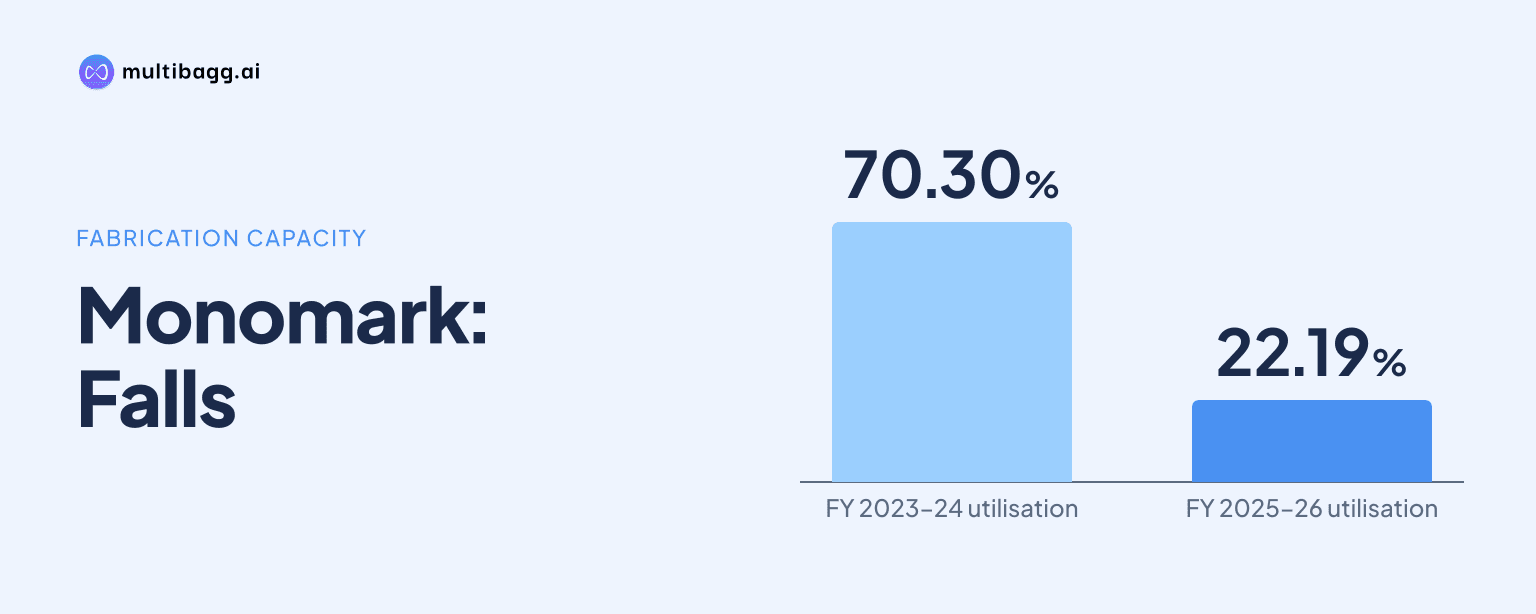
Monomark Engineering’s 4,000-metric-tonne (MT) fabrication plant reported 22.19% capacity utilisation in FY 2025-26, down from 70.30% in FY 2023-24, as actual production declined from 2,812.28 MT to 887.52 MT. The 48.11-percentage-point fall left more of the Chittorgarh workshop’s stated annual capacity unutilised.
What happened to Monomark fabrication plant utilisation?
Monomark’s reported utilisation fell in each of the three full financial years disclosed, from 70.30% in FY 2023-24 to 50.97% in FY 2024-25 and 22.19% in FY 2025-26. Installed capacity remained unchanged at 4,000 MT in all three years, so the movement reflects lower reported production rather than a stated expansion or reduction in plant capacity.
The production data show that actual fabrication volume declined by 1,924.76 MT between FY 2023-24 and FY 2025-26. Output first fell by 773.37 MT, from 2,812.28 MT to 2,038.91 MT in FY 2024-25, then declined by a further 1,151.39 MT to 887.52 MT in FY 2025-26. The second-year volume decline coincided with utilisation dropping by 28.78 percentage points in FY 2025-26, compared with a 19.33-percentage-point reduction in FY 2024-25.
How large is the gap between Monomark capacity and output?
Monomark’s FY 2025-26 production of 887.52 MT was 3,112.48 MT below the disclosed 4,000-MT installed annual capacity. In FY 2023-24, the corresponding unused portion was 1,187.72 MT, based on production of 2,812.28 MT. The reported unused capacity therefore widened by 1,924.76 MT over two years, matching the decline in actual output.
Monomark reported 33.17 MT of production and 3.32% utilisation for the period ended June 30, 2026. The disclosure labels installed capacity as 4,000 MT for that period as well, but 33.17 MT is not mathematically equal to 3.32% of 4,000 MT. The capacity table does not explain whether the June 2026 percentage uses a quarterly capacity denominator or another measurement basis, so the reported figure should not be annualised or reconciled beyond what Monomark states.
What does Monomark fabricate at its Chittorgarh facility?
Monomark fabricates sheet-metal machine components and customised fabricated products, principally using steel and its variations, for original equipment manufacturers (OEMs) and other industrial customers. Its facility is located at Village Samrathpura near Singhpur Toll Plaza, Kapasan, Chittorgarh, Rajasthan, and carries a stated installed annual fabrication capacity of 4,000 MT.
Monomark’s fabrication workflow depends on a customer purchase order, either company-procured or customer-supplied materials, shopfloor cutting and welding, a Black Inspection of the unpainted structure, client approval, surface treatment and final inspection before dispatch and invoicing. A Black Inspection is Monomark’s preliminary internal check of structural alignment, weld integrity and critical dimensions. This workflow means fabrication volume requires orders, material availability, production execution and client inspection clearance; the disclosure does not identify which of these factors caused the FY 2023-24 to FY 2025-26 decline.
Monomark reported total purchases of Rs 94.09 crore in FY 2025-26, compared with Rs 59.88 crore in FY 2024-25 and Rs 68.41 crore in FY 2023-24. Rajasthan accounted for Rs 85.33 crore, or 90.70%, of FY 2025-26 purchases, while no imports were reported in the purchase table for FY 2023-24 through the period ended June 30, 2026. These purchases cover Monomark’s reported operations and are not disclosed as fabrication-only material consumption, so they cannot establish a direct output-to-input relationship for the workshop.
Got a follow-up? Ask IRIS
How does fabrication compare with Monomark’s other business activities?
Monomark operates three verticals: industrial operations and maintenance (O&M), metal fabrication and industrial project execution. O&M involves operating and maintaining client facilities, while industrial projects include complete engineering, procurement and construction (EPC) contracts and on-site fabrication, erection, installation and commissioning. EPC means end-to-end responsibility for engineering design, procurement and construction under the model described by Monomark.
The company’s completed-project schedule for the past five years lists 14 O&M projects with total contract value of Rs 545.71 crore and seven industrial projects with total contract value of Rs 121.42 crore. It separately lists six completed projects awaiting closure certificates with value of Rs 240.28 crore. These contract values are exclusive of goods and services tax and do not allocate revenue or production between the dedicated workshop and on-site project fabrication, so they do not measure the fabrication plant’s revenue contribution.
Monomark says O&M contracts typically average about five years from commencement, whereas industrial project-execution contracts typically run for about one to two years. The different contract durations matter when comparing activity across verticals: the 4,000-MT workshop capacity measure records production at a dedicated facility, while O&M contract values reflect services at client plants and project work can include on-site fabrication under a client-led design and procurement model.
What conditions would support higher Monomark fabrication output?
Higher reported workshop production would require fabrication orders to pass through Monomark’s disclosed process, from technical review of client drawings and purchase-order confirmation to material preparation, cutting, welding, inspections, painting, dispatch and invoicing. Monomark states that raw materials may be procured against an approved bill of quantities or supplied directly by customers, making both order conversion and material handover relevant operational inputs.
Customer concentration is another disclosed condition for Monomark’s overall business activity. For the period ended June 30, 2026, Monomark’s top five customers accounted for Rs 130.04 crore, or 91.37%, of revenue from operations, and its top 10 accounted for Rs 138.26 crore, or 97.15%. Hindustan Zinc Limited was the largest customer, contributing 41.31% of revenue for that period; however, the disclosure does not state how much of those customer relationships relates specifically to the fabrication facility.
Conclusion
Monomark’s reported fabrication plant utilisation fell from 70.30% in FY 2023-24 to 22.19% in FY 2025-26 while installed capacity remained 4,000 MT and actual production decreased by 1,924.76 MT. The data establish a substantial reduction in workshop activity, but the disclosure does not attribute it to demand, materials, pricing, client approvals, capacity changes or any other specific cause.
The next disclosed period is the one ended June 30, 2026, when Monomark reported 33.17 MT of production and 3.32% utilisation. The key unresolved matter is the denominator used for that June-period utilisation figure, while subsequent production disclosures will show whether fabrication orders progress through Monomark’s purchase-order, material, inspection and dispatch process.

