










IRB Mumbai-Pune toll revenue rises 14.2% to Rs 49.19 crore
Key highlights
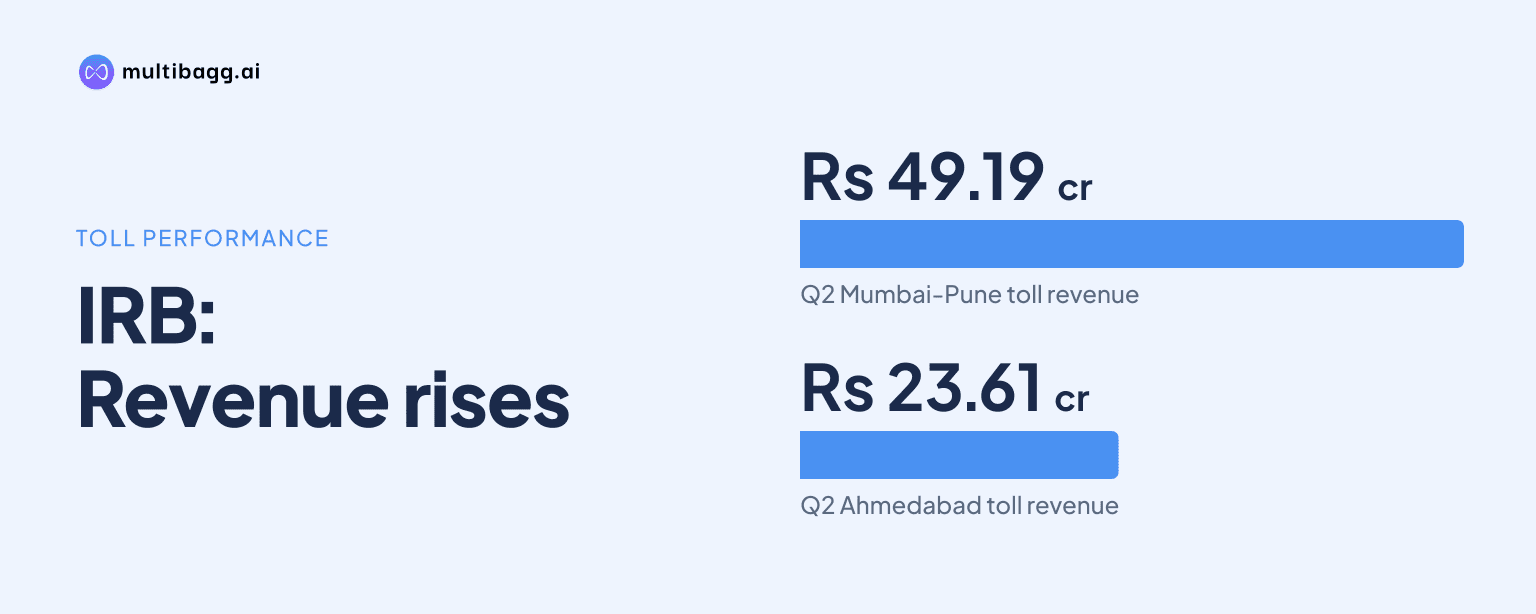
- Mumbai-Pune toll revenue rose 14.2% year on year to Rs 49.19 crore in the September quarter of FY2026-27.
- Ahmedabad-Vadodara collected Rs 23.61 crore in the September quarter, up 15.7% year on year.
- Hyderabad ORR toll revenue increased 18.5% to Rs 25.49 crore in the September quarter.
- Lalitpur-Lakhnadon toll revenue rose 21.0% to Rs 13.06 crore in the September quarter.
powered by IRIS
In the second quarter of financial year 2026-27 (Q2FY27), IRB Infrastructure Developers Limited recorded Rs 49.19 crore of gross toll revenue at Mumbai-Pune, a 14.2% year-on-year increase from Rs 43.09 crore, while newer IRB Private InvIT assets including Lalitpur-Lakhnadon and Hyderabad ORR reported September-quarter growth of 21.0% and 18.5%, respectively.
Know IRB Infrastructure Developers inside out
Results, valuation, peers and who's buying, in one view.
How much did IRB’s wholly owned highways collect in Q2FY27?
IRB’s two wholly owned concessions both increased gross toll revenue from a year earlier in the September quarter of FY2026-27. Mumbai-Pune collected Rs 49.19 crore, up Rs 6.10 crore from Rs 43.09 crore in September FY2025-26, while Ahmedabad-Vadodara collected Rs 23.61 crore, up 15.7% from Rs 20.40 crore.
Both roads reported a modest sequential reduction from the June quarter. Mumbai-Pune’s September collection was Rs 0.79 crore below its Rs 49.98 crore June collection, and Ahmedabad-Vadodara’s Rs 23.61 crore was Rs 0.25 crore below its Rs 23.86 crore June amount. For the first half of FY2026-27, Mumbai-Pune recorded Rs 99.17 crore and Ahmedabad-Vadodara recorded Rs 47.47 crore.
Mumbai-Pune remained the larger reported wholly owned asset, with September toll revenue Rs 25.58 crore above Ahmedabad-Vadodara. The same scale difference was visible in FY2025-26, when Mumbai-Pune generated Rs 184.40 crore for the full year, compared with Rs 88.12 crore at Ahmedabad-Vadodara.
Which IRB Private InvIT roads grew fastest in September?
Lalitpur-Lakhnadon, identified by IRB as TOT-12, posted the fastest September-quarter growth among Private InvIT roads with a comparable prior-year period. Its gross toll revenue increased 21.0% to Rs 13.06 crore from Rs 10.79 crore, following an 18.5% rise to Rs 12.73 crore in June FY2026-27.
Hyderabad ORR recorded the next-highest comparable September growth at 18.5%, collecting Rs 25.49 crore against Rs 21.50 crore a year earlier. The project, which commenced on August 12, 2023, collected Rs 49.90 crore over June and September FY2026-27, compared with Rs 42.66 crore across the corresponding two quarters of FY2025-26.
Palsit-Dankuni collected Rs 6.75 crore in September, up 9.2% year on year, after a 47.6% June increase to Rs 6.97 crore. IRB states that the project received its completion certificate effective July 14, 2025, placing the sharp June increase after that certificate date.
How did IRB’s established Private InvIT roads perform?
Among the four established roads shown on IRB’s first Private InvIT toll-revenue page, Yedeshi-Aurangabad recorded the fastest September increase, rising 11.9% to Rs 7.25 crore. Udaipur-Shamlaji followed with a 9.5% gain to Rs 8.64 crore, while Agra-Etawah increased 3.8% to Rs 6.73 crore and Gulabpura-Chittorgarh rose 1.4% to Rs 10.33 crore.
Gulabpura-Chittorgarh remained the largest September collector within that group at Rs 10.33 crore, but its growth rate was below Udaipur-Shamlaji’s 9.5% and Yedeshi-Aurangabad’s 11.9%. Over the first half of FY2026-27, Gulabpura-Chittorgarh collected Rs 20.78 crore, Udaipur-Shamlaji Rs 17.44 crore, Yedeshi-Aurangabad Rs 14.56 crore and Agra-Etawah Rs 14.03 crore.
IRB says revenue at Yedeshi-Aurangabad in FY2023-24 and FY2024-25 was affected by temporary shifting of multi-axle vehicles, or MAVs, to an alternate route under court orders. The presentation discloses the same factor for Solapur-Yedeshi in those years; despite that history, Solapur-Yedeshi’s September FY2026-27 toll revenue rose 14.8% to Rs 3.86 crore.
Gulabpura-Chittorgarh and Solapur-Yedeshi were transferred to IRB InvIT Fund effective September 30, 2026, according to the presentation. Their September-quarter collections were Rs 10.33 crore and Rs 3.86 crore, respectively, immediately before that disclosed transfer date.
Got a follow-up? Ask IRIS
What did newer toll projects contribute to IRB’s collection base?
Newer IRB assets added meaningful collections, although several do not have a like-for-like prior-year September comparison. Ganga Expressway began toll collection on May 17, 2026 and generated Rs 1.99 crore in June and Rs 4.79 crore in September, taking its reported FY2026-27 total to Rs 6.78 crore.
Lucknow-Ayodhya-Gorakhpur and Lucknow-Sultanpur, grouped as TOT-17, commenced on January 23, 2026. The project collected Rs 17.47 crore in June and Rs 14.24 crore in September, for Rs 31.71 crore in the first half of FY2026-27, compared with Rs 12.18 crore reported in the March quarter of FY2025-26 after commencement.
Chandikhole-Bhadrak, identified as TOT-18, commenced on April 1, 2026 and collected Rs 6.95 crore in June and Rs 6.07 crore in September. Its Rs 13.02 crore first-half collection cannot be compared year on year because IRB reports no earlier operating period for the project.
Samakhiyali-Santalpur showed a mixed pattern after tolling and construction commenced on December 28, 2023. June FY2026-27 revenue fell 9.3% year on year to Rs 3.30 crore, but September revenue rose 4.4% to Rs 3.54 crore, producing a reported first-half total of Rs 6.84 crore.
How do the reported toll figures compare with IRB’s segment results?
IRB reported consolidated revenue of Rs 1,897.10 crore in Q2FY27, down from Rs 2,137.30 crore in Q1FY27. The BOT/TOT segment recorded revenue of Rs 720.50 crore in Q2FY27, versus Rs 733.30 crore in Q1FY27, while its earnings before interest, tax, depreciation and amortisation, or EBITDA, declined to Rs 651.50 crore from Rs 665.30 crore.
The InvITs and related assets segment reported Q2FY27 revenue of Rs 355.90 crore, compared with Rs 436.70 crore in Q1FY27, and EBITDA of Rs 333.60 crore against Rs 409.70 crore. Its EBITDA margin was unchanged at 94%, while the BOT/TOT segment margin moved to 90% from 91% and the construction segment margin remained 15%.
The reported project-level toll data therefore show annual growth at several roads even as segment revenue moved lower sequentially between Q1FY27 and Q2FY27. Mumbai-Pune’s Rs 49.19 crore September collection and Hyderabad ORR’s Rs 25.49 crore collection were among the larger individual quarterly amounts disclosed in the presentation.
Conclusion
IRB’s September-quarter toll data show that the mature Mumbai-Pune concession continued to grow, with revenue increasing 14.2% year on year to Rs 49.19 crore, while Ahmedabad-Vadodara rose 15.7% to Rs 23.61 crore. Within the Private InvIT portfolio, Lalitpur-Lakhnadon’s 21.0% increase and Hyderabad ORR’s 18.5% increase stood out among projects with comparable prior-year September data.
The next collections to watch are those from assets with recent operating starts, including Ganga Expressway from May 17, 2026 and Chandikhole-Bhadrak from April 1, 2026. IRB also disclosed September 30, 2026 transfers of Gulabpura-Chittorgarh and Solapur-Yedeshi to IRB InvIT Fund, while the court-order-related MAV diversions remain relevant context for historical trends at Yedeshi-Aurangabad and Solapur-Yedeshi.