










IRB Q2FY27 profit rises 85% as net debt drops to Rs 10,500 crore
Key highlights
- IRB reported Q2FY27 PAT of Rs 260.7 crore, up 85% from Rs 140.8 crore in Q2FY26.
- Q2FY27 EBITDA rose to Rs 1,102 crore from Rs 973.9 crore, while finance costs fell to Rs 387.7 crore.
- Net debt declined to Rs 10,500 crore at Q2FY27 from Rs 12,500 crore a year earlier, with net debt to equity at 0.50 times.
- IRB received about Rs 161 crore of Q2FY27 distributions from its private and public InvIT platforms.
powered by IRIS
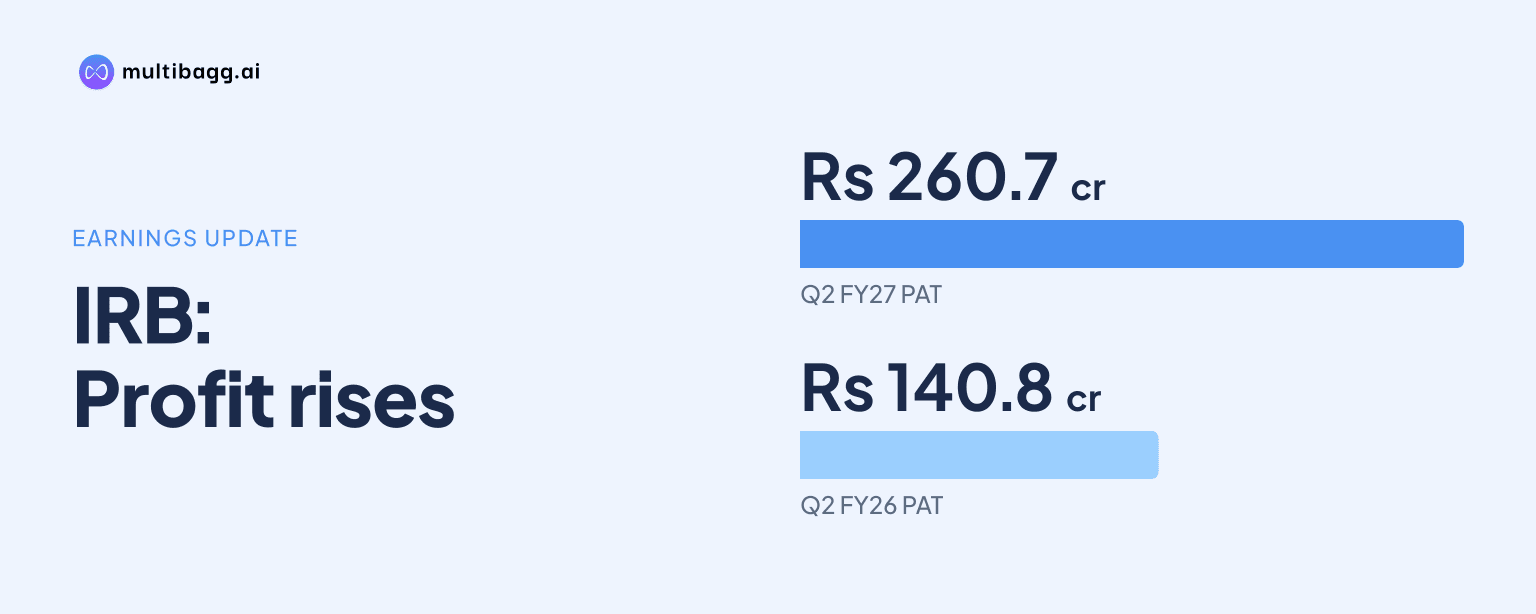
IRB Infrastructure Developers Ltd reported Q2FY27 profit after tax of Rs 260.7 crore, up 85% from Rs 140.8 crore in Q2FY26, as EBITDA rose to Rs 1,102 crore and net debt fell to Rs 10,500 crore from Rs 12,500 crore a year earlier. Lower finance costs also supported the quarterly profit increase.
Know IRB Infrastructure Developers inside out
Results, valuation, peers and who's buying, in one view.
How did IRB’s Q2FY27 earnings change?
IRB’s consolidated profit after tax, or PAT, increased by Rs 119.9 crore year on year to Rs 260.7 crore in Q2FY27. Profit before tax rose to Rs 385.3 crore from Rs 260.8 crore, while total income increased to Rs 1,944.5 crore from Rs 1,800.3 crore. The company reported an 85% PAT increase for the quarter.
Earnings before interest, tax, depreciation and amortisation, or EBITDA, rose by Rs 128.1 crore to Rs 1,102 crore from Rs 973.9 crore. Finance costs declined by Rs 63.3 crore to Rs 387.7 crore, while depreciation and amortisation increased by Rs 66.9 crore to Rs 329 crore. IRB’s quarterly financial track-record presentation shows EBITDA margin at 57% in Q2FY27, compared with 54% in Q2FY26.
IRB’s H1FY27 PAT rose 65% to Rs 566.9 crore from Rs 343.3 crore in H1FY26. First-half EBITDA increased by Rs 298.5 crore to Rs 2,290 crore, although total income rose by a smaller Rs 152.3 crore to Rs 4,117.2 crore. Finance costs declined by Rs 87.3 crore during the six-month period, while depreciation and amortisation rose to Rs 662.4 crore from Rs 531.3 crore.
Which IRB segments drove Q2FY27 EBITDA?
IRB’s build-operate-transfer, or BOT, and toll-operate-transfer, or TOT, segment generated the largest Q2FY27 EBITDA contribution at Rs 651.5 crore. That was Rs 99.3 crore above Q2FY26 EBITDA of Rs 552.2 crore, while revenue rose to Rs 720.5 crore from Rs 627.5 crore. The segment’s EBITDA margin increased to 90% from 88%.
The infrastructure investment trusts, or InvITs, and related assets segment reported Q2FY27 EBITDA of Rs 333.6 crore, up from Rs 275.3 crore a year earlier. Its revenue increased to Rs 355.9 crore from Rs 303.4 crore, and the reported EBITDA margin reached 94%, compared with 91% in Q2FY26. This was the highest reported margin among IRB’s three operating segments.
Construction revenue was nearly unchanged at Rs 820.6 crore in Q2FY27, compared with Rs 820.1 crore in Q2FY26, but segment EBITDA declined to Rs 119.8 crore from Rs 145.6 crore. The construction EBITDA margin therefore declined to 15% from 18%. Across all segments, revenue rose to Rs 1,897.1 crore from Rs 1,751 crore and segment EBITDA rose to Rs 1,105 crore from Rs 973.1 crore, with margin at 58% versus 56%.
IRB states that the segment disclosures follow Indian Accounting Standard 108, or Ind AS 108. Segment EBITDA differs from the consolidated EBITDA figure because of unallocable amounts under Ind AS 108. The difference was Rs 3 crore in Q2FY27, with segment EBITDA of Rs 1,105 crore versus consolidated EBITDA of Rs 1,102 crore.
Got a follow-up? Ask IRIS
How did IRB’s debt and cash position move?
IRB’s net debt declined to Rs 10,500 crore at Q2FY27 from Rs 12,500 crore at Q2FY26. Net debt was also below Rs 11,100 crore at FY26 end. Net debt to equity fell to 0.50 times at Q2FY27, from 0.61 times a year earlier and 0.53 times at FY26 end.
Net worth increased to Rs 21,300 crore at Q2FY27 from Rs 20,400 crore in Q2FY26 and Rs 20,900 crore at FY26 end. The presentation’s FY26-to-FY30 financial transformation plan sets an objective of reducing net debt to equity from 0.6 times at FY26 end towards 0.0 times. The financial track-record slide separately reports the FY26-end ratio as 0.53 times.
IRB’s H1FY27 cash-flow summary began with cash and cash equivalents of Rs 346.3 crore and closed with Rs 174 crore. EBITDA contributed Rs 2,290 crore during the half year, while working capital used Rs 367.2 crore, tax used Rs 36 crore and other operating cash-flow items used Rs 553.8 crore.
The same cash-flow summary records a Rs 542.9 crore reduction in net borrowings, Rs 597.1 crore of interest paid and Rs 297.2 crore of temporary investments. Dividends accounted for Rs 120.8 crore and lease payments for Rs 5.4 crore, while interest received added Rs 58.2 crore. These disclosed movements occurred alongside the reduction in closing cash balances during H1FY27.
What InvIT distributions and asset transfers did IRB report?
IRB reported total Q2FY27 distributions of about Rs 161 crore from its private and public InvIT platforms. Its share of the private InvIT distribution was about Rs 118 crore, compared with about Rs 26 crore in Q2FY26, which IRB described as a 354% increase. Its share of the public InvIT distribution was about Rs 43.3 crore, up 36% from about Rs 31.9 crore.
The private InvIT’s overall Q2FY27 distribution was about Rs 231 crore, of which IRB received about Rs 118 crore. IRB also reported that Solapur Yedeshi and CG Tollway BOT highway assets were transferred to the public InvIT at an enterprise value of Rs 4,600 crore. According to the company, the transfer unlocked equity value of Rs 2,700 crore for the private InvIT.
IRB declared an interim dividend of about Rs 60 crore for Q2FY27. It also reported approximately 24% year-on-year toll-revenue growth in Q2FY27 across IRB, private InvIT and public InvIT projects, followed by approximately 25% growth in H1FY27. The presentation says IRB’s rating was improved to CARE AA and IRB MP Expressway’s rating to IND AAA.
Conclusion
IRB’s Q2FY27 results combined higher EBITDA, lower finance costs and a year-on-year net-debt reduction of Rs 2,000 crore. BOT/TOT and InvIT-related assets raised both revenue and EBITDA margins, whereas construction revenue was flat and its segment margin fell by 3 percentage points. The reported PAT increase of 85% exceeded the growth in total income.
Management’s FY26-to-FY30 plan calls for road assets under management to rise from Rs 80,000 crore to about Rs 1,40,000 crore, cash return on equity to exceed 14%, and PAT to compound at 25%. Investors can watch future toll-revenue growth, asset transfers to InvIT platforms, distributions and the path of net debt to equity towards the stated 0.0-times objective.