










IRB moves new highway assets to private InvIT for recycling
Key highlights
- IRB says all new highway assets will be housed in its private InvIT.
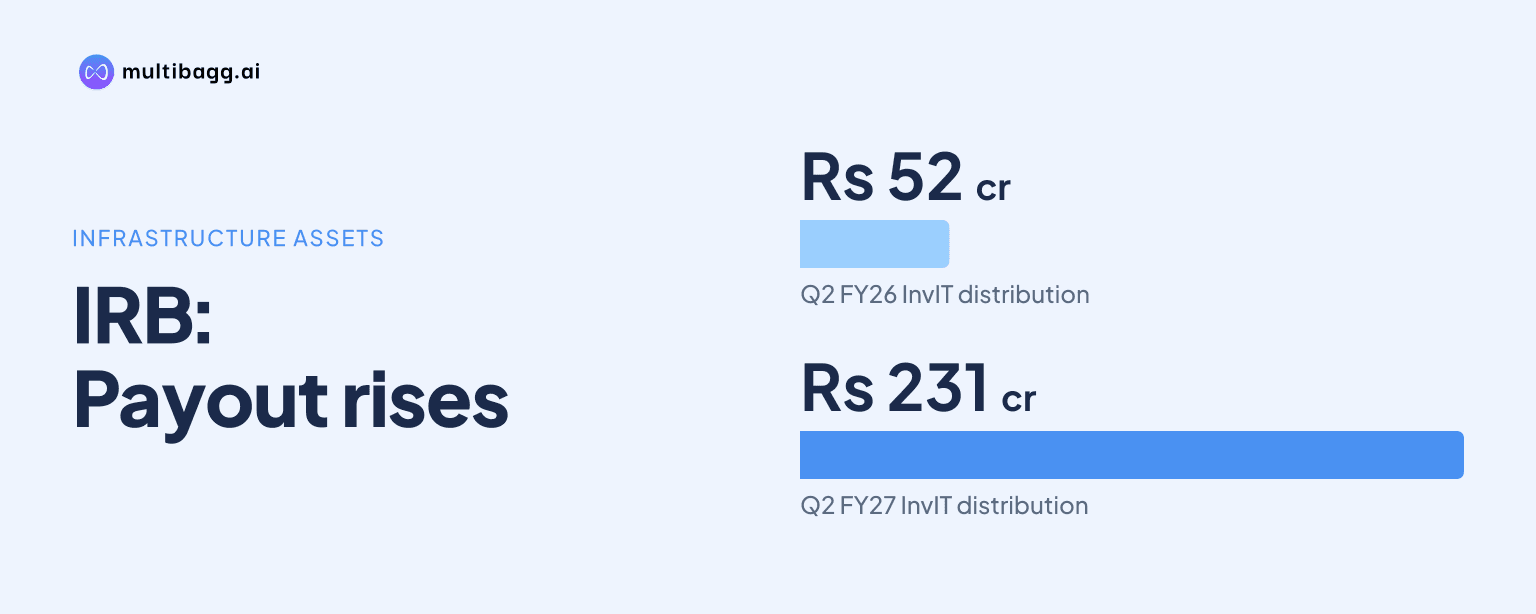
- Private-InvIT distribution rose to Rs 231 crore in Q2FY27 from Rs 52 crore in Q2FY26.
- IRB says InvIT asset transfers released Rs 7,600 crore of equity and left Rs 2,700 crore of available surplus.
- Group toll collections increased 25% year on year to Rs 4,821.5 crore in H1FY27.
powered by IRIS
IRB Infrastructure Developers Ltd will house all new highway assets in its private InvIT under a capital-recycling strategy that has released Rs 7,600 crore of equity through transfers to the public InvIT. The company plans to redeploy capital into new toll-operate-transfer projects while earning distributions, project-management fees, operations-and-maintenance income and recycling gains.
Know IRB Infrastructure Developers inside out
Results, valuation, peers and who's buying, in one view.
How is IRB changing its highway ownership model?
IRB is transitioning from a hybrid developer to a sponsor plus operations-and-maintenance, or O&M, platform, with all new assets designated for the private InvIT. The presentation identifies IRB as sponsor to the private and public InvITs, project manager, and exclusive O&M contractor for projects owned by both vehicles. Its stated earnings streams are InvIT distributions, project-management fees, long-term O&M annuity income and asset-recycling gains.
The private InvIT is intended to sit within a recurring development-and-transfer cycle rather than solely hold mature assets. IRB’s stated strategy is to bid for toll-operate-transfer, or TOT, projects at a targeted internal rate of return, or IRR, of 15% to 16%, execute them, stabilise them for three to four years, and transfer them at a targeted IRR of 12% to 12.5%. These are management’s bidding and transfer parameters, not reported project returns.
IRB has set FY26 to FY30 as the period for its financial transformation. Its stated objectives are to increase road assets under management, or AUM, from Rs 80,000 crore to about Rs 1,40,000 crore, reduce net debt from 0.6 times at FY26-end to zero, lift cash return on equity from 8% to more than 14%, and deliver a 25% compound annual growth rate, or CAGR, in profit after tax, or PAT.
What evidence shows IRB’s private InvIT is expanding?
IRB’s private InvIT reported distribution of Rs 231 crore in Q2FY27, compared with Rs 52 crore in Q2FY26, an increase of 344%. Its AUM rose 12% year on year to Rs 7,110 crore from Rs 6,360 crore, with the Q2FY27 figure including Rs 2,744 crore of cash from asset sales.
On a full-year comparison, private-InvIT distribution increased 44% to Rs 180 crore in FY26 from Rs 125 crore in FY25. AUM increased 13% to Rs 7,000 crore from Rs 6,170 crore, while net asset value per unit rose to Rs 320 from Rs 304. IRB says this growth was achieved through asset churn without fresh capital infusion by the company.
For FY27, IRB presents estimated private-InvIT distribution of Rs 454 crore, comprising Rs 219 crore in H1FY27 and an estimated Rs 235 crore in H2FY27. The presentation says the H2FY27 estimate is based on information available in the public domain, making it different from the reported H1 distribution.
How did IRB’s toll collections and InvIT receipts change?
IRB’s group toll collections increased 24% year on year to Rs 2,378.1 crore in Q2FY27 from Rs 1,920.8 crore in Q2FY26 on a like-for-like basis. The private InvIT delivered the largest absolute increase, with collections rising Rs 354.1 crore to Rs 1,202.6 crore; IRB’s wholly owned subsidiaries, or WOS, rose Rs 93.1 crore to Rs 728 crore, while the public InvIT increased Rs 10.1 crore to Rs 447.5 crore.
In H1FY27, group toll collections rose 25% on a like-for-like basis to Rs 4,821.5 crore from Rs 3,865.6 crore in H1FY26. Private-InvIT collections increased Rs 732.9 crore to Rs 2,417.4 crore, compared with increases of Rs 176.9 crore to Rs 1,466.4 crore for IRB WOS and Rs 46.1 crore to Rs 937.7 crore for the public InvIT.
IRB’s share of private-InvIT distribution was about Rs 118 crore in Q2FY27, up 354% from about Rs 26 crore in Q2FY26. Its public-InvIT distribution share rose 36% to about Rs 43.3 crore from about Rs 31.9 crore, bringing total distribution received from the two InvITs to about Rs 161 crore in Q2FY27.
Got a follow-up? Ask IRIS
How has IRB recycled equity through InvIT transfers?
IRB says transfers of assets from the private InvIT to the public InvIT totalled Rs 13,000 crore and released Rs 7,600 crore of equity. It says Rs 14,000 crore was redeployed in new TOT projects, while Rs 2,700 crore remained available as surplus. This disclosed sequence is the mechanism through which IRB intends to recycle capital without new sponsor equity.
The presentation cites the transfer of the Solapur Yedeshi and CG Tollway build-operate-transfer, or BOT, highway assets to the IRB InvIT Fund, its public InvIT. The assets had an enterprise value of Rs 4,600 crore, and IRB says the transaction unlocked Rs 2,700 crore of equity value for the private InvIT.
Management plans multiple recycling cycles over the next 24 to 36 months. Its opportunity assessment identifies a government monetisation pipeline of about Rs 4,40,000 crore and annual opportunities of Rs 40,000 crore to Rs 50,000 crore, with TOT projects described as the primary growth driver. Those figures set out IRB’s market context and do not specify future project wins or transfers.
What financial results accompany IRB’s transition?
IRB reported consolidated PAT of Rs 260.7 crore in Q2FY27, up 85% from Rs 140.8 crore in Q2FY26. PAT for H1FY27 rose 65% to Rs 566.9 crore from Rs 343.3 crore. Q2FY27 total income increased to Rs 1,944.5 crore from Rs 1,800.3 crore, while earnings before interest, tax, depreciation and amortisation, or EBITDA, increased to Rs 1,102 crore from Rs 973.9 crore.
The Q2FY27 segment comparison showed BOT and TOT revenue rising to Rs 720.5 crore from Rs 627.5 crore, and InvITs and related-assets revenue rising to Rs 355.9 crore from Rs 303.4 crore. Construction revenue was broadly unchanged at Rs 820.6 crore versus Rs 820.1 crore, but construction EBITDA declined to Rs 119.8 crore from Rs 145.6 crore and its EBITDA margin fell to 15% from 18%.
Consolidated finance costs declined to Rs 387.7 crore in Q2FY27 from Rs 451 crore a year earlier, while depreciation and amortisation rose to Rs 329 crore from Rs 262.1 crore. IRB also declared an interim dividend of about Rs 60 crore for Q2FY27, while the presentation records rating improvements to CARE AA for IRB and IND AAA for IRB MP Expressway.
Conclusion
IRB’s strategy makes the private InvIT the planned home for new highway assets and links development to later transfers, distributions and O&M work. The reported Rs 7,600 crore equity release, Rs 231 crore private-InvIT distribution in Q2FY27 and Rs 2,378.1 crore of group toll collections provide the disclosed operating evidence for that model.
The next indicators are management’s planned multiple recycling cycles over the next 24 to 36 months and progress toward its FY30 objectives of about Rs 1,40,000 crore in road AUM, zero net debt, cash return on equity above 14% and 25% PAT CAGR. IRB has not disclosed the identity, timing or transaction values of further prospective asset transfers.