










IRM Energy H1 FY27 EBITDA Doubles as Sales Volumes Hit Record
Key highlights
- IRM Energy reported H1 FY27 revenue of about Rs 660 crore, up 26% year-on-year.
- H1 FY27 EBITDA more than doubled by 108% to Rs 109 crore, while PAT rose 124% to Rs 59 crore.
- Q2 FY27 sales volume reached a record 61.23 MMSCM, supported by CNG and commercial PNG demand.
- Management indicated H2 FY27 EBITDA margin of around 15% and FY27 capex of Rs 250 crore to Rs 260 crore.
powered by IRIS
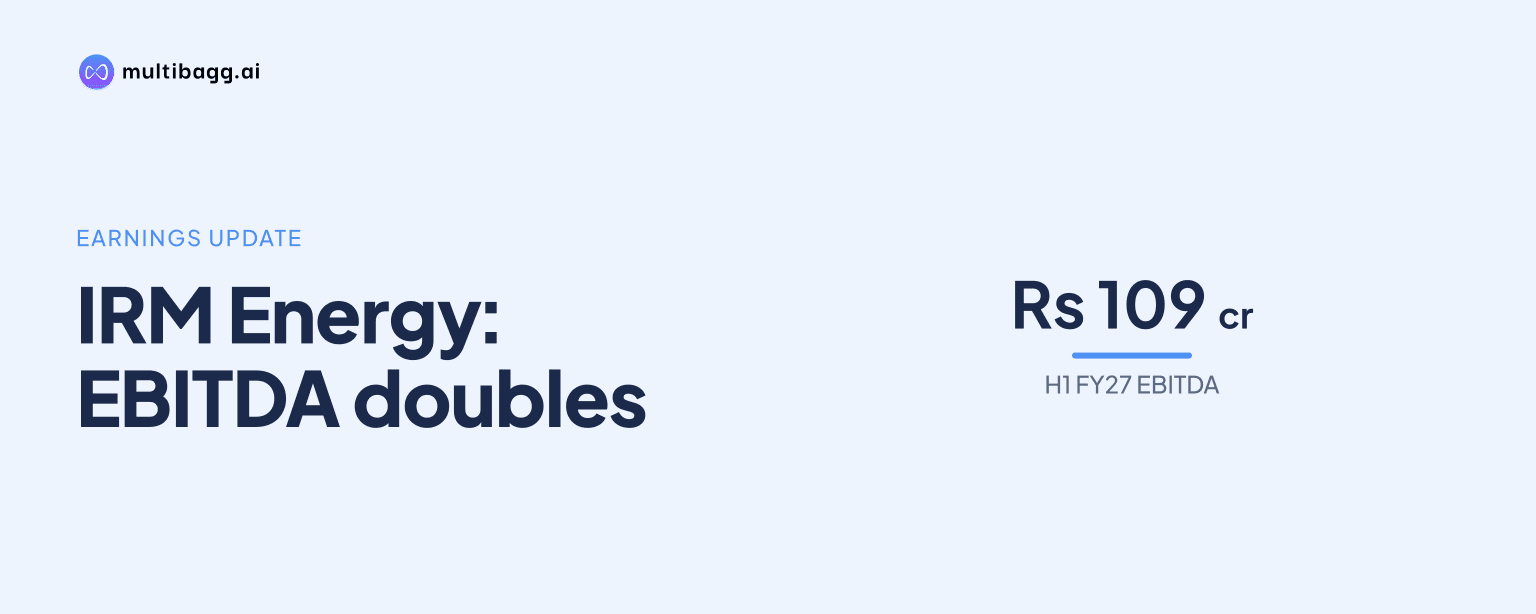
IRM Energy Limited reported H1 FY27 EBITDA growth of 108% to Rs 109 crore, alongside a record Q2 FY27 sales volume of 61.23 MMSCM. The performance reflected higher CNG and commercial PNG volumes, although management said revised gas-allocation rules caused some sourcing-related leakage at the start of Q3.
Know IRM Energy inside out
Results, valuation, peers and who's buying, in one view.
What did IRM Energy report for H1 FY27?
IRM Energy reported revenue of about Rs 660 crore for H1 FY27, up 26% year-on-year, while EBITDA more than doubled to Rs 109 crore. Profit after tax rose 124% year-on-year to Rs 59 crore, according to the earnings-call highlights released after the September-quarter results.
The company also recorded its highest quarterly sales volume of 61.23 million standard cubic metres, or MMSCM, in Q2 FY27. The earnings-call summary attributed the volume increase to CNG and commercial PNG demand. The source described quarterly volume growth as 10% year-on-year, while another result summary cited 12.02% growth for the same 61.23 MMSCM volume figure.
Published quarterly figures distinguished between standalone and consolidated reporting. Standalone revenue from operations was Rs 333.91 crore in Q2 FY27, up 28.7% year-on-year, while consolidated revenue was reported at Rs 363.61 crore, up 29.04% year-on-year. The consolidated result also showed operating profit of Rs 47.32 crore and PAT of Rs 25.43 crore.
Which businesses drove the record Q2 sales volume?
IRM Energy said CNG and commercial PNG were the principal drivers of the record Q2 volume. Commercial PNG volume grew 61%, while CNG volume increased 23%, based on the results summary cited with the earnings update. These customer segments supported the rise in gas sales during the July-to-September quarter.
CNG is used by vehicle customers, while commercial PNG serves businesses using piped natural gas. Growth in these segments matters because sales-volume movement can influence the utilisation of a city gas distributor's network and its fixed infrastructure. The reported operational performance accompanied a rise in both quarterly revenue and operating profit.
The company did not provide a separate financial contribution from each segment in the supplied material. However, management's comments linked the record aggregate volume directly to mobility and commercial demand, making those two categories central to the quarter's operational outcome.
How did the revised HPHC allocation affect IRM Energy?
The revised HPHC allocation methodology affected IRM Energy's gas sourcing at the beginning of Q3 FY27, management said. Chief Financial Officer Ashish Maheshwari stated that the Ministry of Petroleum and Natural Gas notification dated September 3 changed the allocation framework and had a greater effect on smaller companies such as IRM Energy.
The government subsequently provided relaxation for phased implementation on October 19. Even so, the CFO said some margin leakage occurred during the first month of Q3. Management nevertheless indicated that it expected EBITDA margin of around 15% for H2 FY27.
The Q2 sourcing mix illustrates the company's exposure to several gas sources. APM gas accounted for about 21%, New Well Gas for about 13%, HPHT gas for about 33%, LNG/RLNG for about 30%, and spot purchases for roughly 1% to 2%. Changes in allocation or the cost of any component can affect realised margins.
Got a follow-up? Ask IRIS
What is management's outlook for margins and capital spending?
IRM Energy expects H2 FY27 EBITDA margin to be around 15%, despite the early-Q3 impact from the revised allocation arrangement. Chief Executive Officer N.K. Sharma said Q3 could see sequential moderation, but added that Q4 should catch up and that the combined H1 and H2 outcome should remain reasonably good.
This is management guidance rather than a reported result. Its delivery will depend on volume growth, the actual effect of phased allocation implementation, and the cost and availability of the company's gas supply mix. The company did not provide a specific Q3 revenue, EBITDA, or PAT forecast in the supplied material.
Management also said IRM Energy plans to spend Rs 250 crore to Rs 260 crore in FY27 and may exceed that range. This planned capital expenditure points to continued network and infrastructure investment, though the material did not give a project-wise deployment schedule.
Why do the Q2 results matter for investors and the city-gas sector?
IRM Energy's results matter because they combine double-digit sales growth with a substantial increase in profitability. H1 EBITDA growth of 108% exceeded the 26% revenue increase, while Q2 standalone EBITDA was Rs 47.32 crore, up 77.23% year-on-year. The standalone Q2 EBITDA margin was reported at 14.17%, compared with 10.29% a year earlier.
At the same time, the Q3 sourcing issue shows the relevance of gas-allocation policy to city-gas operators. IRM Energy's mix includes regulated and market-linked supply sources, including LNG/RLNG. Management's 15% H2 margin indication therefore remains an important operational benchmark rather than a guaranteed outcome.
Royalty is another continuing cost item. The CFO said royalty, included in other expenses, represents 2% of revenue and will continue. Investors assessing profitability will need to consider both volume expansion and such recurring expenses alongside changes in gas sourcing.
Conclusion
IRM Energy entered H2 FY27 after reporting stronger H1 financial results, record Q2 sales volume, and growth led by CNG and commercial PNG. Revenue increased to about Rs 660 crore in H1, EBITDA rose to Rs 109 crore, and PAT reached Rs 59 crore, demonstrating a marked improvement in earnings over the prior year.
The next key disclosures will be the extent of Q3 margin moderation following the HPHC allocation revision and whether H2 EBITDA margin is maintained around management's 15% indication. Investors will also watch the pace of FY27 capital spending, for which the company has indicated Rs 250 crore to Rs 260 crore, with potential to exceed that amount.