










Iware Supplychain Services H1 Profit Rises 46.9% to ₹9.4 Crore
Key highlights
- Iware Supplychain Services reported H1 FY27 revenue from operations of ₹194.0 crore, up 107.7% year-on-year.
- H1 FY27 net profit rose 46.9% year-on-year to ₹9.4 crore from ₹6.4 crore.
- Operating margin declined to 6.0% in H1 FY27 from 9.2% in H1 FY26.
- The company disclosed ₹76.2 crore of capital work-in-progress and borrowings of ₹85.5 crore.
powered by IRIS
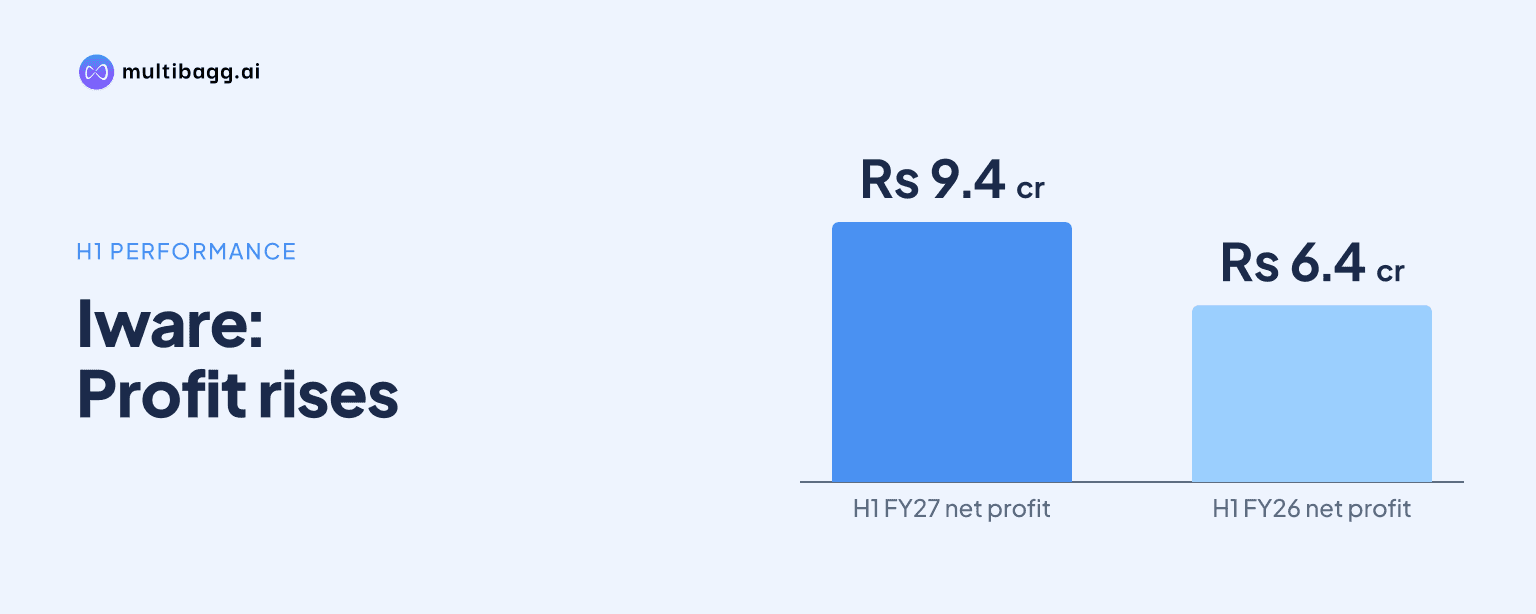
Iware Supplychain Services Limited reported H1 FY27 net profit of ₹9.4 crore, up 46.9% year-on-year, while revenue from operations rose 107.7% to ₹194.0 crore for the half-year ended September 2026. The standalone result shows a sharp increase in business volume, although the reported operating margin was lower than a year earlier.
Know Iware Supplychain Services inside out
Results, valuation, peers and who's buying, in one view.
What did Iware Supplychain Services report for H1 FY27?
Iware Supplychain Services reported total income of ₹194.4 crore in H1 FY27, compared with ₹93.5 crore in H1 FY26. Revenue from operations accounted for ₹194.0 crore of the latest half-year income, while other income was ₹0.4 crore.
Net profit rose to ₹9.4 crore from ₹6.4 crore in the corresponding period of the previous financial year. The company reported profit before tax of ₹11.6 crore, compared with ₹8.6 crore a year earlier. Earnings per share were reported at ₹8.16 for the period, compared with ₹6.00 in H1 FY26.
The results were filed with the National Stock Exchange on November 14, 2026, following the board meeting held to consider the unaudited financial results for the period ended September 30, 2026. The disclosed figures are standalone results.
Why did revenue grow faster than net profit?
Revenue from operations more than doubled year-on-year, whereas net profit increased by 46.9%. The difference is reflected in the operating-margin data reported with the results. Operating margin was 6.0% in H1 FY27, down from 9.2% in H1 FY26.
A lower operating margin means that profit generated from the company’s core operations did not rise at the same pace as revenue. The filing does not provide a detailed cost-wise explanation for the margin movement in the information available. Therefore, the disclosed data supports an assessment of stronger scale but does not establish the exact reason for the change in profitability at the operating level.
Profit before exceptional items and tax stood at ₹11.6 crore, the same as the reported profit before tax, indicating that no exceptional item is shown in the summarised result statement. The company’s reported operating-profit growth was 31.8% year-on-year.
What corporate action did the board approve?
Iware Supplychain Services’ board approved the incorporation of a new wholly owned subsidiary in India. The proposed subsidiary is intended for logistics-related operations and has an initial capital of ₹1 lakh, according to the disclosed announcement.
The company also reported that it had utilised ₹27.13 crore of IPO proceeds and ₹20.17 crore raised through preferential funds, with no deviation reported in the stated use of those funds. These disclosures accompany a period in which the company is undertaking capacity expansion.
The available information also points to a rise in capital work-in-progress to ₹76.2 crore and borrowings to ₹85.5 crore. Capital work-in-progress generally represents spending on assets that are under construction or not yet ready for use. The reported figures indicate that business expansion is being supported by a combination of previously raised funds and higher borrowings.
Got a follow-up? Ask IRIS
How does H1 FY27 compare with Iware's recent financial record?
Iware reported revenue of ₹258 crore and net profit of ₹15 crore for the full financial year ended March 2026, based on the financial history included with the results information. H1 FY27 revenue from operations of ₹194.0 crore therefore represents a substantial part of the prior full-year revenue base within the first six months of the new financial year.
For the corresponding half-year ended September 2025, revenue from operations were ₹93.4 crore and net profit was ₹6.4 crore. The H1 FY27 comparison therefore shows a ₹100.6 crore increase in revenue from operations and a ₹3.0 crore increase in net profit.
The company’s reported revenue history shows growth from ₹86 crore in FY25 to ₹258 crore in FY26. The latest half-year performance extends this higher revenue base into FY27, while the margin comparison shows that investors will need to assess revenue growth alongside cost and profitability trends.
What does the result mean for investors and operations?
The H1 result provides a clear indication of higher operating scale for Iware. Revenue from operations of ₹194.0 crore and net profit of ₹9.4 crore were both above the comparable H1 FY26 levels, while earnings per share increased to ₹8.16 from ₹6.00.
At the same time, the operating margin declined by 3.2 percentage points year-on-year. For investors, this makes the relationship between revenue expansion, operating costs, capital spending and borrowings relevant to evaluating future financial performance. The reported data does not include a share-price movement or management guidance, so no market-price conclusion can be drawn from the filing alone.
The planned wholly owned subsidiary and the disclosed capital work-in-progress show that logistics capacity remains a key operational focus. Higher borrowings of ₹85.5 crore are also material because debt levels can affect finance costs and cash flows as expansion projects progress.
Conclusion
Iware Supplychain Services delivered strong H1 FY27 growth in revenue and net profit, with revenue from operations rising 107.7% to ₹194.0 crore and net profit increasing 46.9% to ₹9.4 crore. However, operating margin declined to 6.0% from 9.2%, showing that profitability expanded more slowly than revenue.
The next disclosures to watch are the progress of the proposed wholly owned logistics subsidiary, the completion or commissioning of capital work-in-progress, and the company’s borrowings as its capacity build-out advances. Subsequent financial filings will also indicate whether operating margins improve, stabilise or remain under pressure.