










JAI targets Rs 5,000 crore revenue and 40% new-market mix
Key highlights
- JAI targets Rs 5,000 crore of revenue and a 40% India aftermarket-plus-export mix by FY 2029-30.
- JAI reported consolidated net sales of Rs 786 crore in Q2 FY 26-27, up 48% year on year.
- JAI’s disclosed market mix is 77% existing markets and 23% new markets.
- JAI’s aftermarket network includes more than 350 distributors, 20,000-plus retailers and 25,000-plus mechanics.
powered by IRIS
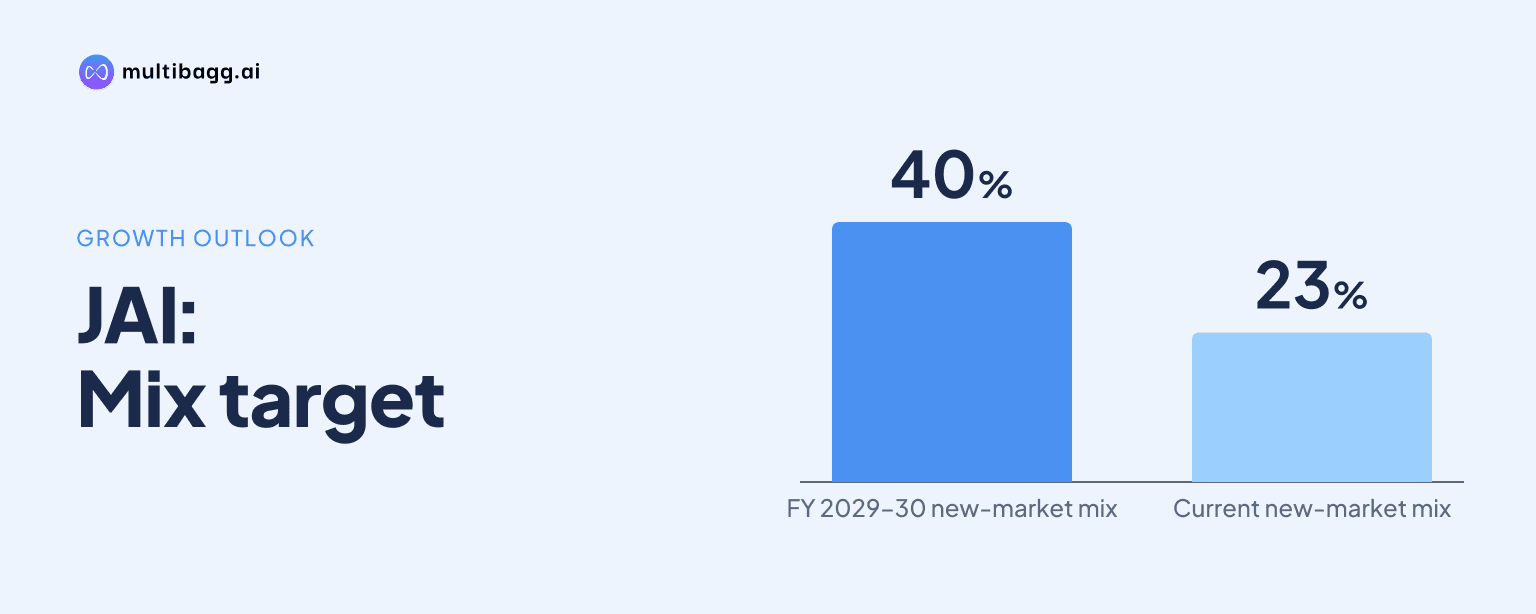
Jamna Auto Industries Limited, or JAI, targets Rs 5,000 crore of revenue by FY 2029-30 and wants India aftermarket plus exports to account for 40% of sales, versus its disclosed 23% new-market revenue mix. Management’s Lakshya RISE 5000 framework also sets targets of 40% return on capital employed and 50% dividend payout.
Know Jamna Auto Industries inside out
Results, valuation, peers and who's buying, in one view.
What is JAI targeting by FY 2029-30?
JAI is targeting Rs 5,000 crore of revenue by FY 2029-30 under its Lakshya RISE 5000 strategy. Management defines new markets as India aftermarket plus exports and seeks a 40% revenue share from those markets, alongside 40% return on capital employed, or ROCE, and a 50% dividend payout. These are management targets rather than reported results.
The target represents a change in mix from JAI’s currently disclosed market profile. Its revenue-mix page records existing markets at 77% and new markets at 23%, while its overview page puts original equipment manufacturer, or OEM, revenue at about 77% and non-OEM revenue at about 23%. The presentation does not provide separate current revenue figures for India aftermarket and exports within the 23% new-market measure.
How will JAI change its revenue mix?
JAI plans to raise the new-market share of revenue by 17 percentage points, from 23% to 40%, through India aftermarket and exports. Management says the strategy is intended to support steadier performance across macroeconomic conditions, but the presentation gives no annual revenue or mix milestones between Q2 FY 26-27 and FY 2029-30.
Product diversification is one mechanism identified in the presentation. JAI reports a product mix of 52% existing products and 48% new products, and its portfolio includes leaf springs, parabolic springs, stabilizer bars, lift axles, drop axles, slipper suspension, trailer suspension and allied products. This product range extends beyond conventional spring assemblies, although the presentation does not disclose revenue by product category.
JAI’s FY26-plus plan includes U-bolt manufacturing, capacity expansion at Indore and Jharkhand, and new facilities for an integrated suspension-system plant with in-house axle and rubber manufacturing. In Q2 FY 26-27, JAI also received a stabilizer-bar business award from Daimler India Commercial Vehicles. The presentation does not assign revenue, capital expenditure or production dates to each of these initiatives.
What supports JAI’s aftermarket and export plan?
JAI’s stated aftermarket network includes more than 350 distributors, 20,000-plus retailers and 25,000-plus mechanics. Its company overview separately cites more than 20,000 aftermarket touch points and exports to 17 countries. These are different network measures, while the presentation does not disclose export revenue by country or customer.
JAI operates 10 manufacturing locations, and its aftermarket logistics plan identifies North, West, East and South regions plus a Central Hub. Its digital tools include a deployed mechanic app, a live dealer management system, or DMS, and an active JAI Connect platform. These systems and the physical network are the disclosed operating infrastructure for serving aftermarket territories.
JAI also reports more than 5,000 part numbers and more than 140 copyrighted designs across springs and suspension products. Its in-house research and development centre has design, simulation and validation capabilities for multi-leaf and parabolic springs, lift axles and air suspension. The JAI trademark is registered in 16 countries, but the presentation does not link those registrations to country-level sales.
Got a follow-up? Ask IRIS
What capacity projects could support JAI’s expansion?
JAI has shifted a planned conventional leaf-spring line with capacity of 1,500 metric tonnes per month from Adityapur to its existing Malanpur facility. The company says the capacity and scope are unchanged, making this a relocation rather than an additional 1,500-metric-tonne-per-month line. JAI describes the project as a brownfield expansion using existing land and utilities.
Malanpur is intended to serve OEM and aftermarket demand across North, Central and West India. That regional role connects the line relocation to JAI’s stated plan to deepen its new-market presence, although the presentation does not provide a commissioning date, project cost or expected sales contribution for the Malanpur line.
At Indore, first-phase assembly operations for trailer, suspension and axle projects were ready in Q2 FY 26-27. Production awaited administrative approval, which JAI expected during November 2026. This approval remains a disclosed execution point because the presentation does not confirm the start of commercial production.
What do JAI’s latest results show about its starting point?
JAI reported consolidated net sales of Rs 786 crore in Q2 FY 26-27, up 28% from Rs 612 crore in Q1 FY 26-27 and 48% from Rs 531 crore in Q2 FY 25-26. Earnings before interest, tax, depreciation and amortisation, or EBITDA, rose to Rs 108 crore from Rs 88 crore sequentially and Rs 72 crore a year earlier. Profit after tax rose to Rs 56 crore from Rs 49 crore in Q1 and Rs 40 crore in the prior-year quarter.
For H1 FY 26-27, JAI recorded net sales of Rs 1,397 crore, 27% above Rs 1,104 crore in H1 FY 25-26. EBITDA increased 31% to Rs 196 crore, profit before tax increased 24% to Rs 149 crore, and profit after tax increased 23% to Rs 105 crore. The presentation does not split these financial results between OEM, India aftermarket, export or product categories.
The presentation links the quarter to commercial-vehicle demand. According to Society of Indian Automobile Manufacturers, or SIAM, domestic commercial-vehicle sales grew 34% year on year in Q2 FY 26-27, while medium and heavy commercial vehicles grew 37%. JAI says spring content is most prominent in medium and heavy commercial vehicles, but its FY 2029-30 plan depends on increasing India aftermarket and export mix rather than only OEM vehicle demand.
Conclusion
JAI’s Lakshya RISE 5000 strategy combines a Rs 5,000 crore revenue goal for FY 2029-30 with a shift toward India aftermarket and exports, which management wants to reach 40% of sales from a reported 23% new-market mix. The plan is supported by a 10-location manufacturing base, more than 350 distributors, a broader suspension portfolio and 48% new-product mix, while OEM revenue remains about 77% of the current mix.
The next disclosed items to watch are JAI’s expected November 2026 administrative approval for Indore production and the Malanpur relocation of the unchanged 1,500-metric-tonne-per-month leaf-spring line. JAI completed the Owen Springs Limited acquisition on 1 September 2026, with consolidation from that date, but it has not disclosed the acquired business’s revenue or contribution to Q2 FY 26-27 results.