










Jamna Auto Industries Limited moves 1,500-tonne line to Malanpur
Key highlights
- JAI relocated its planned 1,500-MT-per-month conventional leaf-spring line from Adityapur to Malanpur without changing capacity.
- JAI reported Q2 FY 2026-27 consolidated net sales of Rs 786 crore, up 48% year on year.
- Medium and heavy commercial-vehicle production increased 37% year on year to 127 thousand units in Q2 FY 2026-27.
- JAI’s Lakshya RISE 5000 plan targets Rs 5,000 crore of revenue by FY 2029-30.
powered by IRIS
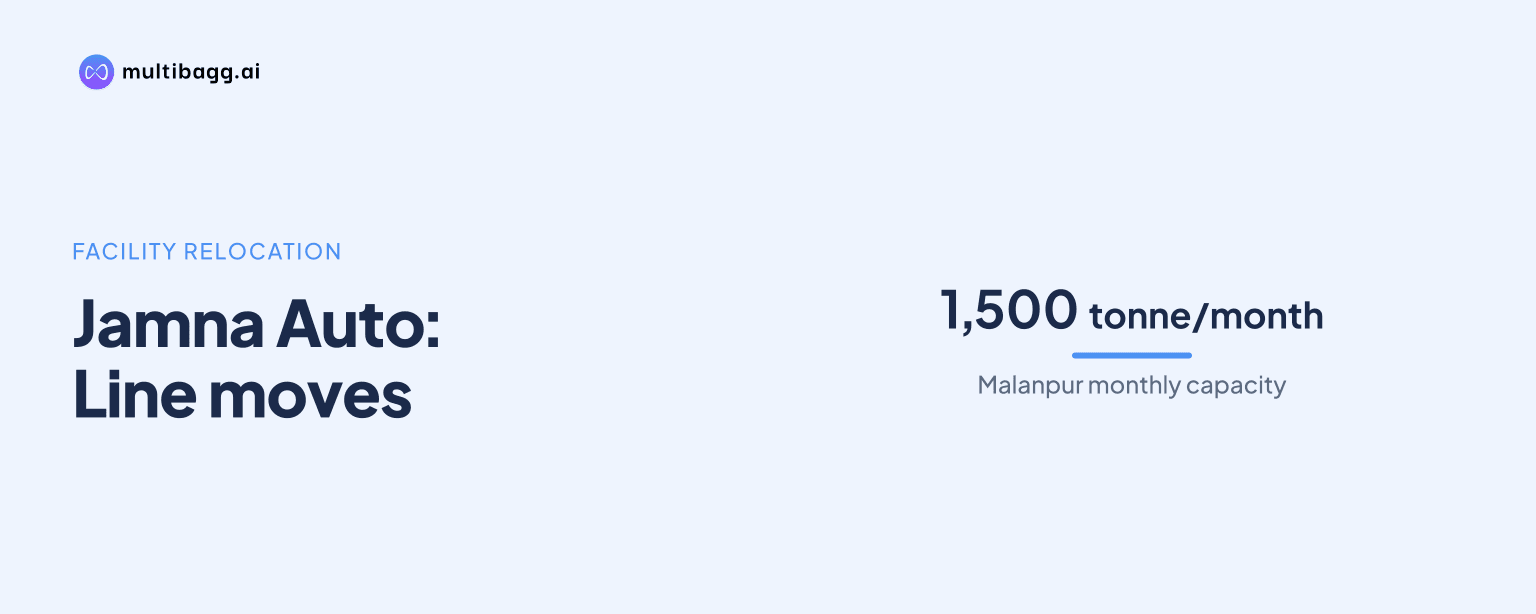
In the second quarter of financial year (FY) 2026-27, Jamna Auto Industries Limited revised the site for its planned 1,500-metric-tonne-a-month conventional leaf-spring line from Adityapur to Malanpur without changing its capacity or scope. JAI says the Malanpur brownfield expansion will use existing land and utilities while serving original equipment manufacturer (OEM) and aftermarket demand across North, Central and West India.
Know Jamna Auto Industries inside out
Results, valuation, peers and who's buying, in one view.
What changed in JAI’s leaf-spring expansion plan?
JAI changed the site of its proposed 1,500 metric tonnes (MT) per month conventional leaf-spring line, not the size or scope of the project. The line had been announced in the preceding quarter for the Adityapur plant of Jai Suspensions Limited, JAI’s subsidiary, and will now be installed at JAI’s existing Malanpur facility. The presentation describes the decision as a relocation rather than an additional production line.
The unchanged 1,500-MT monthly rating means the disclosed plan does not add a second line or increase the previously planned capacity. Conventional leaf springs remain part of JAI’s product portfolio alongside parabolic springs, stabilizer bars, lift axles, drop axles, slipper suspension, trailer suspension and allied products. The relocation therefore changes where the planned output will be made rather than what the project is intended to manufacture.
Why did JAI choose Malanpur for the new line?
JAI chose Malanpur because management says the existing site provides brownfield economics through available land and utilities. Building the 1,500-MT-per-month line within an operating facility is intended to optimise capital expenditure and operating efficiency, according to the presentation. JAI did not disclose project capital expenditure, commissioning timing, utilisation assumptions or incremental revenue for the line.
Malanpur also gives JAI a central location for supplying OEMs and the aftermarket in North, Central and West India, management says. Its geographic-expansion slide identifies 10 manufacturing locations and lists Malanpur alongside Ashok Leyland and Alwar. Adityapur remains in that footprint, where the slide lists Tata Motors, while facilities at Pantnagar, Indore, Pune, Hosur, Chennai and Pallipakkam are positioned near other OEM hubs.
The location change may affect customer reach because JAI explicitly identifies Malanpur as able to supply North, Central and West India, with flexibility for other regional markets. That sits alongside its aftermarket logistics layout, which identifies North, West, Central Hub, East and South. The presentation gives no comparison of freight costs, delivery distances, customer allocations or state-level incentives between Malanpur and Adityapur.
How does the Malanpur project fit JAI’s growth plan?
JAI says the Malanpur line is proactive, demand-led capacity under Lakshya RISE 5000, its five-year growth framework. Management’s FY 2029-30 targets are revenue of Rs 5,000 crore, new markets accounting for 40% of revenue, return on capital employed of 40%, and a dividend payout of 50%. These are management targets rather than forecasts of the Malanpur line’s individual contribution.
The company defines new markets in the framework as India aftermarket and exports. In its current revenue-mix slide, JAI reports 77% from existing markets and 23% from new markets, while its product mix is 52% existing products and 48% new products. The Malanpur project is described as serving both OEM requirements and aftermarket territories, but JAI does not specify how much of its 1,500-MT monthly output would be assigned to either channel.
JAI’s scale also provides context for a regional brownfield expansion, with more than 5,000 part numbers, more than 20,000 aftermarket touch points and exports to 17 countries. Its company-overview slide reports revenue of about 77% from OEMs and about 23% from non-OEM channels. The presentation does not reconcile this OEM and non-OEM mix directly with its separate existing-market and new-market classification.
Got a follow-up? Ask IRIS
What demand backdrop supports JAI’s capacity decision?
The commercial-vehicle market expanded in Q2 FY 2026-27, with domestic commercial-vehicle sales rising 34% year on year, according to Society of Indian Automobile Manufacturers data cited by JAI. Medium and heavy commercial vehicles, the segment where management says spring content is most prominent, grew 37% year on year. JAI attributes industry growth to festive demand, improved affordability following goods and services tax reforms, and sustained infrastructure investment.
Total production increased 19% quarter on quarter and 33% year on year in Q2 FY 2026-27, while medium and heavy commercial vehicle production rose 19% quarter on quarter and 37% year on year. JAI says its revenue performance aligned with industry trends, particularly in medium and heavy commercial vehicles. The company also completed commercial settlements with customers for steel and energy-cost increases reported in the first quarter.
How does the relocation sit alongside JAI’s other expansion activity?
JAI is pursuing the Malanpur relocation alongside several disclosed manufacturing and portfolio initiatives. At Indore, the first assembly phase for trailer, suspension and axle projects was ready in Q2 FY 2026-27, although production awaited administrative approval that the company expected during November 2026. Its future-ready milestones also list capacity expansion in Indore and Jharkhand, plus facilities for integrated suspension systems with in-house axle and rubber manufacturing.
JAI’s Q2 FY 2026-27 consolidated net sales were Rs 786 crore, up 28% from Rs 612 crore in Q1 FY 2026-27 and 48% from Rs 531 crore in Q2 FY 2025-26. Earnings before interest, tax, depreciation and amortisation (EBITDA) rose to Rs 108 crore from Rs 88 crore sequentially, while profit after tax reached Rs 56 crore from Rs 49 crore. For H1 FY 2026-27, net sales were Rs 1,397 crore, compared with Rs 1,104 crore a year earlier.
JAI also completed its acquisition of Owen Springs Limited on 1 September 2026, following board approval on 24 July 2026, and consolidated the business from that date. Separately, the company won stabilizer-bar business from Daimler India Commercial Vehicles. Neither disclosure specifies a production link between Owen Springs, the Daimler award and the Malanpur leaf-spring line.
Conclusion
JAI’s decision preserves the planned 1,500-MT monthly conventional leaf-spring capacity while moving it from subsidiary-operated Adityapur to an existing Malanpur site. The stated rationale combines brownfield use of land and utilities with access to OEM and aftermarket territories in three regions, against Q2 FY 2026-27 medium and heavy commercial-vehicle growth of 37% year on year.
The next disclosed items to watch are progress toward production at Indore after the expected November 2026 administrative approval, and execution of Lakshya RISE 5000 through FY 2029-30. JAI has not disclosed a Malanpur commissioning date, capital expenditure, customer allocation or volume ramp for the 1,500-MT monthly line, leaving these as unresolved implementation details.