










Jamna Auto Industries Limited Q2 revenue rises 48% to Rs 786 crore
Key highlights
- JAI reported Q2 FY 2026-27 consolidated net sales of Rs 786 crore, up 48% year on year.
- Q2 FY 2026-27 EBITDA rose 51% year on year to Rs 108 crore, with a 13.8% margin.
- M&HCV volume rose 37% year on year to 127,000 units in Q2 FY 2026-27.
- Owen Springs Limited was consolidated into JAI's results from September 1, 2026.
powered by IRIS
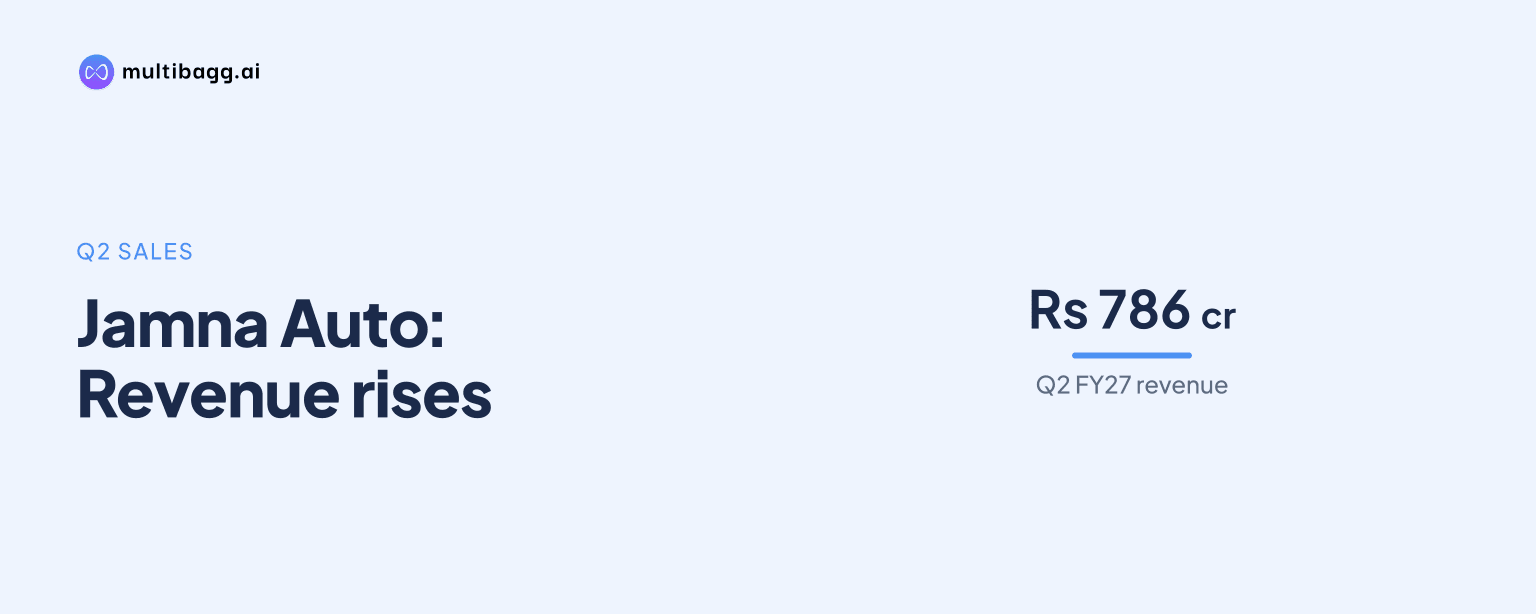
Jamna Auto Industries Limited reported consolidated revenue of Rs 786 crore in Q2 FY 2026-27, up 48% year on year, while earnings before interest, tax, depreciation and amortisation (EBITDA) rose 51% to Rs 108 crore. JAI attributed the performance to commercial-vehicle demand, completed customer cost settlements and consolidation of Owen Springs Limited from September 1, 2026.
Know Jamna Auto Industries inside out
Results, valuation, peers and who's buying, in one view.
Why did JAI's Q2 revenue rise 48%?
JAI's consolidated net sales rose 48% year on year to Rs 786 crore in Q2 FY 2026-27 from Rs 531 crore in Q2 FY 2025-26. Revenue was also 28% above Rs 612 crore in Q1 FY 2026-27, indicating growth versus both the prior quarter and the comparable quarter. Management said JAI's revenue performance was aligned with commercial-vehicle trends, particularly in the medium and heavy commercial vehicle (M&HCV) segment.
The industry backdrop included a 34% year-on-year rise in domestic commercial-vehicle sales in Q2 FY 2026-27, according to Society of Indian Automobile Manufacturers (SIAM) data cited by JAI. M&HCV volume rose 37% to 127,000 units from 93,000 units in Q2 FY 2025-26, while light commercial vehicle (LCV) volume increased 34% to 227,000 units from 171,000 units. Total commercial-vehicle volume reached 354,000 units, compared with 264,000 units a year earlier.
JAI said commercial settlements with customers for steel and energy cost increases reported in Q1 FY 2026-27 had been completed. Owen Springs Limited was acquired on September 1, 2026, after board approval on July 24, 2026, and was consolidated from the acquisition date. The presentation does not disclose Owen Springs Limited's separate revenue or profit contribution, nor the financial effect of the customer settlements.
How did JAI's Q2 profit compare with earlier periods?
JAI's EBITDA increased 51% year on year to Rs 108 crore in Q2 FY 2026-27 from Rs 72 crore, with an EBITDA margin of 13.8%. Profit before tax (PBT) rose 49% to Rs 84 crore from Rs 56 crore, and profit after tax (PAT) increased 42% to Rs 56 crore from Rs 40 crore.
Sequentially, EBITDA was 23% above Rs 88 crore in Q1 FY 2026-27, while PBT rose 27% from Rs 66 crore and PAT rose 17% from Rs 49 crore. Net sales increased 28% quarter on quarter, compared with the 17% increase in PAT. JAI did not provide a detailed bridge for changes in costs, tax or other items between the two quarters.
For H1 FY 2026-27, JAI reported net sales of Rs 1,397 crore, up 27% from Rs 1,104 crore in H1 FY 2025-26. EBITDA grew 31% to Rs 196 crore, PBT rose 24% to Rs 149 crore and PAT increased 23% to Rs 105 crore. Q2 FY 2026-27 therefore accounted for Rs 786 crore of the half-year's net sales and Rs 56 crore of its PAT.
Got a follow-up? Ask IRIS
What did commercial-vehicle demand look like in Q2?
Commercial-vehicle volume increased 19% sequentially in Q2 FY 2026-27, with M&HCV volume rising to 127,000 units from 106,000 units in Q1 FY 2026-27. LCV volume increased to 227,000 units from 191,000 units, taking total volume to 354,000 units from 297,000 units. JAI identified M&HCV as the segment where spring content is most prominent.
M&HCV volume growth of 37% year on year exceeded the 33% rise in total commercial-vehicle volume shown in JAI's SIAM table for Q2 FY 2026-27. Management described the period as the Indian commercial-vehicle industry's strongest-ever second quarter and cited festive demand, improved affordability following Goods and Services Tax reforms, and sustained infrastructure investment as supporting factors.
JAI's product portfolio includes leaf springs, parabolic springs, stabilizer bars, lift axles, drop axles, slipper suspension, trailer suspension and allied products. Its revenue mix is approximately 77% original equipment manufacturer (OEM) business and approximately 23% non-OEM business. The company has 10 manufacturing locations and lists Tata Motors, Ashok Leyland, BharatBenz and VE Commercial Vehicles among its customers.
What expansion and business actions has JAI disclosed?
JAI said the first phase of its Indore project, covering assembly operations for trailer, suspension and axle projects, was ready for production as of the November 14, 2026 presentation. Production awaited administrative approval, which management expected during November 2026. JAI also said Daimler India Commercial Vehicles had awarded it stabilizer-bar business, extending an established customer relationship.
A planned conventional leaf-spring line with capacity of 1,500 metric tonnes per month is being relocated from the Adityapur plant of subsidiary Jai Suspensions Limited to JAI's existing Malanpur facility. The capacity and scope remain unchanged, so the shift is a site revision rather than an additional line. Management said Malanpur's existing land and utilities would support brownfield economics while serving OEM and aftermarket markets across North, Central and West India.
The board approved an interim dividend of Rs 1 per equity share. Management also said JAI may consider share buy-backs and/or dividends as part of shareholder payout in future, without specifying an amount, timing or commitment. Under Lakshya RISE 5000, management targets Rs 5,000 crore of revenue by FY 2029-30, with Indian aftermarket and exports together targeted to represent 40% of revenue.
Conclusion
JAI's Q2 FY 2026-27 outcome combined Rs 786 crore of net sales, up 48% year on year, with Rs 108 crore of EBITDA, up 51%. The reported results coincided with a 37% increase in M&HCV industry volume, completion of customer settlements for steel and energy costs, and the September 1, 2026 consolidation of Owen Springs Limited, although the presentation does not quantify the separate contribution from each factor.
The next disclosed milestone is administrative approval for Indore assembly operations, which management expected during November 2026. Investors can also monitor the relocation of the 1,500-metric-tonnes-per-month leaf-spring line to Malanpur and progress against Lakshya RISE 5000's FY 2029-30 targets of Rs 5,000 crore revenue, 40% new-market revenue, 40% return on capital employed and 50% dividend payout.