










Jain Irrigation gives up Rs 250 crore to protect cash flow
Key highlights
- Jain Irrigation gave up an estimated Rs 200 crore to Rs 250 crore of first-half business to protect liquidity.
- About Rs 100 crore of forgone orders were micro-irrigation business in slow-paying states, while solar-pump business accounted for about Rs 150 crore.
- Management targets a Rs 300 crore net reduction in project receivables and expects Rs 100 crore of Maharashtra incentive receipts by March.
- Jain Irrigation expects Rs 100 crore to Rs 150 crore from land monetisation in the second half.
powered by IRIS
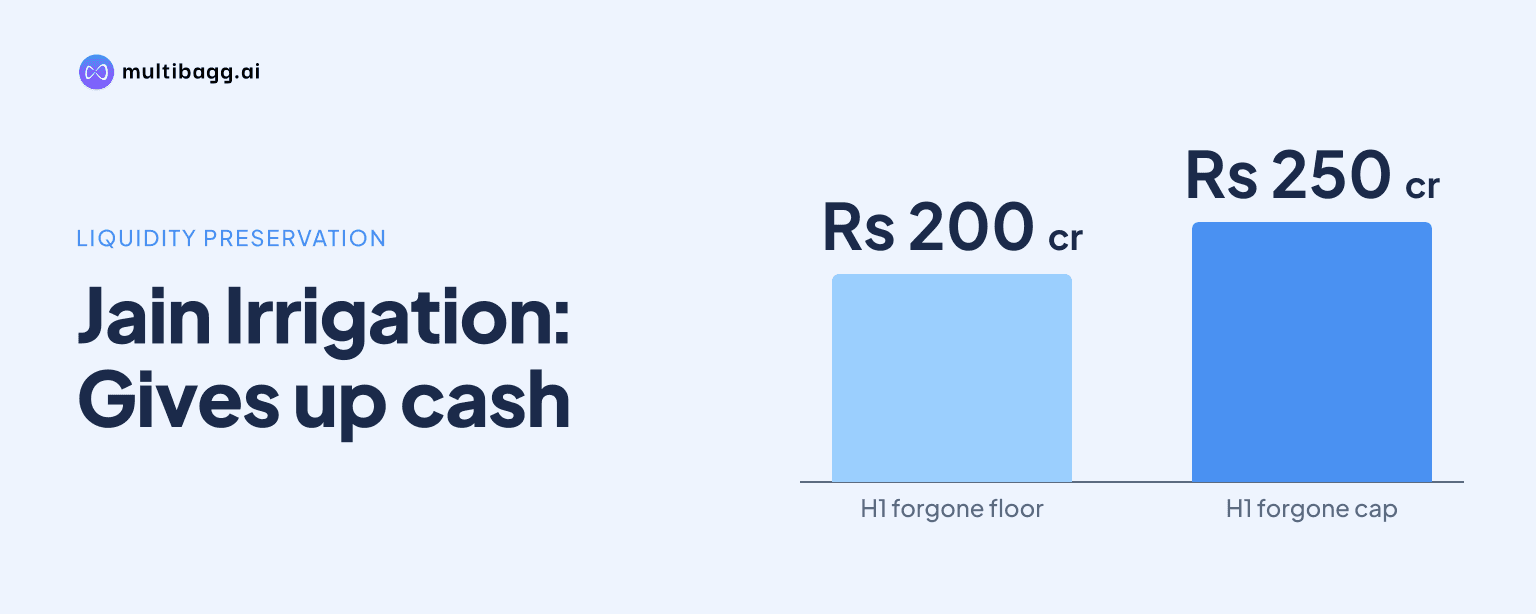
In the first half, Jain Irrigation gave up an estimated Rs 200 crore to Rs 250 crore of business to preserve cash for repayments and working-capital discipline. Management said the forgone orders included about Rs 100 crore of micro-irrigation business and about Rs 150 crore of solar water-pump business with slower collection cycles.
Know Jain Irrigation Systems Ltd-DVR inside out
Results, valuation, peers and who's buying, in one view.
Why did Jain Irrigation give up first-half business?
Jain Irrigation gave up the orders because management judged that collection speed mattered more than booking sales with long payment cycles. Anil Jain said roughly Rs 100 crore of micro-irrigation business was declined in Andhra, Telangana and Tamil Nadu, where payments were slow, while the company also let go of about Rs 150 crore in solar water-pump business because cash was not arriving quickly enough.
The decision was linked to repayment needs and working-capital control. Management said Jain Irrigation needed cash in hand to repay obligations and non-convertible debentures, or NCDs, while bringing more discipline to collection timelines. The Rs 200 crore to Rs 250 crore total is management’s estimate of business passed up in the first half, rather than reported revenue or an order-book figure.
Management’s explanation also shows why the choice became more restrictive when input costs rose. It said a business with a 25% earnings before interest, tax, depreciation and amortisation, or EBITDA, margin could still retain a reasonable return after a year-long collection period and 10% interest cost. But if higher polymer costs reduced EBITDA to 12% to 14%, the same delay could leave only 2% to 3% EBITDA, in management’s illustration.
Which businesses and payment risks drove the decision?
Jain Irrigation identified state-linked micro-irrigation, solar water pumps and projects as activities where collection timing constrained participation. The declined micro-irrigation orders were in Andhra, Telangana and Tamil Nadu, while management said it had also let many projects go and had forgone some solar-pump business valued at about Rs 150 crore.
Projects have a different revenue and recovery profile from product sales. Management said project revenue in the first half was about Rs 33 crore, and estimated second-half project revenue at Rs 60 crore to Rs 70 crore, including Rs 40 crore to Rs 50 crore from the Pune water-supply project. Apart from Pune, it indicated that the remaining second-half project revenue could be about Rs 20 crore.
Jain Irrigation expects project receivables to reduce on a net basis by Rs 300 crore, although management said billing could be Rs 360 crore to Rs 370 crore and actual recovery could be higher. It did not expect further write-offs from receivables, saying provisions had already been made in the past where write-offs were expected and that existing receivables on the books were collectible.
How does cash discipline fit Jain Irrigation’s repayment plan?
Jain Irrigation is directing cash generation towards repayments, lower receivables and margin maintenance rather than accepting every available order. Management said its focus for the next few quarters would remain conversion of EBITDA into cash, alongside repayment of Rs 450 crore to Rs 500 crore and reduction in receivables.
The second half is expected to add liquidity through several channels, according to management. It anticipated about Rs 100 crore from a Maharashtra incentive by March and between Rs 100 crore and Rs 150 crore from land monetisation. Management also said reduction in project receivables, the land transaction and the incentive should occur in the second half, though it did not give a precise timing for each item.
Management separately said Rs 800 crore of debt being repaid during the year consists of 0% NCDs, so repayment itself would not produce a major reduction in interest expense. It estimated annual interest savings, including other improvements, at about Rs 20 crore. Management said interest cost in India was about Rs 50 crore per quarter before those improvements.
Got a follow-up? Ask IRIS
What growth spending is Jain Irrigation still pursuing?
Jain Irrigation is retaining selected expansion spending while limiting orders with slow cash conversion. Management said a tomato joint venture could require Rs 30 crore to Rs 40 crore in the March quarter, subject to closing the acquisition of assets that it hoped would be completed by December. This spending was contingent on the asset acquisition rather than committed capital expenditure.
The second phase of the beverage business had already started, and management estimated investment of about Rs 100 crore between the March and June quarters. By contrast, major growth capital expenditure for biochar was expected in the next fiscal year, because the current year was focused on proof of concept, market use and carbon-credit progress.
Management said lower polymer prices could improve demand and capacity utilisation, which may add 1% to 2% to margins through fixed-cost absorption. It said Hi-Tech MI micro-irrigation margins were around 18% in the current quarter and described a medium-term aim of 18% to 19% for that business, while the Plastic segment was targeted at about 12%.
What could change Jain Irrigation’s second-half outlook?
Jain Irrigation management said it expected at least flat second-half growth compared with the prior year, but declined to commit to a stronger outcome because of drought conditions and polymer-price uncertainty. It said it would be better placed to comment in January on whether the second half could exceed the prior year’s level.
Lower polymer prices between December and March could bring back farmers who had postponed purchases, management said, potentially supporting demand. Drought has a mixed effect in management’s view: limited water can increase the need for drip irrigation, but it also creates uncertainty. Jain Irrigation said dealer and customer pricing is based on average inventory cost, rather than the latest raw-material cost, and therefore it did not anticipate a negative margin effect if polymer prices fall.
Conclusion
Jain Irrigation’s decision to forego Rs 200 crore to Rs 250 crore of first-half business makes cash conversion the governing factor in its order selection. The company is accepting lower near-term participation in slow-paying micro-irrigation, solar-pump and project opportunities to preserve funds for repayments, reduce receivables and avoid returns being eroded by collection delays and interest costs.
What to watch next is management’s expected second-half liquidity actions: Rs 100 crore of Maharashtra incentive receipts by March, Rs 100 crore to Rs 150 crore from land monetisation and a targeted Rs 300 crore net decline in project receivables. Management also plans to comment further in January on second-half demand, while the tomato asset acquisition remains subject to closing and polymer-price movements could affect deferred farmer purchases.