










JAIN Q2 revenue rises 10.1% as half-year EBITDA falls 7.3%
Key highlights
- JAIN’s consolidated 2Q FY27 revenue increased 10.1% year on year to Rs 1,576.7 crore.
- JAIN’s 1H FY27 consolidated EBITDA declined 7.3% year on year to Rs 371.9 crore.
- JAIN’s 1H FY27 Hi-Tech Agri revenue fell 9.9% to Rs 948.6 crore.
- JAIN’s consolidated net working-capital cycle improved by 26 days to 179 days at 30 September 2026.
powered by IRIS
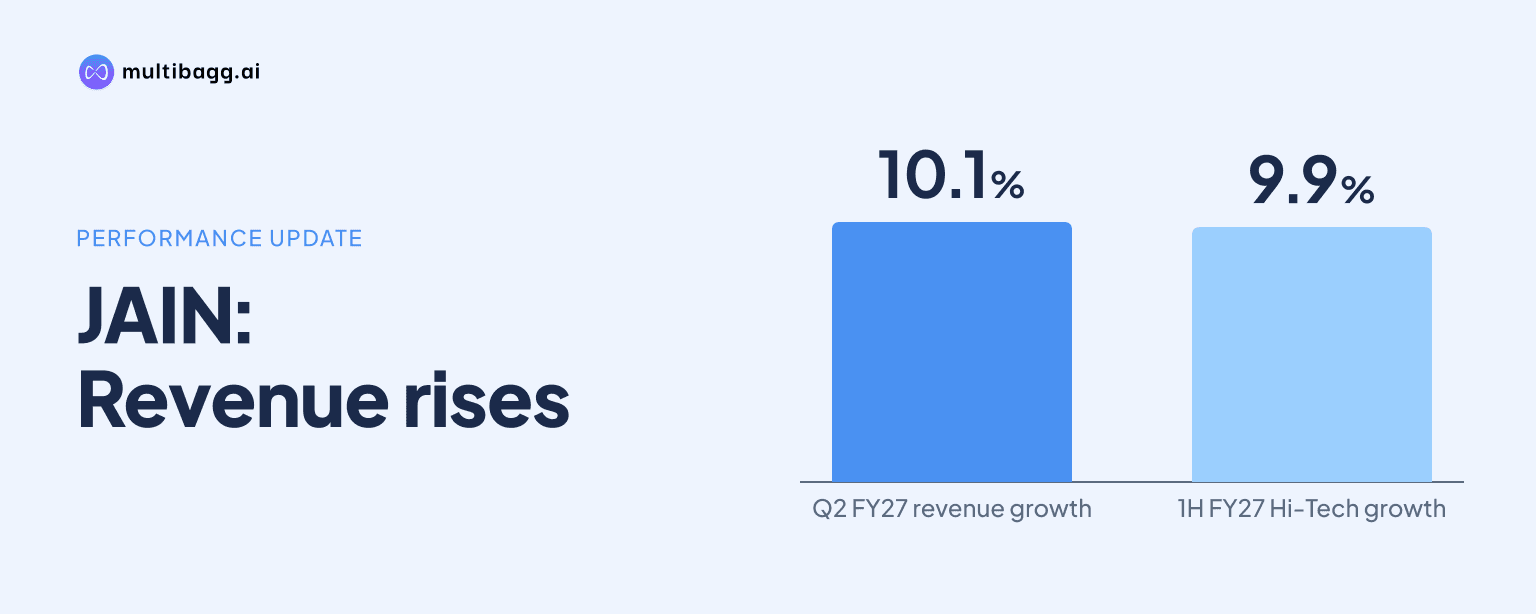
Jain Irrigation Systems Ltd. reported consolidated revenue of Rs 1,576.7 crore in 2Q FY27, up 10.1% year on year, while earnings before interest, tax, depreciation and amortisation (EBITDA) for 1H FY27 fell 7.3% to Rs 371.9 crore as Hi-Tech Agri revenue declined and group margins narrowed.
Know Jain Irrigation Systems Ltd-DVR inside out
Results, valuation, peers and who's buying, in one view.
What drove JAIN’s 2Q FY27 revenue growth?
JAIN’s 10.1% consolidated revenue increase in 2Q FY27 was driven by Plastic and Agro Processing, whose combined revenue rose Rs 121.3 crore year on year. Plastic revenue increased 17.7% to Rs 519.9 crore, Agro Processing rose 8.4% to Rs 559 crore, and Hi-Tech Agri increased 4.9% to Rs 497.8 crore.
Plastic growth came from higher exports from India and expansion in the overseas plastic business, while domestic pipe revenue was stable year on year. Agro Processing benefited from India and overseas subsidiaries, including 16.7% growth in Indian fruit-processing volumes and revenue from the beverage bottling unit. Hi-Tech Agri growth included a 35.2% increase in Tissue Culture and 15.5% growth in the domestic business.
Why did JAIN’s first-half EBITDA decline despite higher revenue?
JAIN’s consolidated EBITDA fell by Rs 29.3 crore in 1H FY27 because a Rs 28.8 crore decline in Hi-Tech Agri EBITDA and a Rs 5.6 crore decline in Agro Processing EBITDA outweighed a Rs 5.1 crore rise in Plastic EBITDA. Consolidated revenue still increased 3.6% to Rs 3,085 crore from Rs 2,978 crore.
Hi-Tech Agri was the principal first-half drag, with revenue falling 9.9% to Rs 948.6 crore from Rs 1,052.5 crore and EBITDA declining 15.4% to Rs 158.6 crore. JAIN said revenue in the business it labels MIS fell 12.5% following a strategic reduction in project business, while exports were lower because of global uncertainty. Tissue Culture revenue nevertheless grew 8.7%.
The consolidated EBITDA margin fell to 12.1% in 1H FY27 from 13.5% in 1H FY26. Hi-Tech Agri margin declined to 16.7% from 17.8% on lower revenue and fixed-cost absorption, while Agro Processing margin fell to 9.8% from 11.7% and Plastic margin eased to 10.2% from 10.5%.
How did JAIN’s segments perform differently in 1H FY27?
JAIN’s first-half revenue growth came from Agro Processing and Plastic, while Hi-Tech Agri declined. Agro Processing revenue increased 13.7% to Rs 1,106.7 crore and Plastic revenue rose 8.2% to Rs 1,029.7 crore, compared with the Rs 104 crore decline in Hi-Tech Agri revenue to Rs 948.6 crore.
Agro Processing growth was led by overseas subsidiaries, particularly the US business, and Indian fruit-processing volumes increased 61.1%. However, EBITDA fell 4.9% to Rs 108.7 crore because JAIN said India margins were lower following a product-mix change, even as overseas EBITDA margins improved.
Plastic EBITDA rose 5.1% to Rs 104.6 crore, supported by 34.6% growth in overseas plastic EBITDA. That offset a 15.1% decline in domestic pipe revenue, where JAIN reported margin pressure from higher polymer prices and lower fixed-cost absorption.
Got a follow-up? Ask IRIS
What do JAIN’s standalone results show?
JAIN’s standalone operations recorded a steeper first-half decline than the consolidated group, with revenue down 11.5% to Rs 1,424.4 crore and EBITDA down 21.4% to Rs 181.5 crore. Standalone profit after tax was a loss of Rs 28.4 crore in 1H FY27, compared with a profit of Rs 9 crore in 1H FY26.
Standalone Hi-Tech Agri revenue declined 10.3% to Rs 946.1 crore and EBITDA declined 16.9% to Rs 155.5 crore in 1H FY27. Standalone Plastic revenue decreased 14.0% to Rs 478.3 crore, while EBITDA fell 40.8% to Rs 26 crore and its margin reduced to 5.4% from 7.9%.
The quarterly standalone outcome also showed a gap between sales and profit. Revenue rose 4.9% to Rs 725.1 crore in 2Q FY27, but EBITDA fell 9.7% to Rs 97.2 crore and profit after tax moved to a Rs 14.5 crore loss from a Rs 2 crore profit. Adjusted profit after tax was Rs 7.1 crore, versus Rs 21.5 crore a year earlier.
How did JAIN’s cash flow, working capital and debt change?
JAIN generated cash from operations of Rs 335 crore in 1H FY27, equal to 90% of EBITDA of Rs 371.9 crore. Consolidated net working-capital days improved by 26 days to 179 days on 30 September 2026 from 205 days on 30 September 2025, while accounts-receivable days fell by 15 days to 121 days.
The company attributed the receivables improvement to substantial Hi-Tech receivables recovery during 2Q FY27 and said gross working capital improved by Rs 60 crore during the quarter despite higher sales. At 30 September 2026, segment net working-capital days were 286 for Hi-Tech Agri, 113 for Plastic and 132 for Agro/Food.
Total reported consolidated debt was Rs 3,874 crore at 30 September 2026, down from Rs 3,901.6 crore at 31 March 2026. Term debt declined to Rs 1,427.3 crore, while fund-based working-capital borrowings increased to Rs 2,446.7 crore from Rs 2,334.7 crore. Outstanding 0.01% NCDs declined to Rs 603.5 crore from Rs 831.1 crore over the same period.
Conclusion
JAIN’s second-quarter revenue growth was led by overseas Plastic activity and Agro Processing, but this did not prevent a first-half EBITDA decline. The key divergence was Hi-Tech Agri, where lower revenue reduced fixed-cost absorption, while Agro Processing increased revenue but recorded lower EBITDA and the standalone business moved to a loss.
The next issue is whether JAIN achieves management’s expectation of recovering margins in the second half of FY27. The disclosed debt schedule also includes Rs 462.6 crore of 0.01% NCD repayments in the remaining six months of FY27, while the company said it subsequently paid Rs 74 crore of Food-Consolidated debt in October 2026.