










Jain Irrigation Systems Ltd. cuts working-capital cycle to 179 days
Key highlights
- JISL's consolidated net working-capital cycle was 179 days at 30 September 2026, down 26 days year on year.
- Consolidated accounts receivable days fell 15 days year on year to 121, led by Hi-Tech Agri collections.
- Hi-Tech Agri's cycle fell to 286 days but remained 107 days above JISL's consolidated cycle.
- JISL said gross working capital improved by Rs 60 crore in Q2 FY27 despite higher sales.
powered by IRIS
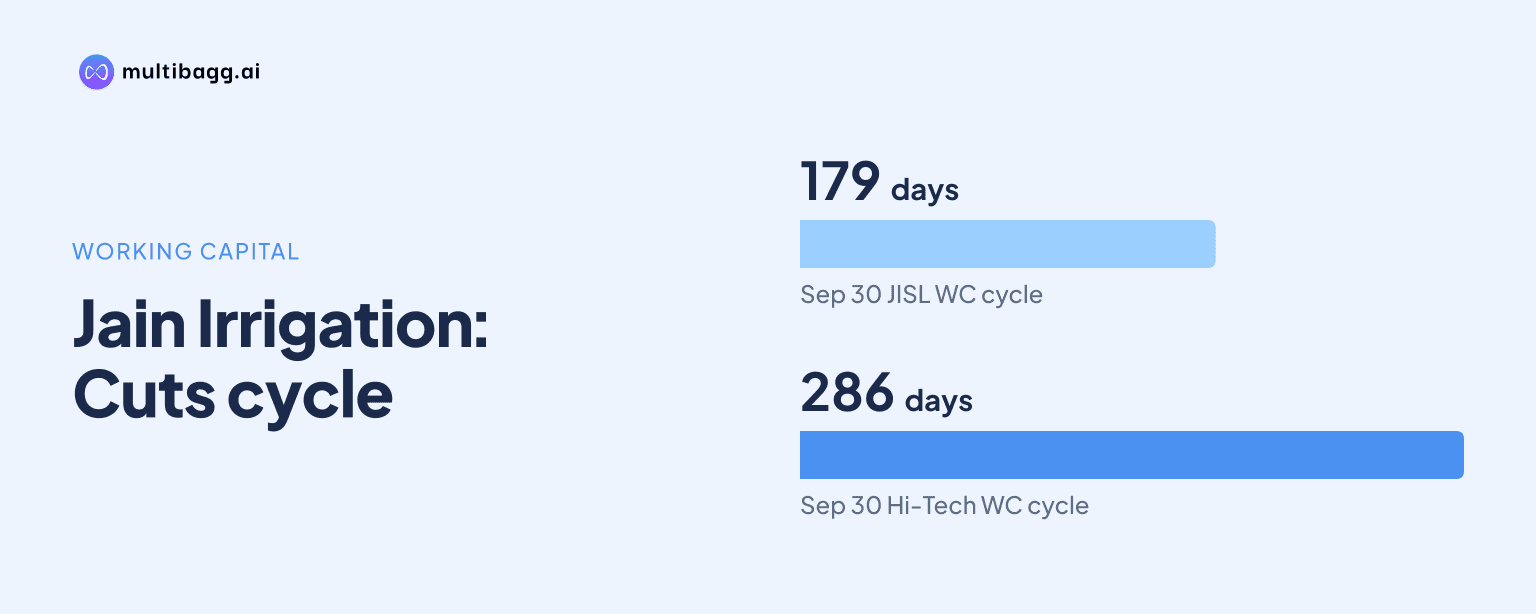
Jain Irrigation Systems Ltd. reduced its consolidated net working-capital cycle by 26 days year on year to 179 days at 30 September 2026, as accounts receivable days declined by 15 to 121. JISL attributed the receivables improvement to substantial Hi-Tech Agri collections during Q2 FY27, although that segment retained the group’s longest cycle at 286 days.
Know Jain Irrigation Systems Ltd-DVR inside out
Results, valuation, peers and who's buying, in one view.
How much did JISL's consolidated working-capital cycle improve?
JISL’s consolidated net working-capital, or NWC, cycle fell to 179 days at 30 September 2026 from 205 days at 30 September 2025, a 26-day reduction. It was also four days below the 183 days reported at 30 June 2026, showing that most of the year-on-year improvement had already occurred by the June quarter.
Inventory days declined to 125 at September 2026 from 130 a year earlier and 127 at June 2026. Accounts receivable, or AR, days fell to 121 from 136 at September 2025 and from 127 at June 2026. The presentation said gross working capital improved by Rs 60 crore during Q2 FY27 despite higher sales.
The 15-day annual AR reduction was the largest stated component of the group-level improvement. JISL specifically linked the result to substantial recovery of Hi-Tech receivables during Q2 FY27, while its business overview described the 26-day NWC change as an improvement in working-capital efficiency.
Which JISL segments changed their working-capital cycles?
All three consolidated operating segments reported lower NWC days at September 2026 than a year earlier, but Hi-Tech Agri remained materially above the group level. Hi-Tech Agri’s cycle fell 21 days to 286, Plastic’s fell 21 days to 113, and Agro/Food’s fell 28 days to 132, compared with a consolidated total of 179 days.
Hi-Tech Agri recorded inventory days of 145 and AR days of 202 at 30 September 2026, versus 147 and 229 days respectively a year earlier. Its 286-day cycle was also 30 days below the 316 days at 30 June 2026, reflecting a 21-day sequential reduction in AR days to 202 and a four-day reduction in inventory days.
Plastic’s 113-day cycle was down from 134 at September 2025, as inventory days declined from 69 to 61 and AR days from 97 to 94. However, the segment’s cycle rose from 99 days at June 2026, while its first-half fiscal year 2027 revenue increased 8.2% year on year to Rs 1,029.7 crore, led by overseas plastic operations.
Agro/Food reported the lowest inventory-adjusted position after Plastic, with NWC days of 132 at September 2026 against 160 a year earlier. Its inventory days declined from 171 to 165 and AR days from 69 to 63, although the cycle increased from 122 days at June 2026; first-half revenue rose 13.7% to Rs 1,106.7 crore, led by overseas subsidiaries.
What role did Hi-Tech Agri receivables recovery play for JISL?
Hi-Tech Agri was the stated source of the consolidated AR improvement, with its receivables days declining 27 days year on year to 202 at September 2026. That decline was larger than the three-day reduction in Plastic AR days and the six-day reduction in Agro/Food AR days, while consolidated AR days fell 15 days to 121.
The quarterly change was also concentrated in Hi-Tech Agri. Its AR days fell from 223 at 30 June 2026 to 202 at 30 September 2026, and inventory days declined from 149 to 145, taking its NWC cycle from 316 to 286 days. JISL did not disclose the rupee amount collected from Hi-Tech customers or identify the customers involved.
Hi-Tech Agri’s operating backdrop was mixed in the first half of FY27. Tissue-culture revenue grew 8.7% year on year, while micro-irrigation systems revenue declined 12.5% because of a strategic reduction in project business and lower exports amid global uncertainty; its earnings before interest, tax, depreciation and amortisation margin declined 110 basis points to 16.7%.
Got a follow-up? Ask IRIS
How did the improvement relate to JISL's cash flow and debt?
JISL reported cash from operations equal to 90% of consolidated earnings before interest, tax, depreciation and amortisation in the first half of FY27. Management separately said improved receivables collections lifted standalone operating cash flow to 180% of EBITDA in Q2 FY27, measures that cover different scopes and periods and are not directly comparable.
Management said the standalone cash generation enabled timely repayment of 0.01% non-convertible debentures, or NCDs. Outstanding 0.01% NCDs declined to Rs 603.5 crore at 30 September 2026 from Rs 831.1 crore at 31 March 2026, and the debt schedule records a further Rs 74 crore payment in October 2026.
Total reported consolidated debt was Rs 3,874 crore at 30 September 2026, down from Rs 3,901.6 crore at 31 March 2026. Reported term debt declined by Rs 139.6 crore to Rs 1,427.3 crore, while fund-based working-capital debt increased by Rs 112 crore to Rs 2,446.7 crore, meaning the lower cycle did not coincide with lower working-capital borrowings at the reporting date.
What remains for JISL to improve in working capital?
Hi-Tech Agri remains JISL’s main disclosed working-capital concentration, with a 286-day NWC cycle that was 107 days above the consolidated total at 30 September 2026. Its AR position of 202 days was also 81 days above the group’s 121 days, whereas Plastic and Agro/Food reported cycles of 113 and 132 days respectively.
Standalone figures show a similar gap. Standalone Hi-Tech Agri recorded a 330-day NWC cycle and 244 AR days at September 2026, compared with standalone totals of 271 and 206 days; the total standalone cycle improved from 284 days a year earlier but increased from 283 days at June 2026.
Management expects Hi-Tech Agri and domestic Piping to recover and anticipates improved operating efficiencies. It also said it remains focused on collections and cash flow, but the presentation gives no future NWC-day target or date for a further reduction.
Conclusion
JISL’s September 2026 data show that receivables recovery, particularly in Hi-Tech Agri, contributed to a 26-day year-on-year reduction in consolidated NWC days to 179. The company also reported Rs 60 crore of gross working-capital improvement during Q2 FY27, while Hi-Tech Agri’s 286-day cycle remained above Plastic’s 113 days and Agro/Food’s 132 days.
The next disclosed milestone is debt repayment: Rs 462.6 crore of 0.01% NCD repayments were scheduled in the remaining six months of FY27, following the Rs 74 crore payment made in October 2026. Management’s stated plan to improve collections and support recovery in Hi-Tech Agri and domestic Piping will determine whether the remaining high segment-level cycle declines further.