










Jain Irrigation targets Rs 300 crore receivables cut by March
Key highlights
- Jain Irrigation targets a net Rs 300 crore-plus reduction in project receivables by March.
- Jain Irrigation reported Rs 800 crore of project receivables and Rs 1,860 crore-plus of total standalone receivables in the September quarter.
- Jain Irrigation has reduced active projects to about seven to eight from roughly 78 at the start of its run-off effort.
- Jain Irrigation estimates second-half project revenue of Rs 60 crore to Rs 70 crore, including the Pune project.
powered by IRIS
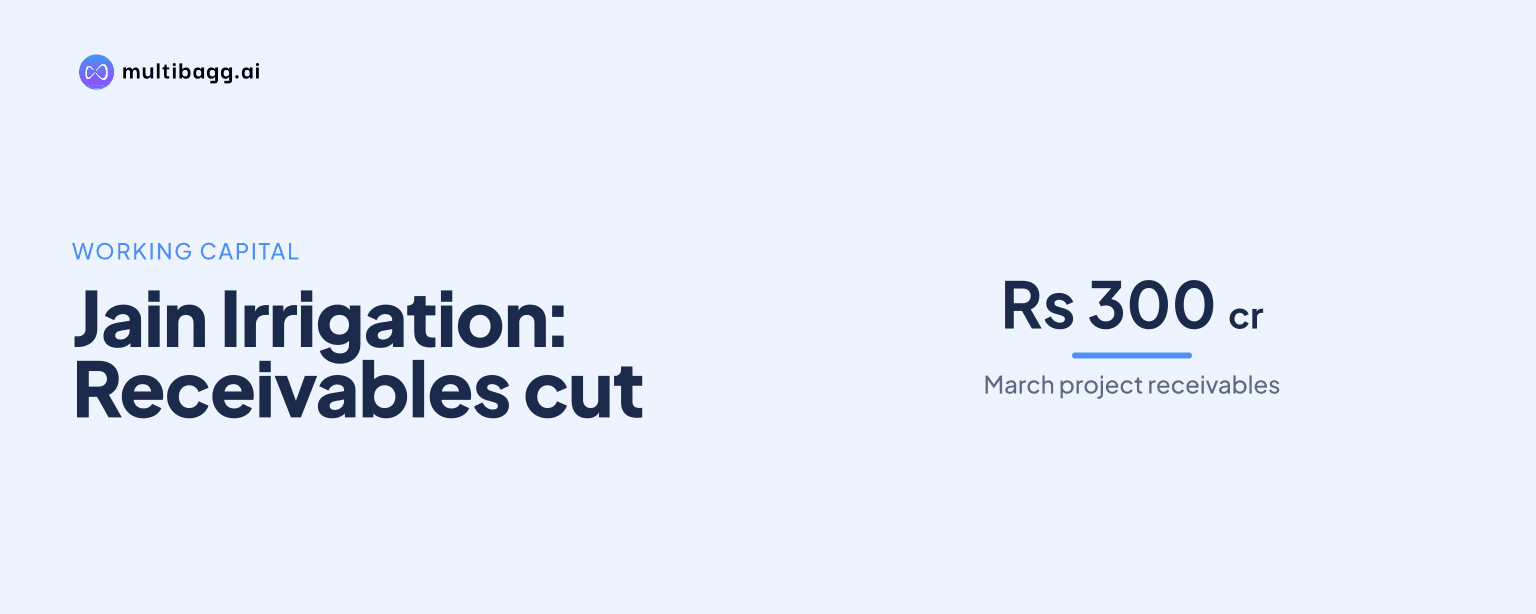
Jain Irrigation said in the September quarter that it expects a net Rs 300 crore-plus reduction in government-linked project receivables by March, roughly 40% of its Rs 800 crore project balance. Management said the collections, combined with earnings before interest, taxes, depreciation and amortisation (EBITDA), should cover obligations falling due by March.
Know Jain Irrigation Systems Ltd-DVR inside out
Results, valuation, peers and who's buying, in one view.
How much will Jain Irrigation reduce project receivables by March?
Jain Irrigation expects project receivables to decline by at least Rs 300 crore on a net basis between the September quarter and March. Management confirmed that the target applies to government-linked project receivables, rather than to the broader micro-irrigation business, or MIP, where receivables continue to revolve with fresh sales and fulfilment.
The Rs 300 crore objective is equivalent to about 40% of the Rs 800 crore project-receivables balance. Management said Rs 800 crore multiplied by 40% equals Rs 320 crore, while its stated target remains a net reduction of Rs 300 crore-plus.
Management said gross billing on remaining projects could be Rs 360 crore to Rs 370 crore through March, while actual recovery would be higher. The difference between fresh billing and cash collection is why Jain Irrigation is measuring the target as a net Rs 300 crore reduction in the receivables balance.
How much of Jain Irrigation's receivables are government-linked?
Jain Irrigation said Rs 1,200 crore of its Rs 1,860 crore-plus standalone receivables in the September quarter was directly linked to government activity. This government-linked amount consisted of Rs 800 crore in projects and Rs 400 crore in MIP, where government subsidy has a role.
The balance outside these categories comprised retail, institutional, solar and export receivables. The Rs 300 crore target therefore does not cover every government-associated receivable, because MIP remains an ongoing business with new product supply and credit rotation.
Management said collections have begun from locations where receivables had previously been difficult to reduce. It expects most old legacy receivables to come through over the next few quarters, supporting repayment of due obligations and creating liquidity for growth in the next fiscal year.
How far has Jain Irrigation progressed in closing rural projects?
Jain Irrigation said seven to eight projects were active, compared with about 78 projects when it began the portfolio reduction effort. It also said it had closed about 15 to 20 projects in the preceding six months.
Physical closure does not immediately complete the process because government settlement and additional billing can continue after field work ends. Management expects the Rs 800 crore project-receivables balance to reduce by about Rs 300 crore on a net basis by March, leaving roughly Rs 500 crore before the effects of remaining project revenue.
One project in Pune is expected to have relatively higher revenue because a meaningful amount of work remains over the next 12 months. Jain Irrigation said its other projects should generate little revenue apart from nominal closing bills for work left to be settled.
Got a follow-up? Ask IRIS
When will Jain Irrigation exit the project business?
Jain Irrigation plans to bring project business and related recovery activity to zero by September 2027, according to management's stated timetable. Management said hardly anything should remain after that point, although it did not present the exit as already completed.
Project revenue is expected to be limited during the run-off. Jain Irrigation said it generated about Rs 14 crore of project revenue in the first half, with the relevant quarter contributing only a small amount, and estimated second-half project revenue of Rs 60 crore to Rs 70 crore including the Pune project.
The projected Rs 60 crore to Rs 70 crore of second-half revenue contrasts with the Rs 300 crore-plus receivables-reduction target. That comparison indicates that management's disclosed focus is on collecting legacy balances and closing work rather than expanding project revenue.
What does the March collection target mean for Jain Irrigation's cash needs?
Jain Irrigation said the Rs 300 crore reduction should be sufficient for its March requirements when combined with EBITDA generation. Management made that assessment when asked whether another funding source would be needed to meet payments due by March.
Management linked legacy-receivable recovery to two uses of cash: repaying obligations as they fall due and providing liquidity for future growth. It also said it expects further improvement in the working-capital cycle over about the next 12 months and a better balance sheet as it enters financial year 2028.
The outlook depends on continued collection from old government-linked balances, including locations that had historically been harder to reduce. Jain Irrigation did not disclose a month-by-month collection schedule, state-level recoveries, or the value of obligations due by March.
Conclusion
Jain Irrigation's disclosed plan combines a Rs 300 crore-plus net reduction in project receivables by March with an eventual withdrawal from project operations by September 2027. The company has reduced active projects to seven to eight from about 78 and expects only Rs 60 crore to Rs 70 crore of second-half project revenue, including Pune.
The next point to watch is whether the Rs 800 crore project-receivables balance falls by the planned amount by March while MIP receivables continue to revolve. Management's later milestone is the September 2027 exit, with Pune work and government settlements on physically completed projects affecting the timing.