










Jain Irrigation Systems Limited flags H2 monsoon risk in core markets
Key highlights
- Jain Irrigation said 80%-85% of its business is in western and southern markets affected by water shortages.
- Q2 FY 2027 revenue was about Rs 1,576 crore and EBITDA was Rs 207 crore.
- Agro-processing revenue was about Rs 560 crore in Q2 FY 2027, up 8.4%.
- Management expects more than Rs 300 crore of net receivables reduction by March.
powered by IRIS
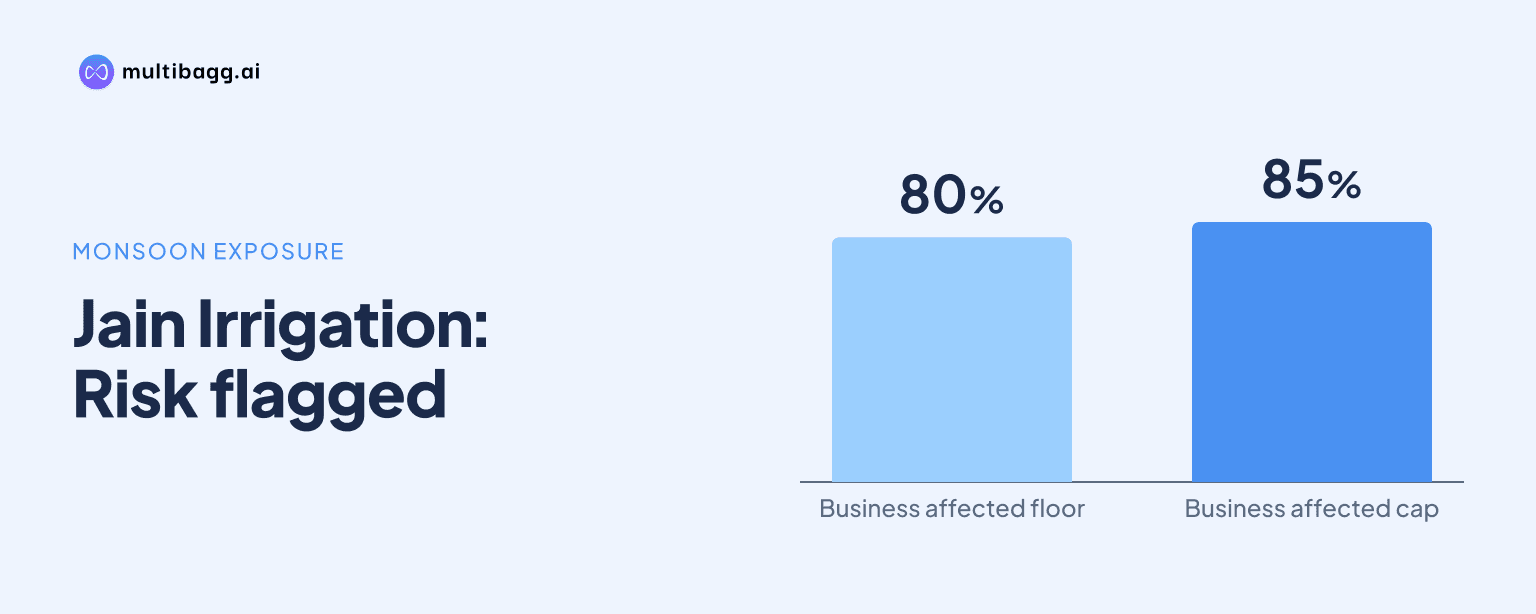
Jain Irrigation Systems Limited said on November 4, 2026, that deficient monsoon conditions could constrain second-half growth because western and southern India account for 80%-85% of its business. Management still expects positive H2 performance by shifting activity to areas with adequate water, expanding exports and pursuing demand beyond farm irrigation.
Know Jain Irrigation Systems Ltd-DVR inside out
Results, valuation, peers and who's buying, in one view.
Why is Jain Irrigation cautious about H2 growth?
Jain Irrigation is cautious because its largest farm markets face water shortages following what management said experts had described as the worst national monsoon in about 35 years. In Maharashtra, a significant market for the company, management said the monsoon was described as the worst in more than 50 years. Kharif crops have already been affected, while Rabi crops are also likely to be affected.
The exposure is concentrated in the affected regions: management said 80%-85% of Jain Irrigation’s business takes place in western and southern India. It described conditions in northern and northeastern states as comparatively acceptable, but those areas represent a smaller part of the company’s market. Management did not give a numerical H2 revenue-growth target or say that H2 growth would be flat; it said it expected positive performance while remaining watchful.
How can a water deficit reduce Jain Irrigation sales?
A water deficit can reduce Jain Irrigation sales because farmers cannot use drip-irrigation systems or agricultural pipes when water allocations are unavailable. Management said some governments may prioritise drinking water over agricultural use. In locations where agriculture receives no water, farmers do not irrigate and therefore may not require drip systems or pipes.
The warning follows a mixed H1 FY 2027. Overseas revenue fell about 24%-25% in Q1 FY 2027, while Q2 FY 2027 recovery lifted H1 revenue to about Rs 3,100 crore, roughly 4% above the prior-year period. Domestic piping fell about 25%-30% in Q1 and was around the prior-year level in Q2, showing that rural agricultural demand had already limited the segment’s momentum.
Q2 FY 2027 revenue was about Rs 1,576 crore, with earnings before interest, tax, depreciation and amortisation, or EBITDA, of Rs 207 crore and an EBITDA margin of 13.2%. That margin was below 13.9% in the earlier comparable period, although management said revenue grew by more than 10% and adjusted profit after tax was about Rs 40 crore in Q2.
Which businesses could offset weaker farm demand?
Jain Irrigation plans to offset some farm-market weakness through regions with adequate water, exports and product lines less directly tied to agricultural irrigation. Management identified demand for large-diameter pipes used in Indian infrastructure projects, solar water pumps, food products and beverages. It also said the overseas plastics business continued to perform well.
Agro-processing generated about Rs 560 crore of Q2 FY 2027 revenue, up 8.4%, while plastics, including domestic and overseas operations, grew about 17%. Management put food EBITDA margin at around 12% and plastics EBITDA margin at around 9%, compared with 18.8% for Hi-Tech MI micro-irrigation. Micro-irrigation therefore remained the higher-margin segment even as its addressable markets faced weather-related constraints.
Jain Irrigation also expects pipe applications outside agriculture to support the full-year outcome. Management said high resin costs have caused rural customers to postpone purchases, whereas some competitors have more exposure to urban plumbing, commercial-building and drainage demand. After a revenue-neutral Q2, management expects 8%-10% full-year piping growth if non-agricultural applications develop as anticipated.
Got a follow-up? Ask IRIS
What other pressures are affecting Jain Irrigation’s H2 plan?
Jain Irrigation is managing the monsoon deficit alongside elevated polymer costs and unpredictable polymer supply. Management linked the polymer issue to the West Asian war’s effect on energy needs and downstream polymer availability, while linking the weather disruption to Super El Niño. These pressures affect the cost and purchase timing of agricultural pipes as well as irrigation products.
Management said it is working with dealers and farmers, directing capacity to locations with sufficient water and increasing exports. These measures are intended to sustain capacity use and profitability, but management acknowledged that they cannot eliminate the impact where agricultural water is unavailable. Domestic retail drip business grew about 18% in Q2 FY 2027, while combined retail business grew about 12%, indicating that some channels remained positive.
Can Jain Irrigation meet its March obligations despite the weather risk?
Jain Irrigation said it does not anticipate a problem meeting the second tranche of repayments due in March, supported by cash generation and planned receivable collections. About Rs 208 crore of Q2 FY 2027 EBITDA converted into about Rs 206 crore of cash, and the company paid Rs 230 crore of non-convertible debenture repayments. Management said operating EBITDA and collections should support the March obligation.
Working-capital days declined to 179 at September-end from 183 during the period and 205 at September-end a year earlier. Management attributed about 15 days of the roughly 25-day year-on-year improvement to lower days sales outstanding, or DSO, which measures the time taken to collect receivables. Inventory and accounts-payable changes accounted for the rest of the improvement.
Of standalone receivables of about Rs 1,860 crore at September-end, about Rs 800 crore related to projects and about Rs 400 crore to micro-irrigation projects involving government subsidies. Management expects net receivables to fall by more than Rs 300 crore by March, including about Rs 320 crore, or 40%, of project receivables. It said seven to eight projects remained active after 15-20 closures in the previous six months.
Conclusion
Jain Irrigation’s H2 FY 2027 outlook combines a concentrated 80%-85% exposure to water-stressed western and southern markets with offsets from exports, agro-processing, overseas plastics, infrastructure pipes and solar pumps. Q2 revenue of about Rs 1,576 crore and EBITDA of Rs 207 crore showed recovery from Q1 disruption, but water availability remains directly linked to demand for drip irrigation and agricultural pipes.
The next points to watch are water allocations in the affected regions, demand for pipe applications outside agriculture and execution of the more-than-Rs 300 crore receivables-reduction plan by March. Management also expects working-capital improvement over the next 12 months and said active project business should be largely completed by the following September.