










Jeena Sikho reports ₹51 crore FY26 free cash flow after expansion
Key highlights
- Jeena Sikho reported ₹262 crore of cash from operations and ₹51 crore of free cash flow in FY26.
- Jeena Sikho’s FY26 investing outflow was ₹211 crore, compared with ₹65 crore in FY25.
- Jeena Sikho reported capital expenditure of ₹3–4 lakh per bed as a basis for internally funded growth.
- Jeena Sikho reported 32 receivable days in FY26, down from 66 days in FY25.
powered by IRIS
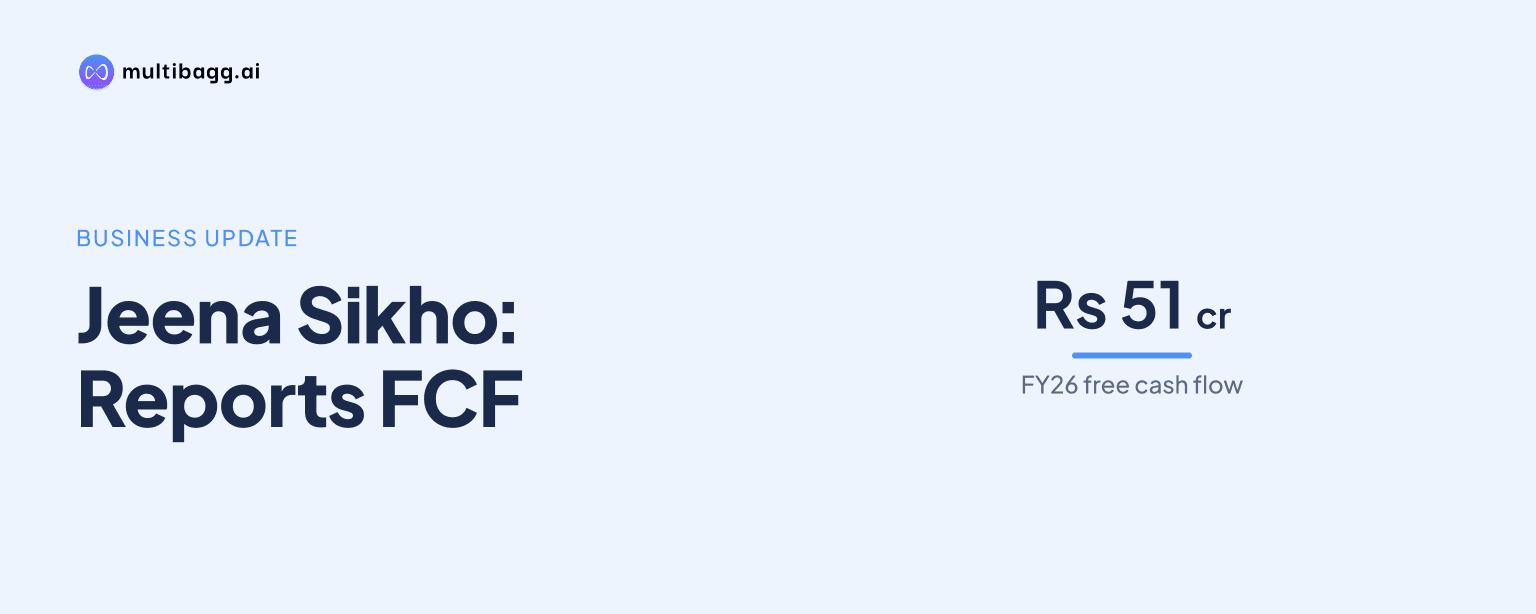
Jeena Sikho Lifecare Limited generated ₹51 crore of free cash flow in FY26 after ₹211 crore of investing outflow, as cash from operations rose to ₹262 crore from ₹85 crore in FY25. The presentation links internally funded expansion to ₹3–4 lakh capital expenditure per bed, ₹0.4 crore of borrowings and its healthcare and product businesses.
Know Jeena Sikho Lifecare inside out
Results, valuation, peers and who's buying, in one view.
How did Jeena Sikho generate ₹51 crore of free cash flow in FY26?
Jeena Sikho generated ₹51 crore of free cash flow in FY26 because its ₹262 crore cash from operations exceeded ₹211 crore of investing outflow. The presentation defines free cash flow as cash from operations less cash used in investing, making the stated FY26 result the difference between those two figures.
Cash from operations increased by ₹177 crore from ₹85 crore in FY25 to ₹262 crore in FY26, while investing outflow increased by ₹146 crore from ₹65 crore to ₹211 crore. The resulting free cash flow changed from ₹20 crore in FY25 to ₹51 crore in FY26, based on the presentation’s stated calculation.
The five-year series shows that cash generation did not increase in every year. Cash from operations declined from ₹18 crore in FY22 to ₹17 crore in FY23, then reached ₹37 crore in FY24 before rising to ₹85 crore in FY25 and ₹262 crore in FY26; investing outflow peaked at ₹211 crore in FY26, above the previous ₹57 crore high in FY23.
What supports Jeena Sikho’s internally funded expansion model?
Jeena Sikho says capital expenditure of ₹3–4 lakh per bed helps keep growth funded through internal accruals. The presentation places that claim alongside FY26 operating cash flow of ₹262 crore and investing outflow of ₹211 crore, but does not disclose the number of beds or a category-wise split of the investment outflow.
Jeena Sikho reported FY26 borrowings of ₹0.4 crore against equity of ₹467 crore and labels its position debt-free. It also reported a 53% revenue compound annual growth rate and a 111% profit after tax compound annual growth rate for FY22 to FY26, alongside the capital-efficiency data.
Jeena Sikho’s cash-from-operations-to-EBITDA ratio rose from 37% in FY23 to 40% in FY24 and 60% in FY25, while the FY26 table shows 0.749. EBITDA means earnings before interest, tax, depreciation and amortisation; the presentation says the ratios were computed from five-year reported financial statements and that FY26 was reported under Indian Accounting Standards, or Ind AS.
Got a follow-up? Ask IRIS
Which Jeena Sikho businesses produce revenue and gross margin?
Jeena Sikho reported that services accounted for 43% of revenue in H1FY27, while Ayurvedic medicines accounted for 57%. Services generated ₹197 crore of H1FY27 revenue at a stated 90% gross margin, compared with ₹262 crore of product revenue at an 87% gross margin.
The products vertical generated ₹65 crore more revenue than services in H1FY27, while services reported a gross margin 3 percentage points higher. The services business operates a hub-and-spoke model comprising 62 hospitals and 60 clinics and day-care centres, with hospitals combining inpatient and outpatient care with bundled care and medicine sales.
The products vertical had more than 440 Ayurvedic product stock-keeping units, or SKUs, and used wellness retail, e-commerce, in-house business-to-consumer tele and web channels, and business-to-business supply to franchise centres. A separate product slide reported 88% overall product gross margin in Q2FY27, compared with the 87% H1FY27 product margin in the business-model slide.
How do franchise centres and accreditations fit Jeena Sikho’s expansion?
Jeena Sikho reported 33 franchisee-operated healthcare centres, where the franchisee bears capital expenditure and operating expenditure except doctor payroll. Ayurveda doctors and medical staff at franchise centres remain on Jeena Sikho’s payroll, while the centres exclusively sell its product portfolio through bundled consultation and product offerings.
Jeena Sikho listed 608 certified Ayurveda doctors and 1,008 supporting healthcare personnel. The presentation says doctor incentives are aligned with patient service and efficient operations, but it does not disclose compensation costs, the incentive formula or doctor productivity data.
Jeena Sikho reported 52 National Accreditation Board for Hospitals and Healthcare Providers, or NABH, accredited hospitals and clinics as of Q2FY27, with another 12 AYUSH hospital accreditations in the pipeline. It also reported receivables of 32 days in FY26, down by 34 days from 66 days in FY25, alongside the increase in operating cash flow.
Conclusion
Jeena Sikho’s FY26 figures show that ₹262 crore of cash from operations covered ₹211 crore of investing outflow and left ₹51 crore of free cash flow under the presentation’s definition. Compared with FY25, operating cash flow increased from ₹85 crore and investing outflow rose from ₹65 crore, while H1FY27 revenue remained weighted toward products at 57% versus 43% for services.
The disclosed expansion item to watch is the 12 NABH accreditations for AYUSH hospitals that were in the pipeline as of Q2FY27, alongside the existing 52 accredited hospitals and clinics. The presentation does not disclose a future investment budget, a bed-addition target or a timetable for those accreditations, leaving subsequent cash-flow and network disclosures relevant to the internal-funding claim.