










JSLL targets 5,000 beds and signs Manali wellness resort
Key highlights
- JSLL targets 5,000 total beds in two to five years, up from 3,031 currently.
- JSLL has signed a Manali wellness resort with 108 rooms, 22 planned villas and more than 20 acres of private forest access.
- JSLL reported 2,424 operational beds and 460 beds in pipeline across 23 states.
- FY26 cumulative OPD, COD and consultation customers reached 14.10 lakh, compared with 5.46 lakh in FY25.
powered by IRIS
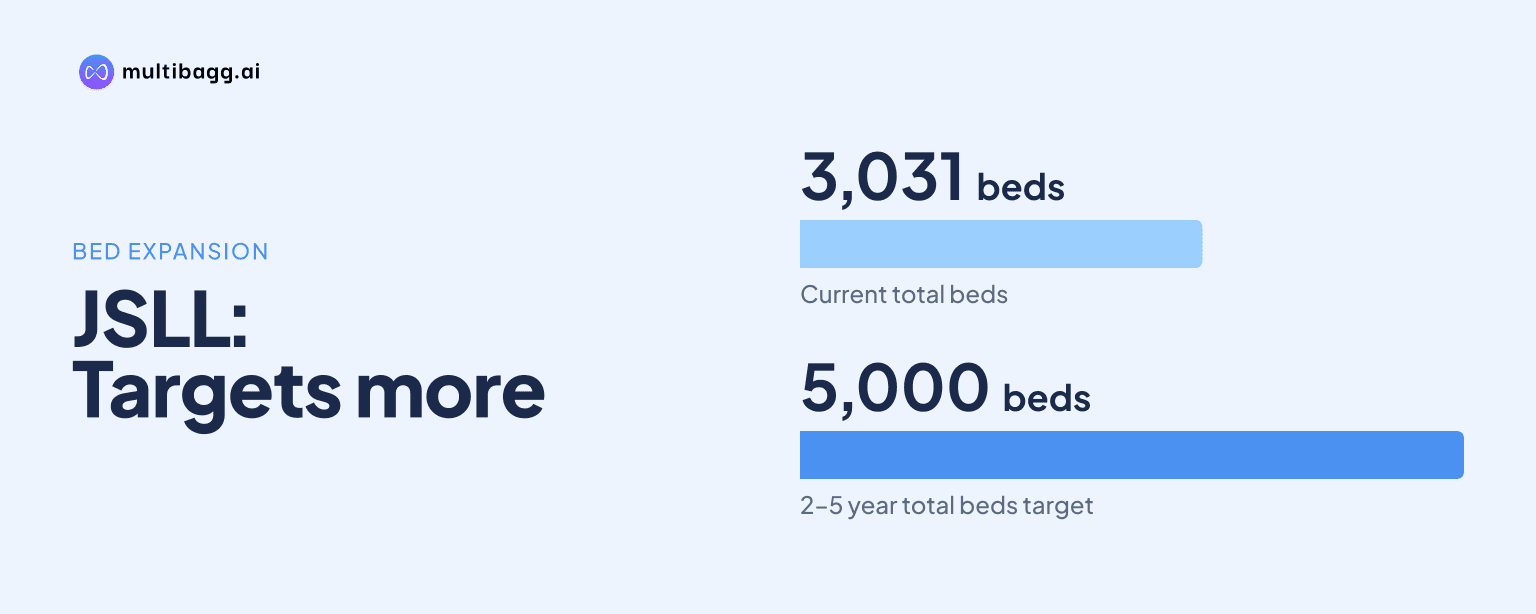
Jeena Sikho Lifecare Limited targets 5,000 total beds within two to five years, from 3,031 currently, and has signed its first 108-room ultra-luxury wellness resort in Manali. The presentation pairs the capacity plan with a hub-and-spoke network, product expansion and clinical research, although it gives no project-level financial forecast for the resort.
Know Jeena Sikho Lifecare inside out
Results, valuation, peers and who's buying, in one view.
How will JSLL reach 5,000 beds?
JSLL plans to add 1,969 beds to take total capacity from 3,031 currently to 5,000 over two to five years. Its longer-range roadmap identifies 10,000 beds in five to 10 years. Hospitals and clinics are planned to increase from 122 currently to 142 in two to five years, before reaching 172 in five to 10 years.
The presentation separately reports 2,424 operational beds, 460 beds in pipeline and four facilities in pipeline. It also lists 62 hospitals and 60 clinics and daycare centres across 23 states and more than 100 cities and towns. These figures differ from the roadmap's 3,031 current beds and 122 hospitals and clinics, and JSLL does not explain the difference in scope between the two sets of measures.
JSLL's largest state-level hospital presence is in Uttar Pradesh, with 13 hospitals, four clinics and four franchises, followed by Rajasthan with 10 hospitals. Haryana has six hospitals, one clinic and five franchises, while Maharashtra has five hospitals, three clinics and three franchises. The presentation describes this geographic footprint as a hub-and-spoke model.
What is JSLL's Manali wellness resort plan?
JSLL has signed its first wellness resort in Manali, Himachal Pradesh, marking its stated entry into the ultra-luxury premium wellness market. The property has 108 rooms and access to more than 20 acres of adjoining private forest. It is located on the bank of a controlled river stream, according to the presentation.
The upcoming phase is planned to include 22 villas and a helipad. JSLL does not disclose an opening date, capital expenditure, ownership structure, operating model, expected room rates or revenue estimate for the Manali resort. The presentation also does not say whether any capacity from the resort is included in the current 3,031-bed figure or the 5,000-bed target.
The resort is positioned differently from the hospital-and-clinic expansion plan. While the network roadmap is measured in beds and facilities, the Manali project is presented through its 108 rooms, 22 planned villas, forest access and planned helipad. This creates a premium wellness offering alongside JSLL's wider healthcare footprint, without a stated financial timetable.
What customer funnel supports JSLL's expansion?
JSLL reported 14.10 lakh cumulative outpatient department, COD and consultation customers in FY26, compared with 5.46 lakh in FY25. Inpatient department, or IPD, patients increased to 40,454 in FY26 from 24,578 in FY25, after rising from 13,159 in FY24 and 5,728 in FY23. The presentation links outpatient, medicine and consultation activity to IPD volumes.
The company reported 1.60 crore followers across social-media channels, including 87.97 lakh on Facebook, 43.03 lakh on Instagram and 28.48 lakh on YouTube. Its stated acquisition channels also include a client support centre, e-commerce, national and regional media, and healthcare camps. In Q2FY27, JSLL organised four 72-hour camps attended by 201 cumulative visitors.
Q2FY27 patient-contact indicators rose year on year, while occupancy declined from the prior quarter. IPD volumes increased 14% to 10,980 from 9,614 in Q2FY26, and outpatient department, or OPD, volumes rose 14% to 1.59 lakh. Occupancy was 55% in Q2FY27, down from 59% in Q1FY27, as operational beds increased to 2,424 from 2,400.
Got a follow-up? Ask IRIS
What economics does JSLL present for a 100-bed facility?
JSLL estimates capital expenditure of Rs 2.50 crore to Rs 3.50 crore for a 100-bed facility, or Rs 3 lakh to Rs 4 lakh per bed. The estimate includes Rs 45 lakh to Rs 50 lakh for furniture and fixtures, Rs 60 lakh to Rs 65 lakh for medical equipment, and Rs 1.50 crore to Rs 2.50 crore for infrastructure that varies by facility.
Monthly operating expenditure for a 100-bed facility is estimated at Rs 1.35 crore to Rs 1.40 crore. This includes Rs 60 lakh to Rs 70 lakh of monthly payroll for 20 to 25 Ayurveda doctors and 80 support staff or 100 contract staff, plus Rs 15 lakh to Rs 20 lakh of rent. Consumables and electricity are estimated at 12% to 15% of sales.
JSLL estimates bundled Panchakarma revenue, including medicine sales, at Rs 7,500 per bed per day and monthly revenue potential of about Rs 3 crore at full occupancy. The presentation estimates break-even occupancy at about 35% under its standard operating-cost structure. Management also indicates 12 to 18 months to reach 70% utilisation and a payback period of less than six months for smaller hospitals, without facility-level supporting results.
How do products and research fit JSLL's roadmap?
JSLL reports more than 440 stock-keeping units, or SKUs, and plans to widen its range through Dr. DS products, protein launches and joint-care launches. The roadmap also includes pharmacy and retail rollout, an owned e-commerce platform and refill subscriptions. The presentation does not assign dates or financial targets to these product and distribution initiatives.
The company reports more than 200 published research papers, 52 National Accreditation Board for Hospitals and Healthcare Providers, or NABH, accredited units, and about 608 certified Ayurveda doctors. It also identifies 12 NABH-accredited units in pipeline and says about 30% of camp attendees convert to IPD. Its listed evidence areas cover Ayurveda IPD and OPD care, Panchakarma therapies, products, health camps, diet care and tele-consultations.
Q2FY27 day-care volumes were 21,200 per day, 24% above 17,154 in Q2FY26, while video OPD consultations rose 19% to 66,806 from 56,347. These measures show activity across care formats beyond hospital admissions. However, JSLL does not disclose how much of the 1,969-bed addition is expected from new hospitals, expansion of existing facilities, franchises or international locations.
Conclusion
JSLL's presentation combines a capacity roadmap, from 3,031 to 5,000 beds in two to five years, with an entry into premium wellness through the signed 108-room Manali resort. The plan is supported by a footprint of 2,424 operational beds, 62 hospitals and 60 clinics and daycare centres, as well as FY26 cumulative OPD, COD and consultation customers of 14.10 lakh.
The next disclosures to watch are progress toward 142 hospitals and clinics and 5,000 beds, along with execution of the 460 beds and four facilities already in pipeline. For Manali, the key unresolved matters are timing and economics for the 22 planned villas and helipad; JSLL also has product launches, pharmacy and retail rollout, e-commerce and refill subscriptions in its stated roadmap.