








JFL says Turkey accounting masks Domino's local sales growth
MAX Plan at ₹4,999/yr

Find your next multibaggerBe a Pro Investor
Research stocks and track your picks on the go. Download the app.
Key highlights
- JFL said Domino's Turkey had positive store-level transaction growth despite negative reported LFL.
- JFL said Domino's Turkey raised prices ahead of its own inflation and kept franchisees profitable.
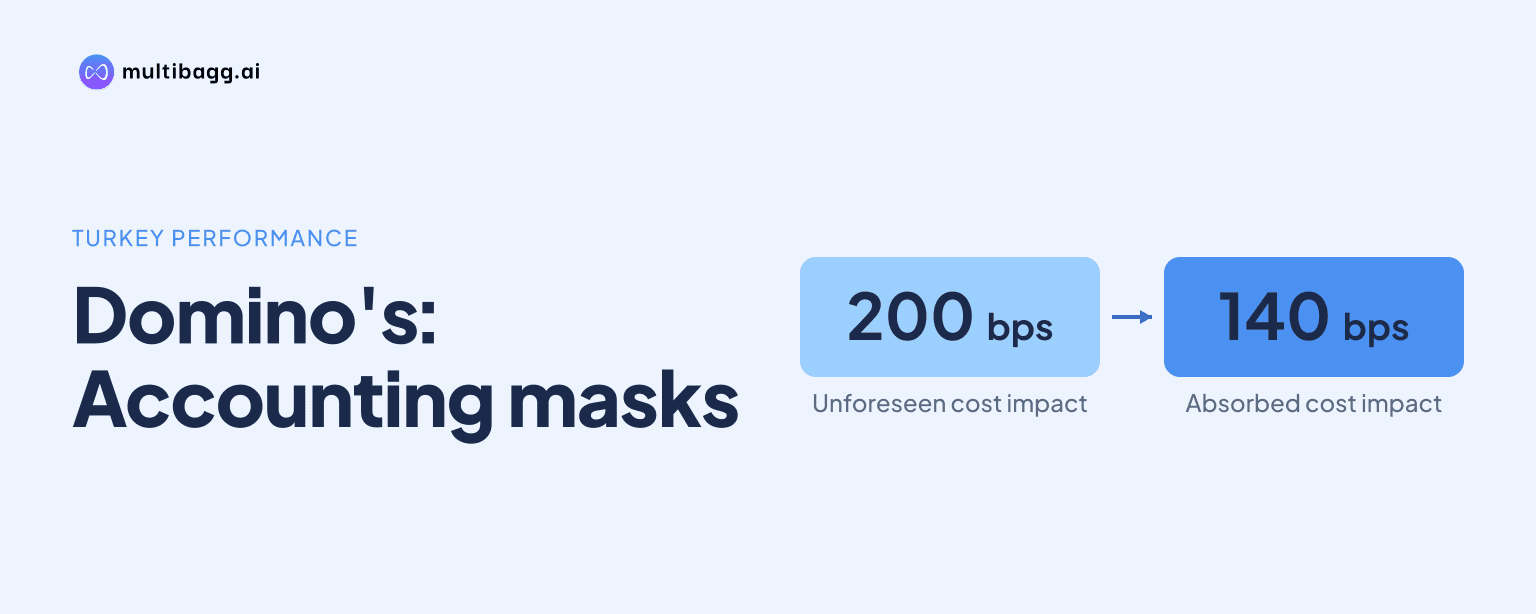
- Management said nearly 140 bps of a 200-bps unforeseen cost impact had been absorbed.
- JFL said it would consider lira-to-lira disclosure to clarify Turkey's operating performance.
powered by IRIS
Jubilant FoodWorks Limited said on its earnings call that Domino's Turkey recorded positive store-level transactions and average order growth, but reported negative like-for-like sales because inflation accounting adjusts revenue using a government headline inflation measure. Management said Domino's had also passed its own inflation through to customers and kept franchisees profitable.
Know Jubilant Foodworks inside out
Results, valuation, peers and who's buying, in one view.
Why is JFL's Domino's Turkey LFL negative?
JFL said Domino's Turkey's negative like-for-like sales, or LFL, primarily reflect an accounting adjustment rather than a decline in store activity. Management said average order growth per store and transaction growth were positive, even as the reported LFL remained negative. It also said Domino's had raised prices ahead of the inflation affecting its own profit and loss account.
The adjustment uses a government headline inflation number under JFL's accounting policies. Management said revenue must be reduced or adjusted by that standard countrywide or industrywide inflation measure to calculate LFL. If that benchmark exceeds the inflation JFL expects or experiences in its own Domino's operations, reported LFL can be negative despite transaction growth and price-led sales growth.
Management said the same accounting mechanism can move in either direction, creating positive or negative effects in different periods. That distinction matters because the reported LFL is not, in management's view, a complete measure of local operating performance. JFL did not disclose the Turkey LFL percentage, transaction-growth percentage or average-order-growth percentage on the call.
How did JFL's Domino's Turkey protect margins?
JFL said Domino's Turkey protected its operating economics by increasing prices ahead of the inflation it faced internally while maintaining positive transaction growth. Management said the business had passed its own profit and loss inflation on to customers and had ensured franchisees remained profitable. No franchisee profitability measure or Turkey operating-margin figure was disclosed.
Management distinguished its own inflation from the higher headline inflation figure used for the accounting adjustment. Its explanation was that a company can hold margins if its actual inflation is below the standardized measure used to adjust revenue, even though that adjustment reduces the LFL reported to investors. This is why management described the negative LFL as more of an accounting outcome for Domino's.
JFL also said the Turkish business earns in Turkish lira and spends in lira, making local operating performance different from a result translated into rupees. Management said movements from lira to rupee can make reported figures less intuitive and added that Turkey and the business were growing in US dollar terms. It did not provide a lira growth rate, rupee translation impact or US dollar growth rate.
How is JFL's Coffy business different in Turkey?
JFL said Coffy faces an operating reset rather than the primarily accounting-led issue described for Domino's. Management said high coffee prices in the prior year required Coffy to increase customer prices, which disrupted its value-led proposition. The response has included revised pricing, stores closer to universities and changes to the product and digital offer.
Coffy is targeting younger Generation Z customers by opening more stores near universities, according to management. JFL also cited app growth, loyalty programmes and a portfolio intended to make Coffy more youthful, focused on cold beverages and technology-driven. Management said the brand is also seeking differentiation from Starbucks, Espresso Lab and other market participants.
Management said Coffy's initiatives were producing quarter-on-quarter improvement, but its statement was qualitative. JFL did not disclose Coffy's sales growth, transaction growth, store count, LFL, profitability or the number of university-adjacent stores. The contrast is that Domino's was described as having positive transactions despite accounting-adjusted LFL, while Coffy is working to restore its value positioning after prior-year coffee-price pressure.
Got a follow-up? Ask IRIS
Can JFL provide clearer Turkey operating disclosures?
JFL said it would consider whether it could provide Turkey information without the inflation number, potentially on a lira-to-lira basis. Management made that comment after an analyst said the accounting treatment made the operating picture difficult to assess. JFL did not commit to a new disclosure format or provide a timetable for one.
A local-currency measure could help distinguish Turkish operating trends from two separate reporting effects identified on the call: inflation adjustments to revenue and lira-to-rupee currency translation. Management said the government inflation number used in its policies is standard across the country or industry, rather than a number tailored to JFL's own cost base.
Management encouraged analysts to visit Turkey to understand the market's operating dynamics, while stating that the lira is readily exchangeable. That was management's view of the market rather than a financial target. The company gave no revised revenue, earnings or margin target for Turkey and no quantified estimate of the accounting adjustment's effect on consolidated results.
What does JFL's margin plan indicate for the group?
JFL said its broader plan remains directed toward 200 basis points, or bps, of margin expansion, although unforeseen costs had created a 200-bps impact. Management cited liquefied petroleum gas pricing and wage inflation across states as examples of those costs. It said actions already taken had absorbed nearly 140 bps, leaving 60 bps still to be addressed.
For Domino's, management listed pricing, cost per delivery, discount reduction, store operating costs, marketing and mix modelling as the levers used to offset the cost pressure. It said it had additional levers if oil prices did not decline, but that the challenge was to preserve growth while using them. Management did not specify which further levers it would use or their expected contribution.
JFL said reducing the drag from emerging brands was the other main part of the margin plan. Management said Popeyes and Hong's were ahead of a plan to provide 100 bps of improvement, while also saying it no longer considered Popeyes an emerging brand. Turkey was not identified as the source of the 200-bps cost impact or as a quantified contributor to the group's margin target.
Conclusion
JFL's position is that Domino's Turkey's negative reported LFL does not indicate falling store demand. Management pointed to positive transaction growth, positive average order growth and customer price increases that covered the business's own inflation. The reported measure, it said, is reduced by a standardized inflation-accounting adjustment that can differ from Domino's actual cost experience.
The next item to watch is whether JFL provides the lira-to-lira disclosure management said it would consider, which could separate operating trends from inflation accounting and rupee translation. Investors can also track progress on the stated 200-bps margin-expansion plan, including management's indication that nearly 140 bps of the 200-bps unforeseen cost impact had been absorbed while 60 bps remained.

