








Jubilant FoodWorks keeps Popeyes pace at 40-45 stores yearly
MAX Plan at ₹4,999/yr

Find your next multibaggerBe a Pro Investor
Research stocks and track your picks on the go. Download the app.
Key highlights
- Jubilant FoodWorks retained Popeyes opening guidance of 40-45 stores a year in Q2 FY27.
- Jubilant FoodWorks had about 100 Popeyes stores in 25 cities and planned the next 150 locations.
- Jubilant FoodWorks wants Popeyes average daily sales to move closer to Rs 1 lakh.
- Jubilant FoodWorks sees another 100 to 200 basis points of Popeyes gross-margin opportunity.
powered by IRIS
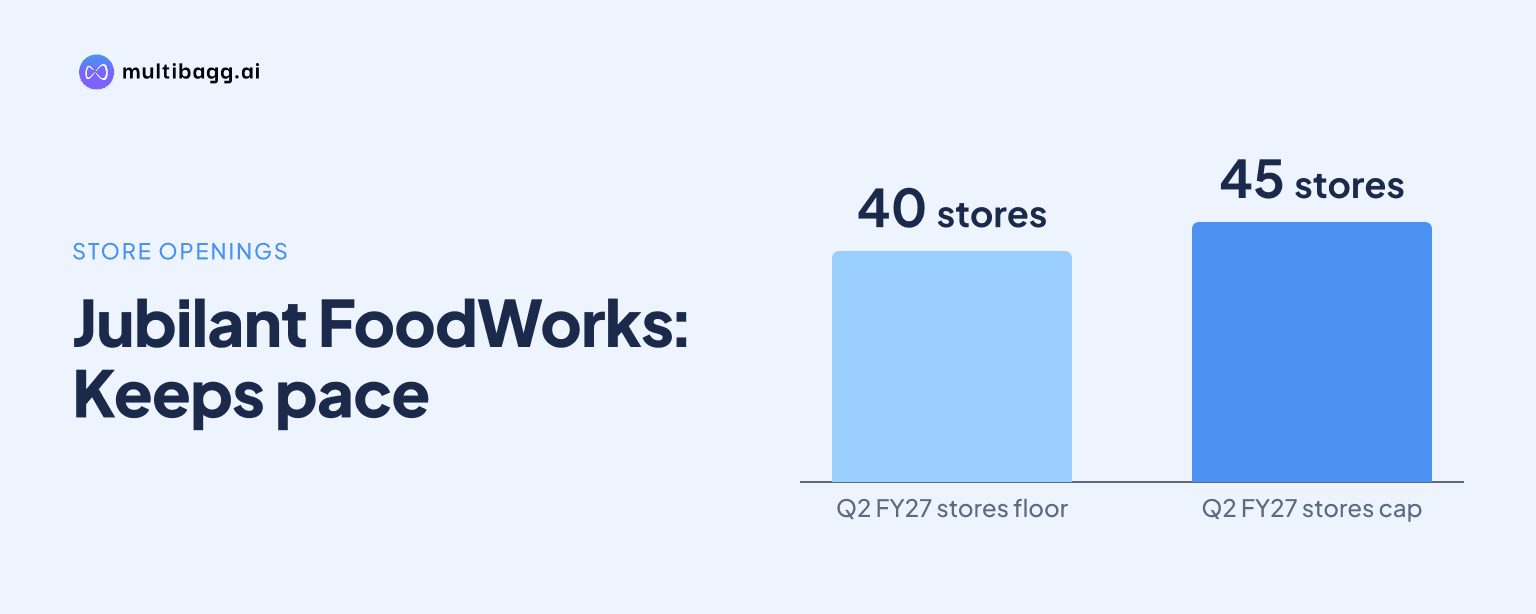
In Q2 FY27, Jubilant FoodWorks Limited said Popeyes would continue opening 40-45 stores a year despite having plans for the next 150 locations, because restaurant economics still need to improve. Management wants average daily sales closer to Rs 1 lakh, further gross-margin gains and lower operating costs before materially accelerating the rollout.
Know Jubilant Foodworks inside out
Results, valuation, peers and who's buying, in one view.
What is Jubilant FoodWorks' Popeyes opening plan?
Jubilant FoodWorks plans to maintain Popeyes opening guidance at 40-45 stores a year rather than accelerate immediately. Chief Executive Officer and Managing Director Sameer Khetarpal said on the November 6, 2026 Q2 FY27 call that the business had about 100 stores and could open faster if it found the right areas. He said the pace reflected the need to operate with quality and achieve appropriate unit economics, rather than a shortage of capital or intent.
Jubilant FoodWorks said it knows where to put the next 150 Popeyes stores, which would take the network from about 100 stores towards 250. Management said that scale could create a business with a run rate of around Rs 1,000 crore or more. However, it also said it would build backend supply-chain capability geography by geography, making network support part of the sequence for new openings.
Why is Jubilant FoodWorks not accelerating Popeyes now?
Jubilant FoodWorks is not accelerating Popeyes because restaurant-level profitability still needs to reach management's intended level. Khetarpal said Popeyes had established a second growth engine through product differentiation, service differentiation and customer love, but unit economics at restaurant level still needed to fall into place. The company is therefore linking the 40-45-store guidance to format execution rather than to the availability of 150 planned locations.
Average daily sales, or ADS, is a central operating condition. Management said it wanted Popeyes ADS to move closer to Rs 1 lakh, which it said would bring substantial benefit to the restaurant profit and loss account given the current gross-margin profile. Jubilant FoodWorks did not disclose current Popeyes ADS or provide a date for reaching that reference point, describing it instead as an operating objective.
Popeyes also has a different cost position from Domino's, according to management. Khetarpal said Popeyes often enters a high street or mall as the fifth or sixth quick-service restaurant, or QSR, player, which can mean higher rents. He contrasted this with some Domino's leases signed 10 to 15 years ago, explaining why comparable sales or gross-margin outcomes do not necessarily produce the same restaurant-level profitability.
What profitability levers does Jubilant FoodWorks see for Popeyes?
Jubilant FoodWorks sees another 100 to 200 basis points of Popeyes gross-margin opportunity, alongside improvements in costs below gross profit. A basis point is one-hundredth of a percentage point, meaning 100 basis points equal one percentage point. Management said Popeyes had benefited from Domino's scale in logistics, infrastructure management and procurement, even as chicken costs were inflating.
The remaining work is in store operating cost, manpower and marketing, management said. Jubilant FoodWorks is using technology to optimise staffing inside stores and is changing equipment, capital expenditure and operating expenditure to suit Indian operations. The company did not provide a savings target for these actions during the Q2 FY27 call, but described them as part of a clear path to restaurant profitability.
Marketing efficiency is also dependent on store density. Management said Popeyes had about 100 stores in 25 cities and would need a larger city-level network on the route to 250 stores. It expects wider scale to allow marketing costs to be amortised more effectively, meaning the profitability task involves both raising store-level sales and spreading support costs across more restaurants.
Got a follow-up? Ask IRIS
How do supply chain and site selection shape the rollout?
Jubilant FoodWorks will use a geography-by-geography rollout because backend supply-chain capacity must be built alongside Popeyes store openings. Management said it was clear about the next 150 locations and that the business was not being starved of capital. But it paired that disclosure with a focus on operating quality and building on customer love, rather than treating available sites as sufficient reason to open all 150 rapidly.
The Q2 FY27 call also highlighted the relevance of food-cost management. Management said dairy prices had seen significant inflation in the immediate year and cited inflation in chicken and vegetables, partly because of monsoons and factors including the West Asia crisis. Across the wider business, it said it had taken about 140 to 200 basis points of calibrated price increases through machine-learning-led decisions across dayparts and channels, without disclosing a Popeyes-only increase.
Jubilant FoodWorks said it was covered on cheese supplies for the financial year and would manage inflation through pricing, discount management and product mix. For Popeyes, the disclosed objective remains improving restaurant economics while preserving the gross-margin support provided by Domino's logistics, infrastructure and procurement. The rollout is therefore tied to supply-chain readiness as well as progress towards the Rs 1 lakh ADS reference point.
What does the 40-45-store guidance mean for Jubilant FoodWorks?
Jubilant FoodWorks' 40-45-store annual guidance means Popeyes expansion is planned but paced against operating milestones. The company has a route for 150 further locations and sees a potential Rs 1,000 crore-or-more run-rate business at about 250 stores, yet management said restaurant profitability, rather than site identification, is the constraint on materially faster network growth.
The strategy combines a further 100 to 200 basis points of gross-margin opportunity with work on rents, manpower, equipment and marketing efficiency. It also reflects the current base of about 100 stores in 25 cities, where support and marketing costs have fewer restaurants over which to spread. Management's comparison with Domino's leases signed 10 to 15 years ago shows that Popeyes is being scaled with a different rental cost base.
Conclusion
Jubilant FoodWorks is prioritising the economics of each Popeyes restaurant over the speed of its planned 150-location rollout. Management said the brand has become a second growth engine, but needs ADS closer to Rs 1 lakh, a further 100 to 200 basis points of gross-margin opportunity and better control of store-level costs before it can support a materially faster opening pace.
The next indicators to watch are management's progress on manpower, marketing and store operating costs, together with its geography-by-geography supply-chain build. These measures will determine whether Popeyes can move from about 100 stores towards 250 stores and the Rs 1,000 crore-or-more run-rate business management outlined.

