










JG Chemicals targets 40,000+ MTPA Dahej capacity by Q3FY27
Key highlights
- JG Chemicals targets more than 40,000 MTPA of stated capacity at Dahej by Q3FY27.
- The Dahej project requires Rs 100 crore of investment and carries Rs 900 crore of stated revenue potential.
- JG Chemicals acquired 11.43 acres for the Dahej facility and plans to fund it through internal accruals.
- JG Chemicals aims to increase non-rubber revenue contribution from 15% to 30% over the next few years.
powered by IRIS
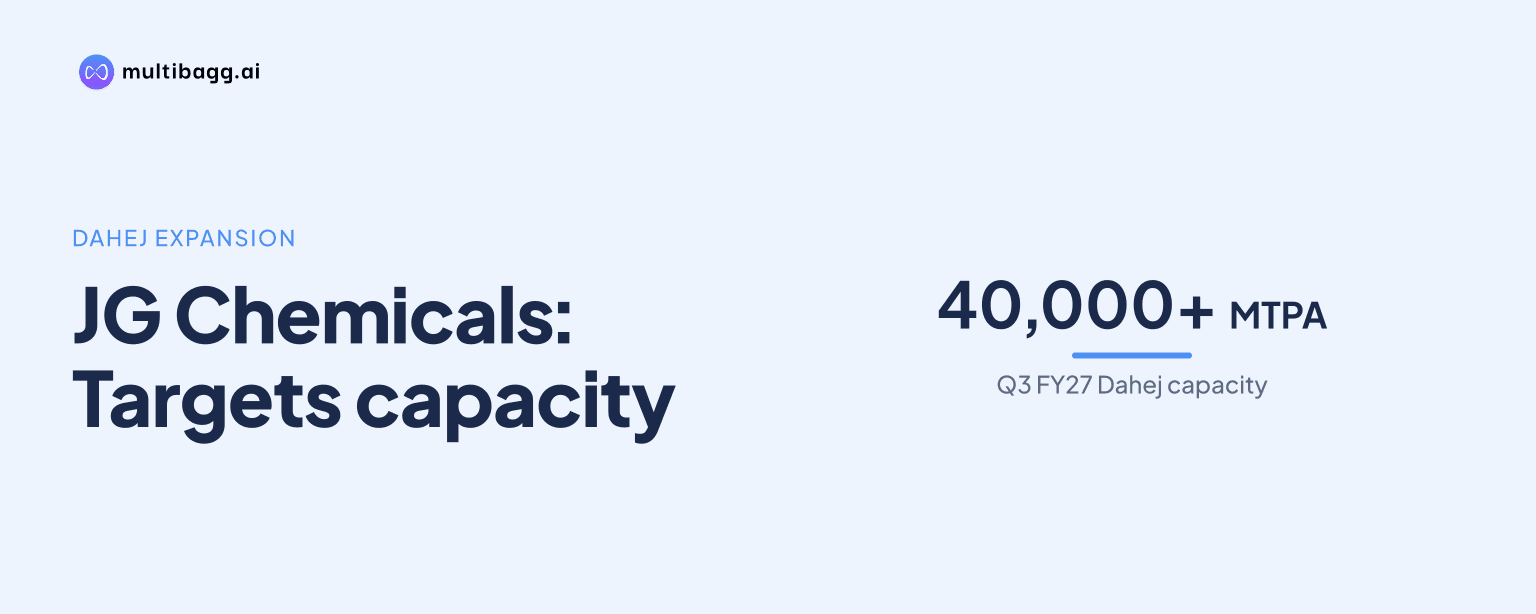
JG Chemicals Limited plans to commission a Dahej, Gujarat facility with more than 40,000 metric tonnes per annum (MTPA) of stated capacity in Q3FY27, backed by Rs 100 crore of investment and carrying Rs 900 crore of stated revenue potential. JG Chemicals says the project will expand its western India presence and support a shift in non-rubber revenue contribution from 15% to 30% over the next few years.
Know J.G.Chemicals inside out
Results, valuation, peers and who's buying, in one view.
What will JG Chemicals build at Dahej?
JG Chemicals will build a greenfield manufacturing facility on 11.43 acres at Dahej with more than 40,000 MTPA of stated capacity. The presentation does not disclose a product-wise capacity split, but identifies ceramics, specialty chemicals, pharmaceuticals and agriculture as target end-use industries, alongside tyre customers located near the Gujarat site.
The project requires Rs 100 crore of investment and has Rs 900 crore of stated revenue potential, equivalent to nine times the investment on the company’s presentation metric. JG Chemicals says it will fund the project through internal accruals and design the plant for high use of recycled or secondary zinc feedstock.
Management presents Dahej as a strategic platform to serve western India and large tyre customers with whom it already has long-standing relationships. It also says the project will support a product mix with a higher share of value-added non-rubber applications, although it does not disclose expected utilisation, pricing or operating-margin figures.
How does Dahej compare with JG Chemicals’ current manufacturing network?
Dahej’s more than 40,000 MTPA of total stated capacity is close to the 43,704 MTPA zinc oxide capacity at JG Chemicals’ Naidupeta, Andhra Pradesh plant. The company’s three existing sites disclose 59,904 MTPA of zinc oxide capacity, comprising 16,200 MTPA in West Bengal and 43,704 MTPA at Naidupeta.
Naidupeta is JG Chemicals’ largest disclosed zinc oxide site, with capacity exceeding the two West Bengal plants’ combined 16,200 MTPA. The company describes Naidupeta as the only International Automotive Task Force-approved zinc oxide facility globally and says it has World Health Organization Good Manufacturing Practice certification.
Dahej cannot be compared directly with the existing zinc oxide sites on a product-for-product basis because JG Chemicals has not identified its zinc oxide, zinc derivative or other capacity allocation. However, the more than 40,000 MTPA figure exceeds the combined West Bengal zinc oxide capacity and is near Naidupeta’s disclosed zinc oxide scale.
Why is JG Chemicals increasing non-rubber applications?
JG Chemicals is targeting a rise in non-rubber revenue contribution to 30% from 15% over the next few years. The stated rationale is to increase exposure to ceramics, specialty chemicals, pharmaceuticals and agriculture while retaining access to nearby tyre customers through the Dahej facility.
Rubber contributed about 84% of JG Chemicals’ revenue as on FY26, according to the presentation. In its zinc oxide revenue-segmentation chart, JG Chemicals shows 85% exposure to rubber, compared with 70% for India’s zinc oxide industry and 50% globally; the chart assigns India 20% to ceramics and 10% to other uses.
Zinc sulphate is one existing non-rubber product route. JG Chemicals has 10,080 MTPA of zinc sulphate and allied-chemical capacity at Naidupeta, while the company estimates the Indian zinc sulphate market at more than 200,000 MTPA, with south India accounting for 30% to 35% of demand.
The company says zinc sulphate contributes less than 3% of its revenue and that cross-selling is intended to support growth from FY25 onwards. It also states that specialized zinc derivatives will be manufactured at the Gujarat plant, with operations planned to commence in 12 to 15 months, though it gives no product-wise volume or revenue target.
Got a follow-up? Ask IRIS
How will recycled zinc feature in the Dahej project?
Recycled zinc will be a core input at Dahej because JG Chemicals says the plant is designed for high use of recycled or secondary zinc feedstock and advanced in-house recycling technologies. Across its wider operations, the company says it uses 100% recycled zinc scrap for the majority of grades and procures materials through more than 100 global suppliers.
JG Chemicals processes zinc dross, zinc ash and scrap into zinc oxide, zinc sulphate and recycled zinc ingots. Its portfolio includes more than 90 specialized zinc oxide grades, while its zinc ash is converted into zinc sulphate using zero-liquid-discharge technology for agricultural applications.
The company states that using recycled metal rather than virgin ores reduces air pollution by 80%, water pollution by 76% and water use by 40% for every unit of zinc oxide produced. It separately reports reductions of 73% in energy consumption and 82% in carbon footprint from recycled or secondary zinc, which are company-presented manufacturing comparisons rather than Dahej-specific forecasts.
JG Chemicals also illustrates a 70% recycled-zinc and 30% primary-zinc mix, alongside a 100% recycled-zinc mix, with 4% and 12% reductions respectively in energy consumption and carbon-dioxide footprint. The presentation does not state the exact recycled-zinc proportion that Dahej will use, so the facility-specific environmental result is not disclosed.
What are the Dahej commissioning and product rollout milestones?
JG Chemicals targets Q3FY27 for commissioning of the Dahej project. At the time of the presentation, it said civil works were at an advanced stage, equipment installation had commenced and the project was progressing as planned.
The company does not provide a specific commissioning month, construction-completion date or utilisation ramp-up schedule for the more than 40,000 MTPA facility. Nor does it disclose customer commitments, product pricing or the time required to reach the stated Rs 900 crore revenue potential.
Dahej is also linked to JG Chemicals’ Gujarat plan for specialized zinc derivatives, for which the presentation indicates a 12-to-15-month commencement window. Other product-development areas named by the company include pharmaceutical-grade zinc oxide, zinc-based agricultural chemicals and nutrients, battery-grade zinc oxide and recycled rubber, where pilot trials have been successful and a commercial project plan remains under development.
Conclusion
JG Chemicals’ Dahej project combines more than 40,000 MTPA of stated capacity, Rs 100 crore of planned investment and Rs 900 crore of stated revenue potential. Its disclosed purpose extends beyond additional scale: management links the Gujarat site to western India access, tyre-customer proximity, recycled-zinc processing and a higher contribution from non-rubber applications.
The next disclosed milestones are the Q3FY27 commissioning target, progress in equipment installation and the planned 12-to-15-month start for specialized zinc derivatives at the Gujarat plant. Future disclosures will be needed to establish product-wise capacity, plant utilisation, the recycled-zinc mix and progress towards the 30% non-rubber revenue target.