










JG Chemicals says LME pricing makes zinc swings largely neutral
Key highlights
- JGCL says most zinc oxide sales use the procurement month’s average LME zinc price plus a premium.
- JGCL identifies approximately 30–45 days of residual zinc-price exposure from inventory timing.
- JGCL illustrates the model with 4,500 MT bought in March and sold using March’s benchmark in April.
- JGCL says it sells more than 90 zinc oxide grades tailored to customer requirements.
powered by IRIS
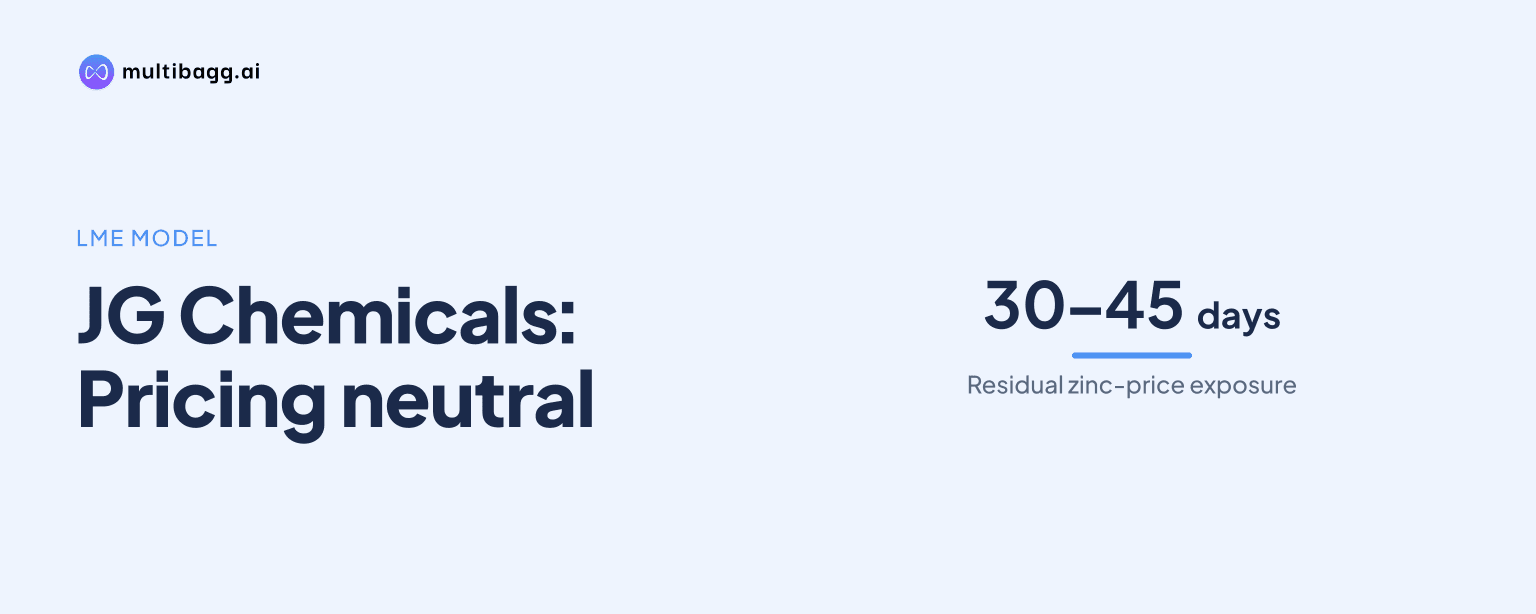
JG Chemicals says its monthly London Metal Exchange, or LME, pricing makes the zinc oxide business largely neutral to absolute zinc-price swings because scrap bought during a procurement month and most resulting sales use that same month’s benchmark; management identifies only 30–45 days of inventory timing exposure and names conversion spread as the principal economic driver.
Know J.G.Chemicals inside out
Results, valuation, peers and who's buying, in one view.
How does JGCL match zinc scrap purchases with zinc oxide sales?
JGCL matches purchases and sales by using the procurement month’s LME benchmark on both sides of the transaction. It buys zinc dross and scrap on either spot pricing or a monthly-average LME zinc-price basis, while domestic scrap is linked to Hindustan Zinc Ltd., or HZL, rates that the company says preserve LME linkage across domestic and imported sourcing.
The company says material typically arrives in the following month and is then converted into zinc oxide for sale. Most zinc oxide sales use a formula based on the monthly average LME zinc price for the month in which the scrap was procured, plus a premium, rather than the market price prevailing in the delivery month.
JGCL illustrates the structure with 4,500 metric tonnes, or MT, of scrap purchased during March at an average price of US$3,000 per MT. That material is sold as zinc oxide in April using March’s average zinc price plus a premium, separating the physical sale date from the benchmark month used to establish the metal-value component.
Why does JGCL call its business neutral to zinc prices?
JGCL calls the model neutral to absolute zinc prices because input costs and zinc oxide selling prices both track monthly LME averages. Under its stated formula, a higher or lower March benchmark changes the zinc value of both March procurement and the April sale of the resulting product.
The comparison is with a sale priced at the prevailing April zinc level. In JGCL’s example, March scrap is sold in April using March’s benchmark, whereas an April spot-priced sale could create a mismatch between the purchase and sales bases if zinc moved during that period.
The company does not say zinc prices are irrelevant to its operations. It processes zinc dross and scrap that vary in size, shape and quality, while page 17 describes this material as complex to handle; its narrower assertion is that the absolute LME price should not ordinarily determine economics when the same monthly reference applies to procurement and sales.
What drives JGCL’s economics after the LME price is matched?
JGCL identifies conversion spread as the principal economic driver once the LME-linked metal value is matched. The presentation does not disclose a conversion-spread amount, premium amount or sensitivity, but it distinguishes this spread from changes in the absolute zinc benchmark.
Manufacturing and product specifications are part of that conversion activity. JGCL says it sells more than 90 grades of zinc oxide to customer requirements and has more than 50 years of manufacturing experience, with in-house processing of various zinc-scrap types.
Customer approvals can also affect access to sales volumes for those specialised products. JGCL says approval with large tyre accounts takes about four to five years on average because customers seek established suppliers, large facilities and consistent quality systems; this is a customer-qualification process, not a disclosed measure of conversion profitability.
Got a follow-up? Ask IRIS
What zinc-price risk remains in JGCL’s pricing model?
JGCL says residual zinc-price exposure is limited to approximately 30–45 days of inventory timing. Management says the impact is immaterial unless zinc prices move very sharply in a very short period, identifying timing rather than the long-run zinc-price level as the remaining stated exposure.
Import lead times are the clearest example. Material bought on a March LME basis may arrive in May instead of the following month, creating a temporary accounting lag; JGCL says such variations largely even out on an annualised basis, without quantifying any quarterly financial effect.
Domestic scrap follows a different supply route but remains linked to HZL rates. JGCL says those rates are indirectly LME-linked and help capture exchange-rate movements, so domestic and imported sourcing share a zinc-price reference even where shipment timing differs.
Why does JGCL say China has no zinc-price advantage?
JGCL says Chinese suppliers have no feedstock-price advantage because zinc oxide prices are determined by LME zinc prices. Its argument is that Chinese producers cannot gain a metal-cost advantage simply from location when zinc oxide prices and feedstock are tied to the same global benchmark.
Management also says zinc oxide conversion costs in China are comparable with those in India and cites customs duties, local supply reliability, quicker support, customisation speed and technical alignment as competitive factors. The presentation provides no customs-duty rate or quantified comparison of Chinese and Indian conversion costs.
JGCL supports its wider positioning with customer and certification claims rather than the LME mechanism alone. It says nine of the top 10 global tyre manufacturers and the top 11 domestic tyre manufacturers are customers, and that its Naidupeta facility is the only International Automotive Task Force, or IATF, certified facility in India.
Conclusion
JGCL’s disclosed model carries the procurement month’s LME zinc benchmark from scrap buying into most zinc oxide sales, generally with March material sold in April on a March base price. The arrangement means the company’s stated earnings focus is conversion spread, product execution and customer specifications rather than a directional view on absolute zinc prices.
The next issues to watch are whether the disclosed 30–45-day timing exposure becomes more visible during a sharp short-term zinc move and how management executes its product expansion plan. JGCL lists deeper domestic penetration, new geographies, zinc sulphate ramp-up and broader end-user applications as future strategies, while specialised zinc derivatives at its Gujarat plant are planned to commence operations in 12–15 months.