










IndiQube Spaces Limited has 65% occupancy from large clients
Key highlights
- Clients with more than 300 seats accounted for 65% of IndiQube occupancy as at September 30, 2026.
- GCCs contributed 54% of IndiQube revenue in H1 FY27 and occupied 49% of its area.
- The 300-plus-seat client segment had a 47-month average lease duration, versus 42 months for the portfolio.
- IndiQube’s rent-yielding area rose 22% year on year to 7.05 million square feet in Q2 FY27.
powered by IRIS
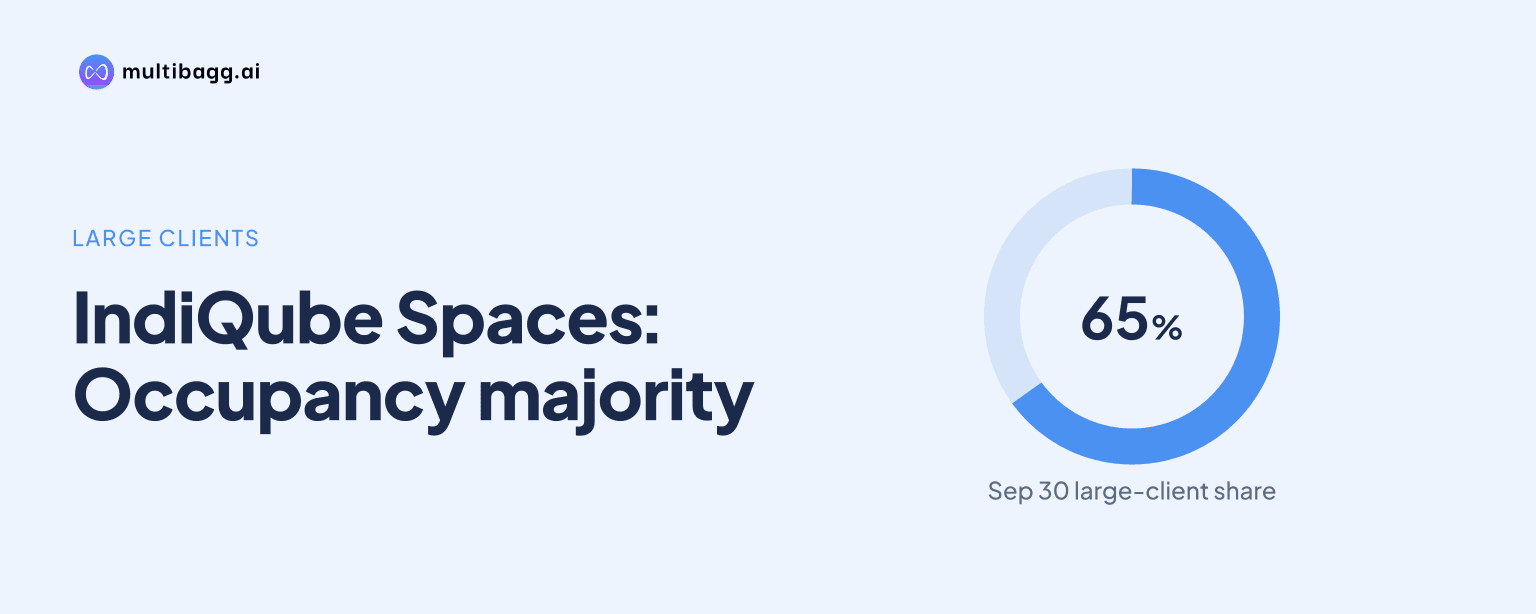
IndiQube reported that clients with more than 300 seats accounted for 65% of occupied seats as at September 30, 2026, while global capability centres (GCCs) generated 54% of H1 FY27 revenue. The largest client band had a 47-month average lease duration, compared with 42 months across the portfolio.
Know Indiqube Spaces inside out
Results, valuation, peers and who's buying, in one view.
Who occupies IndiQube’s workspace portfolio?
IndiQube’s occupancy is concentrated in large accounts: the 300-plus-seat segment accounted for 65% of occupied seats as at September 30, 2026. Clients with 101 to 300 seats represented another 25%, meaning clients with more than 100 seats accounted for 90% of occupied seats. By contrast, the 0 to 50-seat segment was 4% and the 51 to 100-seat segment was 6%, together making up the remaining 10%.
The client base included 884 clients across India in H1 FY27, with 63% of acquisition described as brand led. Multi-centre clients contributed 41% of revenue, showing that a material portion of revenue came from customers using more than one IndiQube location. The presentation reports brokerage expense at 2.29% of operating revenue alongside the brand-led acquisition measure, but does not provide a comparable earlier-period client count or brokerage ratio.
How important are GCCs to IndiQube’s revenue and occupied area?
GCCs contributed 54% of IndiQube revenue in H1 FY27 and occupied 49% of its area, making them the largest disclosed client segment on both measures. Indian enterprises held 29% of occupied area, while unicorns and startups each represented 11%. The five-percentage-point difference between the GCC share of revenue and occupied area indicates that GCCs generated a larger share of revenue than their occupied-area share during the period, although the presentation does not disclose segment pricing or revenue per square foot.
The remaining 51% of occupied area was spread across Indian enterprises, unicorns and startups. IndiQube’s supply strategy identifies GCC-centric micro-markets as locations where it selectively acquires multiple floors in large technology parks to serve global enterprise demand. Full buildings comprised 55% of area-under-management supply, compared with 23% for renovated properties and 20% for technology parks, providing context for the types of space used to serve clients.
Do larger IndiQube clients stay longer?
Yes. IndiQube reported an average lease duration of 47 months for clients with more than 300 seats, five months longer than the 42-month portfolio average. The duration rose progressively with client size: 27 months for 0 to 50 seats, 30 months for 51 to 100 seats, and 36 months for 101 to 300 seats. The disclosed data therefore links the segment holding 65% of seats with the longest average lease term.
The 20-month gap between the 47-month duration for the largest clients and the 27-month duration for the smallest segment is relevant to IndiQube’s operating model because lease terms overlap with its fit-out recovery cycle. This does not establish renewal rates or client retention, neither of which the presentation provides. It does show that the stated contractual duration is longer in the 300-plus-seat segment than in every other disclosed seat band.
Got a follow-up? Ask IRIS
How does IndiQube align client commitments with property costs?
IndiQube states that the average client lock-in is 35 months from rent commencement, during which clients cannot exit and must pay the full rental for the duration. The company says interior and renovation fit-out expenditure of Rs 1,650 per square foot is fully recovered in 36 months. Its lock-in with landlords is 38 months, with IndiQube holding the sole option to continue or vacate after that tenure, placing the three milestones within roughly three years.
A centre is reported to reach operational breakeven within six months at 55% to 60% occupancy, and steady state within 12 months at 85% to 90% occupancy. At the portfolio level, IndiQube reported a revenue-to-rent ratio of 2.27 and a landlord lock-in of about 15 years. The presentation describes these figures as portfolio averages, so they do not show the cost-recovery or occupancy profile of individual centres, cities or client accounts.
Is IndiQube’s occupied footprint growing alongside this client mix?
Yes. IndiQube’s rent-yielding area reached 7.05 million square feet in Q2 FY27, up 22% from 5.80 million square feet in Q2 FY26. Rent-paying area also rose 22% to 8.19 million square feet, while area under management increased 19% to 10.86 million square feet over the same comparison. Steady-state occupancy increased to 91% in Q2 FY27 from 89% a year earlier and 90% in Q1 FY27.
IndiQube had 182,000 operational seats across 8.19 million square feet of rent-paying area, plus letters of intent signed for 2.67 million square feet and 59,000 future-supply seats. Those signed areas are intended to become operational in the next 12 to 18 months. Of the 10.86 million-square-foot area under management, 7.05 million square feet was rent yielding and 3.81 million square feet was described as headroom for growth, equal to 85,000 seats.
Conclusion
IndiQube’s disclosed client mix combines high occupancy from large-seat accounts, the longest average lease duration in that segment, and a majority revenue contribution from GCCs. Its stated 35-month client lock-in, 36-month fit-out payback and 38-month landlord lock-in place customer commitments, capital recovery and property obligations on a broadly similar timetable.
The next measure to watch is conversion of 2.67 million square feet of signed future supply into operating space over the stated 12 to 18 months, alongside movement in the 91% steady-state occupancy reported in Q2 FY27. IndiQube’s disclosed 59,000 future-supply seats will also show whether the 65% large-client seat share and 54% GCC revenue contribution change as capacity is added.