










JG Chemicals targets 30% non-rubber revenue share from 15%
Key highlights
- JG Chemicals targets a 30% non-rubber revenue share, up from 15% over the next few years.
- Rubber contributed about 84% of JG Chemicals revenue as of FY26.
- The Dahej project is scheduled for Q3FY27, with more than 40,000 MTPA capacity and Rs 900 crore of stated revenue potential.
- Naidupeta has 10,080 MTPA of zinc sulphate and allied-chemical capacity.
powered by IRIS
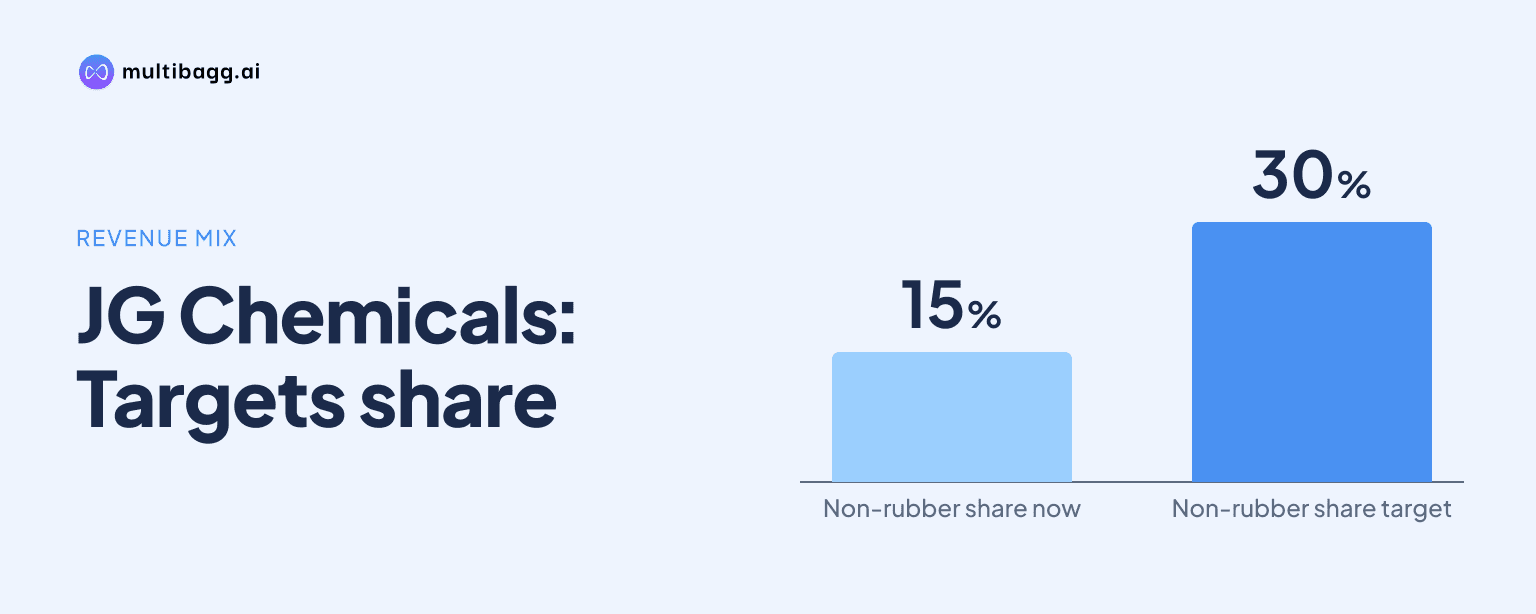
JG Chemicals Limited is targeting a 30% non-rubber revenue share from 15% over the next few years, supported by a Dahej, Gujarat facility scheduled for commissioning in Q3FY27. The project has more than 40,000 metric tonnes per annum (MTPA) of capacity and Rs 900 crore of stated revenue potential, while the plan extends into pharmaceutical, agricultural, battery and specialty products.
Know J.G.Chemicals inside out
Results, valuation, peers and who's buying, in one view.
How dependent is JG Chemicals on rubber revenue?
JG Chemicals remains heavily dependent on rubber, which contributed about 84% of revenue as of FY26, according to the presentation. Management’s stated diversification objective is to increase non-rubber revenue from the current 15% to 30% over the next few years, using applications beyond conventional tyre-related zinc oxide volumes.
The presentation’s market comparison places JG Chemicals above both Indian and global zinc oxide markets in rubber concentration. India is shown with 70% of zinc oxide revenue from rubber and 20% from ceramics, while the global market is shown at 50% rubber and 25% ceramics; JG Chemicals is shown at 85% rubber and 15% other applications. The 85% chart share and the approximately 84% FY26 contribution both indicate a rubber-led sales base.
JG Chemicals sells more than 90 zinc oxide grades for customer-specific requirements across tyres, ointments, batteries, oil-well drilling fluids, lubricants, ceramics, fertilisers, pigments and livestock products. The breadth of uses means the diversification programme depends on application-specific grades, certifications and customer approvals rather than solely on increasing zinc oxide capacity.
What role will Dahej play in JG Chemicals' diversification plan?
Dahej is intended to be JG Chemicals’ main western India platform for non-rubber products, with commissioning targeted in Q3FY27. The greenfield site covers 11.43 acres, has more than 40,000 MTPA of capacity and requires Rs 100 crore of investment.
Management says the Dahej facility will address ceramics, specialty chemicals, pharmaceuticals and agriculture, while also serving tyre customers located nearby. The presentation states Rs 900 crore of revenue potential, nine times the Rs 100 crore investment, and says internal accruals will fund the project. It describes the intended mix as margin accretive, which is management’s expectation rather than a reported financial outcome.
Civil works at Dahej were at advanced stages and equipment installation had commenced at the time of the presentation. The facility is designed around in-house recycling technologies and a high use of recycled or secondary zinc feedstock, connecting the project with JG Chemicals’ existing zinc-scrap processing model.
Which non-rubber products is JG Chemicals expanding?
JG Chemicals is expanding zinc sulphate, pharmaceutical-grade zinc oxide, specialised zinc derivatives, agricultural chemicals and battery-grade zinc oxide, while recycled rubber remains at the pilot stage. Zinc sulphate is the most established non-rubber line: the Naidupeta facility has 10,080 MTPA of zinc sulphate and allied-chemical capacity, though the product contributes less than 3% of revenue.
The presentation puts India’s zinc sulphate market above 200,000 MTPA, with South India representing 30% to 35% of demand. JG Chemicals identifies agriculture and pharmaceuticals as end uses and says cross-selling was intended to support zinc sulphate growth from FY25 onward. It also says Naidupeta can accommodate zinc-based agricultural chemicals, micronutrients, feeds and additives using in-house zinc oxide and zinc sulphate.
Specialised zinc derivatives are planned at the Gujarat plant, with operations expected to begin in 12 to 15 months, according to the presentation. Management links these products to demand in newer sectors and government initiatives including the Production-Linked Incentive scheme. Separately, JG Chemicals says it supplies battery-grade zinc oxide to select battery manufacturers, develops customised products and is among the top two to three suppliers eligible for the battery market through registration with the International Battery Users Association.
Got a follow-up? Ask IRIS
What supports JG Chemicals' pharmaceutical expansion?
JG Chemicals’ pharmaceutical expansion is based on approvals, high-purity zinc oxide capability and Naidupeta certifications. The company secured its pharmaceutical-grade zinc oxide licence in 2020, while subsidiary BDJ Oxides has the required approvals and the Naidupeta facility obtained World Health Organization Good Manufacturing Practice certification in 2023.
JG Chemicals says it is licensed to manufacture zinc oxide to Indian Pharmacopoeia, British Pharmacopoeia, United States Pharmacopeia and European Pharmacopoeia standards. These standards are relevant to pharmaceutical customers because the presentation identifies zinc oxide use in ointments and wound-healing products. It also identifies regulatory approvals as an entry barrier in pharmaceutical, cosmetics, nutraceutical and specialty-chemical segments.
Naidupeta is described by the company as the only International Automotive Task Force-approved zinc oxide facility globally and has 43,704 MTPA of zinc oxide capacity. The presentation says using recycled rather than primary zinc can reduce energy consumption by 73% and carbon footprint by 82%, making recycled feedstock a part of the manufacturing approach for both existing and newer grades.
How is JG Chemicals developing new products?
JG Chemicals is using launches, research and development, and external technical collaboration to develop additional grades. Its Naidupeta research and development centre was inaugurated recently and is intended to evaluate products and chemistries for rubber, cosmetics, agriculture and other end-user applications.
The company recently launched Lab Pure, a 99.9% lab-grade zinc oxide product conforming to Indian, United States, British and European pharmacopoeia standards. It also launched Zinc Oxide ZRA, a blend of zinc oxide and other compounds designed for specific customer requirements in rubber, where JG Chemicals says the product has demand and export potential.
A rubber curing activator jointly developed with IIT Kharagpur is at an advanced patent stage. JG Chemicals says the blend is intended to improve processability, cure characteristics and handling. Recycled rubber remains at an earlier stage: pilot trials have been successful, while a commercial project plan is still under development.
Conclusion
JG Chemicals’ target of a 30% non-rubber revenue share addresses a business where rubber represented about 84% of revenue in FY26 and 85% in the presentation’s segment chart. The stated route combines the Rs 100 crore Dahej project, 10,080 MTPA zinc sulphate capacity at Naidupeta, pharmaceutical approvals, battery-grade product development and research into tailored grades.
The next disclosed milestone is Dahej commissioning in Q3FY27, followed by planned specialised zinc-derivative operations in 12 to 15 months. Progress toward management’s 30% target will depend on whether zinc sulphate, pharmaceutical-grade products, agricultural chemicals and battery-grade zinc oxide increase non-rubber revenue from the stated 15% base.