










Jio Platforms Falls 2.4% as Earnings and Market Risks Weigh
Key highlights
- Jio fell 2.4% to an intraday low of ₹1,386.80 on October 30 before Q2 FY27 results.
- Jio recovered to around ₹1,420 by 11:48 am IST, about 0.11% below its previous close.
- Combined NSE and BSE volume exceeded 16.7 million Jio shares on October 30.
- Jio's October 28 listing reportedly attracted about $1.1 billion of foreign portfolio investment.
powered by IRIS
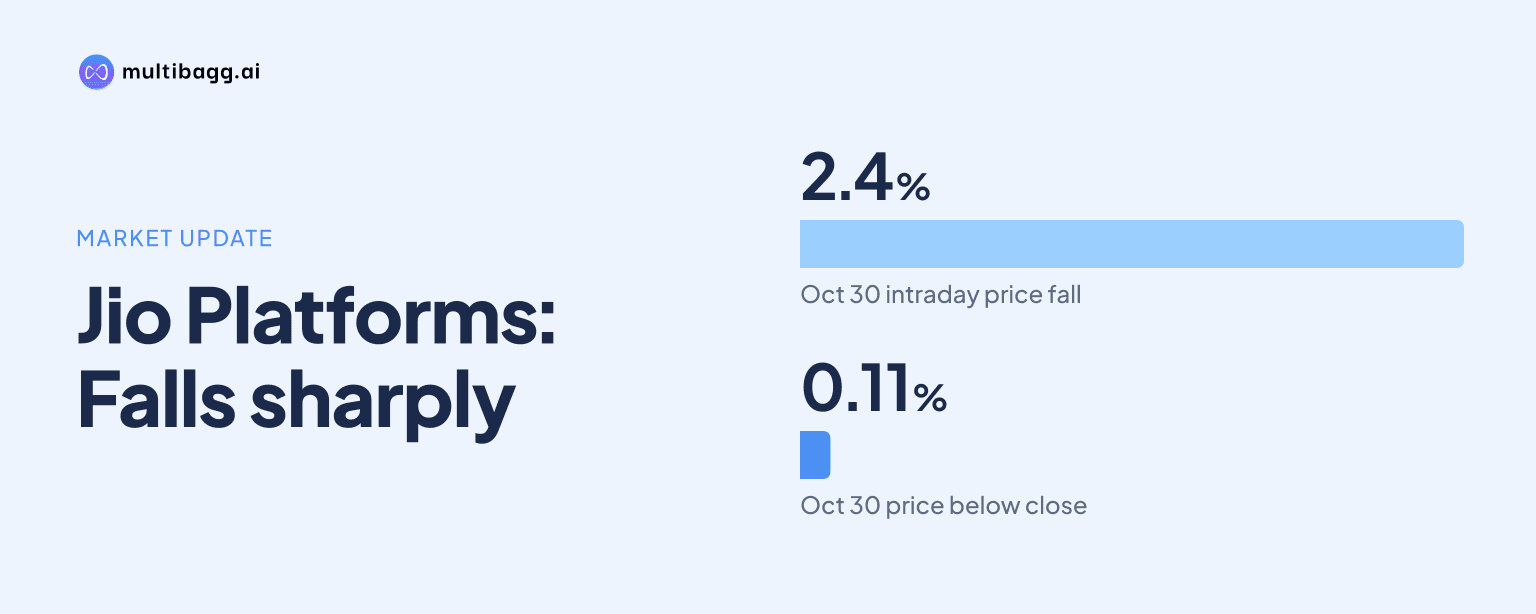
Jio Platforms fell 2.4% to an intraday low of ₹1,386.80 on October 30, before its Q2 FY27 results, as investors assessed the upcoming earnings update during a broader Indian equity sell-off marked by higher oil prices, foreign investor selling and pressure on heavyweight stocks.
Why did Jio shares fall before Q2 FY27 results?
Jio shares fell as the market awaited the telecom and technology company's July-September quarter results, while the available information does not identify a single definitive trigger for the move. Investors were assessing operating indicators and the earnings update that could influence expectations for the recently listed company.
The stock declined from the previous close of ₹1,421.60 to ₹1,386.80 intraday on October 30. It later recovered most of the decline and was trading around ₹1,420 at 11:48 am IST, down 0.11% at that point. The reversal indicates that the sharp early move did not persist through the reported part of the session.
What were the key Jio trading figures on October 30?
Jio's intraday movement was accompanied by elevated investor activity, with combined NSE and BSE volumes exceeding 16.7 million shares, according to Trendlyne data. The stock had listed on October 28, placing its early trading under close scrutiny from both IPO participants and secondary-market investors.
At the intraday high levels reported on October 30, Jio had delivered returns of more than 28% to IPO investors on the NSE since listing. That context matters because a newly listed stock can see active position adjustments as investors weigh listing gains against the next major information point, in this case the Q2 FY27 release.
How did the broader Indian market affect Jio trading?
The wider market backdrop was weak, with rising crude oil prices, geopolitical tension in the Middle East and foreign institutional investor selling weighing on Indian equities. Oil was reported at $114 a barrel, while Indian equities had recorded four straight losing sessions in the period described.
The weakness was not confined to Jio. IT and oil and gas stocks were reported to have fallen more than 2% in a weak session, and Reliance Industries was also under pressure. In another reported session, the Sensex fell nearly 800 points and the Nifty slipped below 22,600 amid IT-sector weakness, higher crude prices and continued foreign outflows.
Got a follow-up? Ask IRIS
Was foreign investor activity uniformly negative for Jio?
Foreign investor activity was mixed across the reported periods, rather than uniformly negative for Jio. Some market reports cited FII or FPI selling as a broader risk for equities, while another said foreign portfolio investors had invested a combined $2.28 billion through stock exchanges and primary-market transactions over 10 days.
Jio's October 28 listing reportedly attracted about $1.1 billion, nearly half of that 10-day FPI buying total. Separately, retail investors and proprietary traders sold more than ₹70 billion of shares through October 26, according to Bloomberg-compiled data, while leveraged stock positions fell below ₹1.5 trillion, more than 5% below September. These figures point to selective investor behaviour: interest in a large new listing existed alongside caution in the broader secondary market.
What should investors watch after Jio's early volatility?
Investors should watch the Q2 FY27 earnings release and the operating indicators disclosed with it, because these were the immediate company-specific event being assessed before the October 30 decline. The available information does not provide the results themselves, so it cannot establish whether earnings justified or altered the market's earlier expectations.
Market conditions will remain relevant as well. Higher crude prices, geopolitical developments, foreign flows and sentiment toward heavyweight shares were all cited as influences on the risk environment. MSCI rebalancing was also expected to create heightened activity in several Indian stocks, particularly in the final 30 minutes of the relevant Monday session, as investors adjusted positions.
Conclusion
Jio's 2.4% intraday fall occurred before a closely watched quarterly update and during a broader risk-off phase in Indian equities. The reported trading data show substantial interest in the newly listed stock, but they do not support assigning the decline to one cause alone.
The next focus is the Q2 FY27 earnings release and the operating measures accompanying it. Investors will also be watching whether crude oil prices, geopolitical risks and foreign investor flows continue to drive volatility across Indian heavyweight stocks.