










Jio Platforms shares fall 2.4% before Q2 FY27 results
Key highlights
- Jio shares declined 2.4% intraday on October 30 ahead of Q2 FY27 results.
- Jio reported ARPU of ₹215.60 in Q1 FY27 and had around 285 million 5G users at June 2026-end.
- Q1 FY27 operating revenue rose 11.8% year on year, while profit increased 9.2%.
- Jio listed at ₹1,358, a 21.36% premium to its ₹1,119 issue price.
powered by IRIS
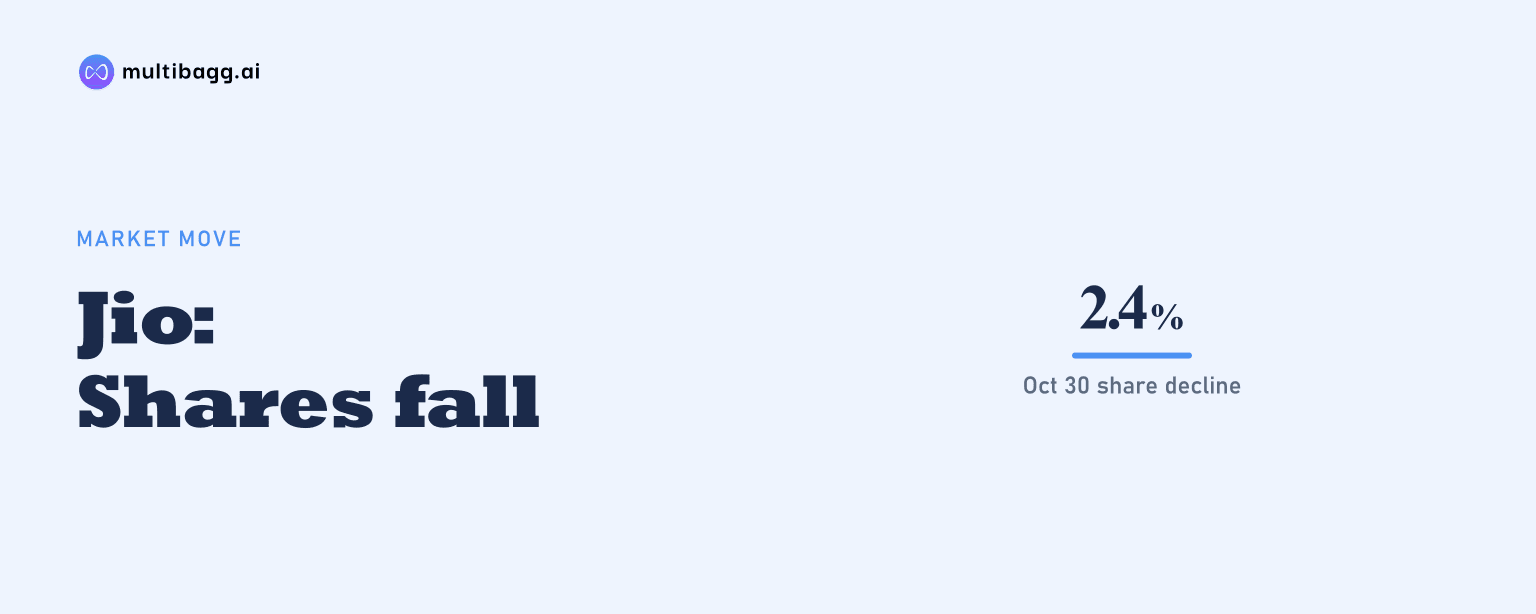
Jio Platforms shares fell 2.4% intraday on October 30 before the company’s Q2 FY27 results, as investors weighed an earnings update against a weaker Indian equity market marked by higher oil prices, foreign investor selling and pressure on heavyweight stocks. The available information does not establish one single reason for the decline.
Why did Jio shares fall before Q2 FY27 results?
Jio shares fell as the market awaited the July-September quarter results and assessed the operating indicators that could shape expectations after the company’s listing. A pre-results decline can reflect caution around revenue, profitability, subscriber additions and margin performance rather than a confirmed change in the company’s outlook.
The broader market setting was also unfavourable. Indian equities had recorded four consecutive losing sessions amid geopolitical tensions in the Middle East, oil prices reported at $114 a barrel and continued foreign institutional investor selling. IT and oil and gas stocks were among the sectors that fell more than 2% in a weak session, while Reliance Industries was also under pressure. These factors created a risk-off environment for heavyweight and recently listed shares.
What Q2 FY27 numbers will Jio investors watch?
Investors will primarily watch Jio’s ARPU, 5G subscriber base, fixed broadband growth, revenue, profit and EBITDA margin. These measures indicate whether the company is improving customer monetisation while expanding its telecom and digital-services businesses.
In Q1 FY27, Jio reported operating revenue growth of 11.8% year on year and profit growth of 9.2%. Its ARPU rose to ₹215.60, helped by a better subscriber mix and positive seasonality, although promotional schemes for fixed broadband customers partly offset the improvement. EBITDA margin expanded by 150 basis points in the prior quarter, but higher finance costs and depreciation after 5G asset capitalisation partly offset EBITDA growth.
Can tariff hikes and 5G monetisation support Jio?
Potential tariff hikes and 5G monetisation are the main factors supporting the positive brokerage view on Jio. Nomura, Motilal Oswal, Dolat Capital and Elara Capital have remained positive, citing higher tariffs, 5G monetisation, broadband expansion and growth in digital services.
Jio had more than 500 million users and a significant share of India’s mobile data traffic, according to the context. Its 5G data traffic was nearly 1.5 times that of 4G in the preceding quarter, indicating strong customer engagement. However, a future tariff increase could also test price-sensitive customers, with analysts noting that another industry-wide rise may lead some users to switch to cheaper plans.
Got a follow-up? Ask IRIS
How important are broadband and digital services to Jio?
Broadband and digital services matter because they can broaden Jio’s revenue base beyond wireless subscriber additions. Investors will monitor total fixed broadband subscriber growth in Q2, as it can affect Jio’s position in the Wi-Fi business and indicate the pace of its home-connectivity expansion.
The company’s future growth is not expected to rely mainly on adding subscribers through discounted plans. The stated opportunity includes entertainment, cloud computing, gaming and financial services, alongside telecom. Investors will therefore look for evidence that these services, broadband growth and improving subscriber mix are translating into sustainable revenue and cash generation as heavy 5G investment eases.
Does the listing change the investment case for Jio?
The listing gives the market a direct valuation reference for Jio and makes quarterly disclosures more important for investors. Jio debuted at ₹1,358 per share on the BSE and NSE, a 21.36% premium to its ₹1,119 issue price, following a ₹30,000 crore IPO round.
The listing may also affect how the company approaches pricing. One view cited in the context is that Jio, as a price setter, could move towards steady tariff hikes that peers may follow. Moody’s said the listing could improve transparency and provide a clearer market valuation because Jio had previously been part of Reliance Industries, which also operates refining and retail businesses. A strong debut, however, does not remove the need to assess subsequent earnings delivery, cash flows and execution.
Conclusion
The 2.4% intraday decline in Jio shares came before a closely watched Q2 FY27 release and alongside a broader market sell-off driven by oil-price, geopolitical and foreign-selling concerns. The immediate focus is not one confirmed trigger but whether Jio can sustain the Q1 trends in ARPU, revenue, profit, 5G adoption and margins.
Investors should next watch the Q2 FY27 results for movement from the ₹215.60 Q1 ARPU level, updates on the roughly 285 million 5G users, fixed broadband additions and EBITDA margin. Commentary on tariffs, digital-services expansion, finance costs, depreciation and cash flows will also be important for judging the company’s post-listing execution plan.