








JohnsonCab targets 247,530 KMS capacity by April 2027
MAX Plan at ₹4,999/yr

Find your next multibaggerBe a Pro Investor
Research stocks and track your picks on the go. Download the app.
Key highlights
- JohnsonCab targets total installed cable capacity of 247,530 KMS per annum by April 2027, from 79,950 KMS currently.
- Unit II capacity is planned to increase from 9,950 KMS to 177,530 KMS per annum.
- JohnsonCab targets March 2027 commercial production for its 47.25-metric-tonne PICC line.
- JohnsonCab reported FY26 revenue of Rs 210.47 crore, compared with Rs 88.34 crore in FY24.
powered by IRIS
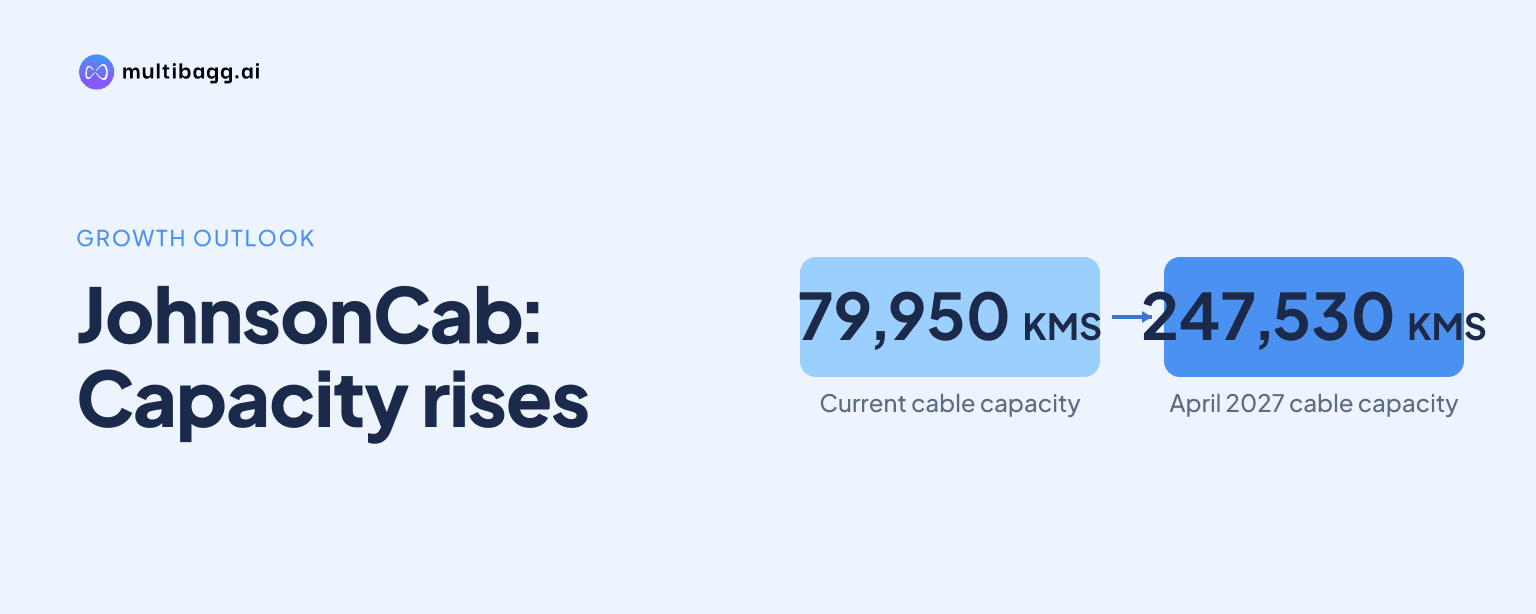
JohnsonCab Electricals Limited targets total cable capacity of 247,530 KMS per annum by April 2027, from 79,950 KMS currently, through a 167,580-KMS addition at Unit II. JohnsonCab also targets March 2027 commercial production of paper insulated copper or aluminium conductors, or PICC, for transformer and generator applications.
Know Johnsoncab Electricals inside out
Results, valuation, peers and who's buying, in one view.
How will JohnsonCab reach 247,530 KMS of capacity?
JohnsonCab will reach 247,530 KMS per annum by adding 167,580 KMS per annum at Unit II, taking that facility from 9,950 KMS to 177,530 KMS per annum. Against the current total installed capacity of 79,950 KMS per annum, the proposed addition is more than twice the existing company-wide capacity.
JohnsonCab plans to make the increase through additional machinery at Unit II. The facility currently includes wire drawing, stranding or bunching, insulation and sheathing extrusion, armouring, finished-goods storage and a polyvinyl chloride, or PVC, compound mixing plant. Unit I has cable cooling and sizing, auto-coiling and packing, annealing, extrusion and finished-goods warehousing.
The presentation describes the proposed capacity as a response to growing demand and a means to improve operating flexibility. It does not disclose capacity utilisation, projected cable production, selling prices or revenue attributable to the additional 167,580 KMS. The stated figure is therefore an installed-capacity target rather than a sales forecast.
When will JohnsonCab commission the Unit II expansion?
JohnsonCab targets commercial production from the Unit II cable expansion in April 2027. Its implementation timetable schedules building and civil works for November to December 2026, machinery delivery and installation for January to February 2027, and trial runs and commissioning for March to April 2027.
JohnsonCab has earmarked Rs 8.46 crore of IPO funding for an additional factory shed and Rs 9.38 crore for plant and machinery. These two listed allocations total Rs 17.84 crore and are the disclosed physical investments tied to the cable-capacity expansion at Unit II.
The company also lists Rs 3.23 crore of IPO funding for a rooftop solar plant at its facilities. JohnsonCab presents rooftop solar as an energy-efficiency initiative intended to lower conventional power costs, but does not quantify planned generation, the share of electricity supplied, or expected savings from the investment.
The stated commissioning range overlaps the April 2027 commercial-production target. JohnsonCab has provided no separate contingency timetable beyond the November 2026 to April 2027 sequence, making completion of the shed, machinery delivery and trial runs the disclosed milestones before production begins.
What is JohnsonCab’s PICC product plan?
JohnsonCab plans to manufacture PICC at Unit II, with commercial production targeted for March 2027. The proposed paper insulated copper or aluminium conductors are intended for oil-filled power and distribution transformers, dry-type transformers, high-tension motors, generators and windmill generators.
The PICC project has a total investment of Rs 8.50 crore, including Rs 7.33 crore from IPO net proceeds. JohnsonCab says Rs 1.17 crore had already been paid as an advance, while the new machinery will be installed in the constructed Unit II shed.
The presentation states that civil works for the PICC shed were completed in August 2026 and funded through a term loan. A technical evaluation report dated 6 August 2026 puts proposed PICC capacity at 47.25 metric tonnes, with machinery installation planned for October to November 2026.
JohnsonCab schedules PICC trial runs for December 2026 to January 2027, ahead of the March 2027 production target. That timing is earlier than the April 2027 target for the main cable expansion, although both initiatives are located at Unit II.
Got a follow-up? Ask IRIS
Which businesses will JohnsonCab’s expansion complement?
JohnsonCab’s expansion will add capacity alongside a portfolio led by power cables and housing or building wires, which together accounted for 62.62% of FY26 revenue. Power cables contributed 32.58% of FY26 revenue, while housing or building wires accounted for 30.04%.
Submersible flat cables represented 13.75% of FY26 revenue, solar or photovoltaic cables 9.01%, industrial single and multicore control cables 7.18%, and welding cables 0.38%. The remaining 7.06% was classified as others, including scrap, raw materials and residual products.
PICC would extend the offering into transformer, motor and generator applications beyond the seven disclosed cable product segments. JohnsonCab also identifies solar cables and aluminium earthing wires as part of its renewable-energy presence, while it says it is building an international presence, particularly in Africa, for mining and power applications.
JohnsonCab reported that government and public-sector undertaking customers contributed 18.89% of FY26 revenue. The presentation names approvals from Western Railway, Uttar Gujarat Vij Company Limited, Jaipur Vidyut Vitran Nigam Limited, Gujarat Roads and Buildings Department and Gujarat State Road Transport Corporation, but does not allocate the added Unit II capacity among customer groups or product lines.
What financial trend supports JohnsonCab’s expansion plan?
JohnsonCab cites revenue growth from Rs 88.34 crore in FY24 to Rs 210.47 crore in FY26, an increase of Rs 122.13 crore over two financial years. Revenue in H1 FY27 was Rs 139.56 crore, according to the presentation.
Earnings before interest, tax, depreciation and amortisation, or EBITDA, increased from Rs 5.52 crore in FY24 to Rs 24.43 crore in FY26. Profit after tax, or PAT, rose from Rs 2.52 crore to Rs 13.30 crore over the same period, while the presentation does not provide post-expansion earnings forecasts.
Cost of goods sold, or COGS, declined to 85.12% of revenue in FY26 from 90.50% in FY24, a reduction of 5.38 percentage points. JohnsonCab’s strategy cites cost optimisation and automation, but it does not disclose a future COGS target or a quantified financial benefit from the proposed capacity addition or rooftop solar plant.
Conclusion
JohnsonCab’s plan combines a move from 79,950 KMS to 247,530 KMS of annual cable capacity with a 47.25-metric-tonne PICC line for transformer, motor and generator uses. The programme follows revenue growth from Rs 88.34 crore in FY24 to Rs 210.47 crore in FY26, with power cables and housing or building wires representing 62.62% of FY26 revenue.
The next disclosed milestones are PICC machinery installation in October to November 2026, PICC trial runs through January 2027 and commercial production in March 2027. For the wider Unit II cable expansion, JohnsonCab schedules civil works in November to December 2026, machinery installation in January to February 2027, and commercial production in April 2027.

