








Subex puts $4.11 billion of TAM in newer categories
MAX Plan at ₹4,999/yr

Find your next multibaggerBe a Pro Investor
Research stocks and track your picks on the go. Download the app.
Key highlights
- Subex states a $4.3 billion TAM across four market segments.
- New-age leakage vectors are the largest segment at $1.70 billion.
- Telco adjacencies represent $1.53 billion, while traditional telco leakage is $0.19 billion.
- Subex’s FY27 plan targets AI-use-case expansion across more than 100 customers with 92% customer retention.
powered by IRIS
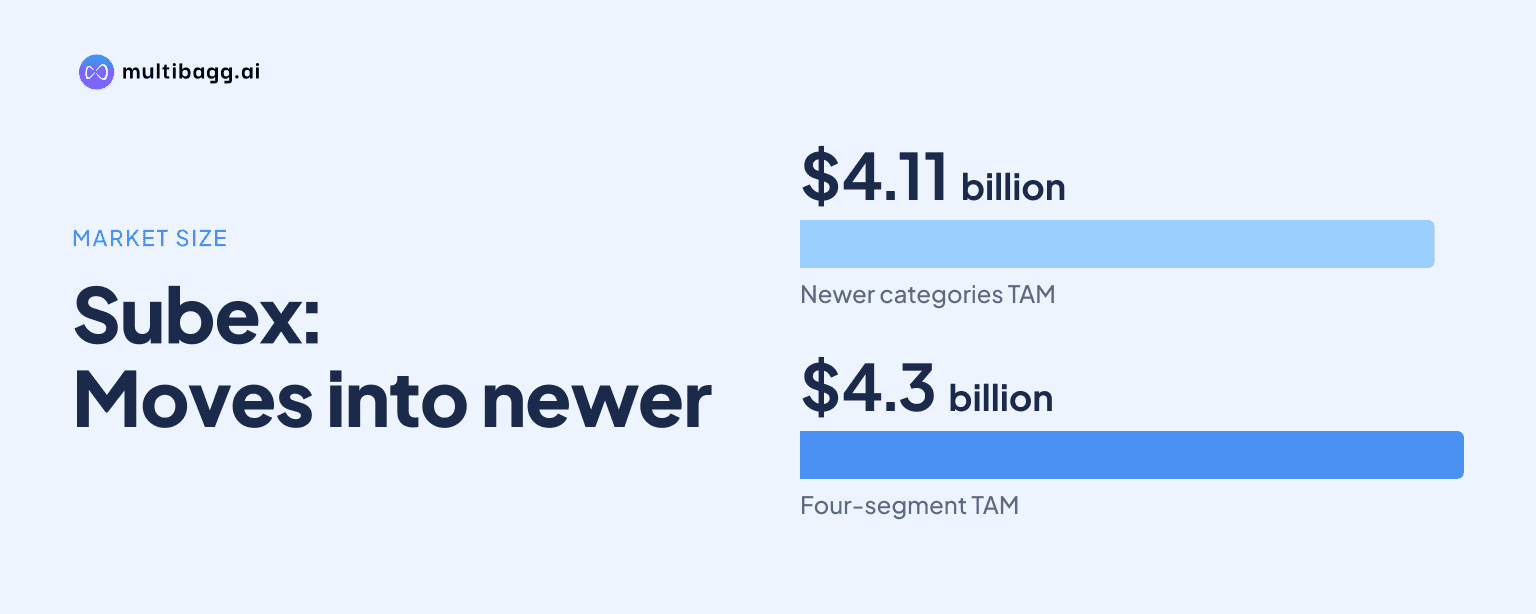
In its FY27 priorities presentation, Subex places $4.11 billion of its $4.3 billion total addressable market in agentic replacement, new-age leakage and telco-adjacency categories, versus $0.19 billion in traditional telco leakage. The company says most of this market did not exist three years ago and maps opportunities as delivered, under way or next.
Know Subex inside out
Results, valuation, peers and who's buying, in one view.
How is Subex’s $4.3 billion market divided?
Subex divides its $4.3 billion total addressable market, or TAM, into four segments led by new-age leakage vectors at $1.70 billion and telco adjacencies at $1.53 billion. Agentic in-house and managed-service replacement accounts for $0.88 billion, while traditional telco leakage represents $0.19 billion. The four segments add to the company’s stated $4.3 billion market figure.
The three categories outside traditional telco leakage total $4.11 billion, or about 96% of the stated TAM. Subex characterises most of the $4.3 billion opportunity as a market that did not exist three years ago. This marks a shift from established telecom fraud and revenue-assurance cases toward automation, newer digital fraud methods and adjacent telecom services.
New-age leakage vectors are the largest ring at $1.70 billion and include subscription fraud, device and equipment theft, account takeover, social engineering, and application-to-person, or A2P, and SMS fraud. Telco adjacencies, at $1.53 billion, include telco fintech, mobile virtual network operator, or MVNO, fraud controls, data-centre assurance and non-terrestrial networks, or NTN.
Which Subex products and use cases are already mapped?
Subex maps opportunities across its four TAM rings using three stages: delivered, under way and next. The company calls the list a sample rather than a comprehensive catalogue, so the presentation identifies product-coverage areas without assigning market share, contract value or revenue to individual use cases.
In traditional telco leakage, the $0.19 billion segment, Subex lists usage and billing assurance, interconnect and roaming settlement, dealer commission fraud, recharge and voucher fraud, private branch exchange, or PBX, hacking, and roaming and high-usage fraud. The map also includes calling-line-identification, or CLI, spoofing and refiling, Wangiri fraud, international revenue-share fraud, or IRSF, artificial inflation of traffic, or AIT, and SIM-box and bypass cases.
The $0.88 billion agentic replacement segment identifies managed-service, or MS, agents that tune and retrain, fix and patch, and monitor and alert. It also names root-cause analysis, or RCA, agents, reconciliation agents, a product-assurance agent and investigation agents for CLI spoofing, SIM-box activity, Wangiri or IRSF, and handset fraud. These cases describe automating parts of in-house teams and managed services rather than only adding fraud alerts.
For the $1.70 billion new-age segment, the map adds eSIM swap and squatting, network application programming interfaces, or APIs, flash calls and robocalls, e-commerce fraud, SIM swap, account takeover and handset fraud. The $1.53 billion adjacency list includes NTN and satellite, Internet of Things, or IoT, and connected cars, eSIM and travel, enterprise business-to-business-to-anything, or B2B2X, 5G and network slicing, gaming and digital content, MVNO and mobile money. Economic integrity is marked separately as on the horizon, with its TAM still to be determined.
Got a follow-up? Ask IRIS
Why is Subex linking fraud controls to economic integrity?
Subex links its expansion plan to the $1.7 trillion annual telecom-revenue pool, where it says every dollar is set by a decision on price, offer, credit or a partner deal. The presentation puts fraud and leakage at $42 billion, or 2.46% of that revenue pool, describing this as the value Subex protects today.
The company describes its role as progressing through three positions. Its core activity over 30 years is a security guard that finds loss after it happens; its current role is a gatekeeper that stops loss at the point of transaction; and its proposed next role is a fund manager that decides where money goes and proves the return. These are Subex’s product-positioning descriptions, not financial forecasts.
Subex defines net value as cash recovered plus loss avoided, less customer harm and the cost to run. It says the model uses the same customer relationships, data and trust, but aims to measure a better-run business in money rather than a higher number of alarms. The mechanism it identifies for this shift is its Architecture of Autonomy.
The transformation timeline sets out four operating stages: rule-based ROC and HS systems in the foundation phase; supervised and unsupervised artificial intelligence, or AI, and embedded generative AI in the transformation phase; investigation and assurance agents in acceleration; and agent-led, human-supervised systems at the destination. Examples include proposing a new fraud-pattern model after an unusual handset-return spike and running assurance on enterprise IoT contracts with latency anomalies above 20 milliseconds.
What will Subex prioritise in FY27?
Subex’s FY27 priorities are to grow its core faster, lead economic integrity and convert proof into revenue. The core-growth plan is to expand AI use cases across more than 100 customers and an installed base for which the company reports 92% customer retention.
The economic-integrity priority is to move from fraud detection toward governing economic decisions made by people or machines. This aligns with the on-the-horizon economic-integrity entry in the $1.53 billion adjacency ring, but the presentation explicitly says its TAM is still to be determined. It should therefore not be treated as part of the stated $4.3 billion figure.
The third priority is commercial conversion: turning pilots, products and customer conversations into contracts. Management frames the plan as adding ambition while retaining the discipline of the preceding three years. The FY27 plan gives direction on product deployment and sales conversion, but does not disclose a revenue target, contract target or timetable for individual agentic use cases.
Conclusion
Subex’s $4.3 billion TAM claim is concentrated outside its $0.19 billion traditional telco-leakage category. The largest components are $1.70 billion of new-age leakage vectors and $1.53 billion of telco adjacencies, while $0.88 billion of agentic in-house and managed-service replacement connects its fraud and assurance work to automation-led operations.
The next issue to watch is execution of the FY27 plan across more than 100 customers with reported 92% retention, particularly whether pilots and customer conversations become contracts. Economic integrity remains unresolved because Subex identifies it as on the horizon and says its TAM is still to be determined.

