








Subex shifts to economic integrity for AI money decisions
MAX Plan at ₹4,999/yr

Find your next multibaggerBe a Pro Investor
Research stocks and track your picks on the go. Download the app.
Key highlights
- Subex illustrates 290 million annual AI-agent money decisions at a 5 million-customer telecom operator.
- Subex estimates $42 billion, or 2.46%, of $1.7 trillion in telecom revenue is lost to fraud and leakage.
- Subex reported Q2 FY27 revenue of Rs 85.60 crore, up 24.2% year on year.
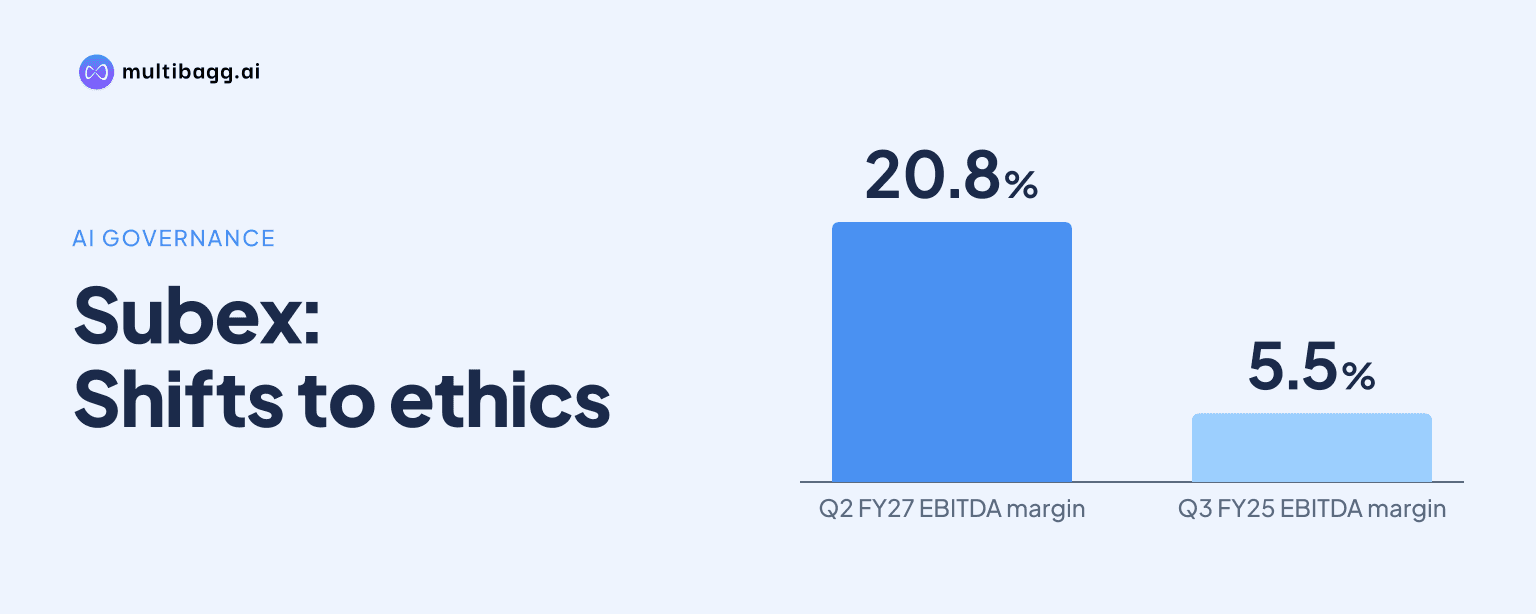
- Subex reported a 20.8% normalised EBITDA margin in Q2 FY27, versus 5.5% in Q3 FY25.
powered by IRIS
Subex is shifting from telecom fraud and leakage controls toward “economic integrity” for AI-driven money decisions, using an illustration of 290 million annual agent decisions at a 5 million-customer telecom operator. The company’s proposed role is to measure whether machine-approved actions create net financial value, rather than only verify whether each action followed rules.
Know Subex inside out
Results, valuation, peers and who's buying, in one view.
Why is Subex changing its telecom assurance position?
Subex is changing its position because it says AI is making telecom networks and customer systems autonomous decision machines. The presentation cites Verizon’s 70 million autonomous network changes in 2025 and says 81% of operators aim for networks with no human in the loop by 2030, creating more pricing, offer, credit and network decisions with direct financial consequences.
The company also links the change to higher AI activity and new market participants. It cites 45 billion AI tokens a day at AT&T, up from 27 billion, and forecasts of roughly three times more uplink traffic by 2031 driven by AI. In Subex’s framing, every new AI service, telecom channel or entrant creates another surface requiring assurance.
Subex describes the next three years as an opening for new telecom spending and control layers. Its presentation estimates annual new telecom spending of $30 billion to $40 billion and a $4.3 billion total addressable market, most of which management says did not exist three years ago. The strategy therefore extends beyond established fraud categories toward risks and spending associated with AI deployment.
What does economic integrity mean at Subex?
Economic integrity means assessing whether an AI-enabled approval remains financially appropriate after its full outcome is measured. Subex contrasts this with a fraud check that asks whether every step was valid, using a phone promotion that meets offer rules and customer-consent requirements but becomes loss-making when thousands of AI agents repeat it.
Subex defines net value as cash recovered plus loss avoided, minus customer harm and the cost to run the control system. The mechanism is intended for decisions affecting the $1.7 trillion annual telecom revenue base cited in the presentation, including prices, offers, credits and partner deals. It shifts the stated objective from generating alarms to measuring the financial outcome of approved decisions.
The company places this proposition beyond its existing loss-protection role. Subex estimates that $42 billion, or 2.46% of global telecom revenue, is lost to fraud and leakage, which it describes as the value it protects today. Its next role is described as governing where money goes and proving the return, moving from “security guard” to “gatekeeper” and then “fund manager.”
Why does Subex see a proof gap in AI decisions?
Subex sees a proof gap because it says decision volumes can rise faster than human review capacity. It cites a 2026 TM Forum and IBM Institute for Business Value finding that 72% of operators consider their AI trustworthy, while only 14% can prove its trustworthiness.
The company calls the difference a verification gap and a measurability gap. The verification gap arises when the same team reviews only a limited number of actions while AI agents make more decisions; the measurability gap arises when a procedurally valid decision still harms economics. In its example, a correctly approved loyalty credit can change the profitability of an offer when repeatedly granted.
Subex supports the scale argument with an estimate of more than 100 billion AI agents by 2030, or about 16 agents per person aged 15 or older in that scenario. Its estimate of 290 million annual money decisions at a 5 million-customer operator is illustrative, not reported customer activity. The company uses those figures to explain its focus on automated measurement and evidence of economic outcomes.
Got a follow-up? Ask IRIS
How does Subex plan to deliver economic integrity?
Subex says its “Architecture of Autonomy” will support economic integrity through AI agents that act under human supervision. The presentation sets out a progression from rule-based ROC and HS systems, through supervised and unsupervised AI, to investigation and assurance agents and, ultimately, human-supervised autonomous systems.
The company’s examples show the intended mechanisms. An investigation agent could detect a spike in iPhone 20 Pro returns, deploy a fraud-pattern model and update a standard operating procedure before review. An assurance agent could examine enterprise Internet of Things contracts for latency anomalies above 20 milliseconds, while another could cross-check roaming settlements and flag deviations below 3%.
Subex identifies four market segments within its $4.3 billion addressable market: $1.70 billion for new-age leakage vectors, $1.53 billion for telecom adjacencies, $0.88 billion for agentic in-house and managed-service replacement, and $0.19 billion for traditional telecom leakage. The segments include subscription fraud, device theft, account takeover, telecom fintech, data-centre assurance and investigation automation.
How does the shift fit Subex’s recent performance?
Subex is presenting the new strategy after improved quarterly operating metrics. Consolidated revenue reached Rs 85.60 crore in Q2 FY27, up 24.2% year on year from Rs 68.90 crore in Q2 FY26 and up from Rs 79.50 crore in Q1 FY27. The company described Q2 FY27 as its fifth consecutive quarter of quarter-on-quarter revenue growth.
Normalised earnings before interest, tax, depreciation and amortisation margin was 20.8% in Q2 FY27, compared with 5.5% in Q3 FY25 eight quarters earlier. Subex also reported six consecutive quarters of positive profit after tax from Q1 FY26 through Q2 FY27. These metrics do not disclose revenue from economic integrity, but they provide the setting for management’s FY27-and-beyond focus on growth, AI monetisation and economic integrity.
Conclusion
Subex’s strategic message is that autonomous AI expands telecom assurance from detecting fraud or blocking losses into measuring the financial consequences of machine decisions. Its economic-integrity proposition combines the 290 million annual-decision illustration, the 72% versus 14% trust-and-proof gap, and the $42 billion fraud-and-leakage estimate to define the proposed need for a new control layer.
The next issue is execution through the Architecture of Autonomy and whether Subex converts its stated $4.3 billion addressable market into deployments or disclosed revenue. Management identifies FY27 and beyond for growth, AI monetisation and economic integrity, while also characterising the coming three years as a period in which AI-led telecom market positions may be established.

