








Subex™ lifts normalised EBITDA margin to 20.8% in Q2 FY27
MAX Plan at ₹4,999/yr

Find your next multibaggerBe a Pro Investor
Research stocks and track your picks on the go. Download the app.
Key highlights
- Subex reported Rs 85.6 crore of consolidated revenue in Q2 FY27, up 24.2% year on year.
- Subex's normalised EBITDA margin increased from 5.5% in Q3 FY25 to 20.8% in Q2 FY27.
- Revenue rose for five consecutive quarters to Rs 85.6 crore in Q2 FY27.
- Subex reported positive PAT for six consecutive quarters from Q1 FY26 to Q2 FY27.
powered by IRIS
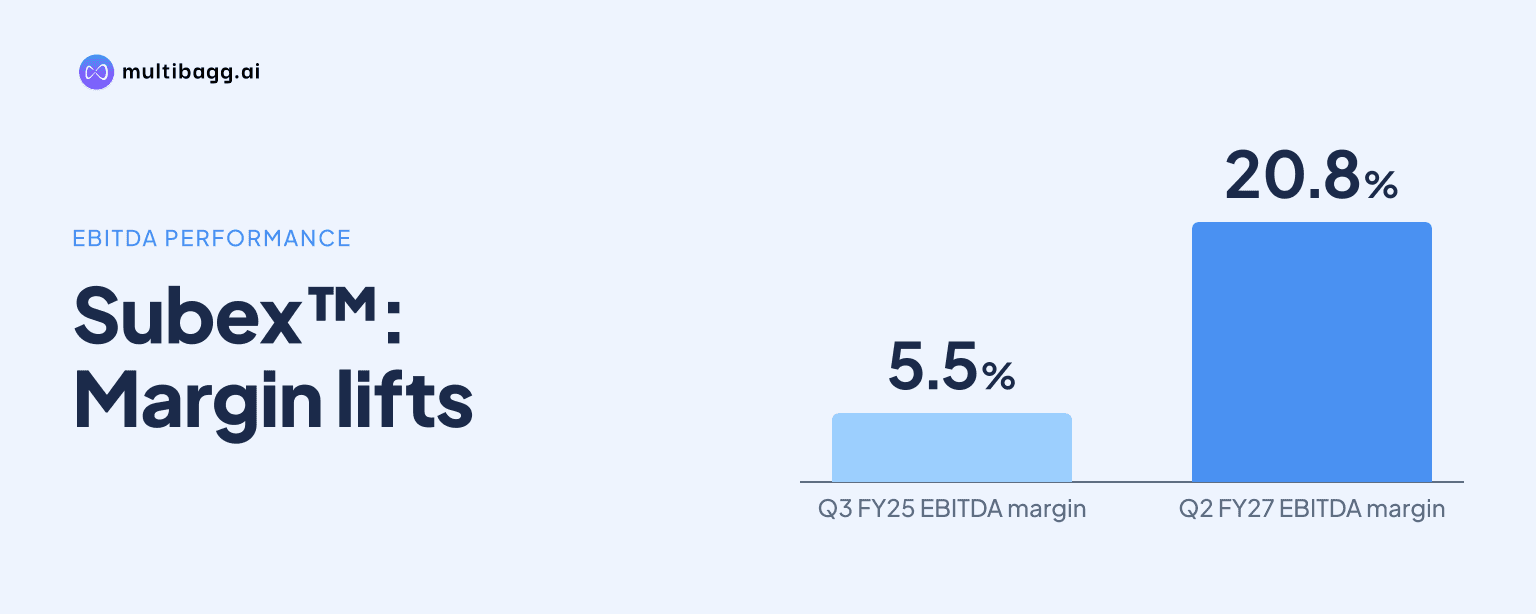
In Q2 FY27, Subex™ lifted normalised EBITDA margin to 20.8%, from 5.5% in Q3 FY25 eight quarters earlier, while consolidated revenue reached Rs 85.6 crore, up 24.2% year on year. The presentation also records five consecutive quarters of quarter-on-quarter revenue growth and six consecutive quarters of positive reported profit after tax.
Know Subex inside out
Results, valuation, peers and who's buying, in one view.
How did Subex's normalised EBITDA margin change over eight quarters?
Subex's normalised EBITDA margin increased by 15.3 percentage points, to 20.8% in Q2 FY27 from 5.5% in Q3 FY25. The Q2 FY27 reading was the second-highest in the eight-quarter record, after 21.2% in Q1 FY27. The presentation labels the measure as normalised EBITDA, or earnings before interest, tax, depreciation and amortisation, but does not disclose a reconciliation for the normalisation.
The improvement did not occur in a straight line. Margin rose to 7.5% in Q4 FY25 before falling to 6.3% in Q1 FY26, then recovered to 7.1% in Q2 FY26. It moved higher to 12.8% in Q3 FY26 and 14.5% in Q4 FY26, before passing 20% in both quarters of H1 FY27. Q2 FY27 was 0.4 percentage points below Q1 FY27 but 6.3 percentage points above Q4 FY26.
How fast did Subex's revenue grow in Q2 FY27?
Subex reported consolidated revenue of Rs 85.6 crore in Q2 FY27, a 24.2% year-on-year increase and its fifth consecutive quarter of quarter-on-quarter growth. Revenue was Rs 68.9 crore in Q2 FY26, making the year-on-year increase Rs 16.7 crore. Sequentially, revenue rose by Rs 6.1 crore from Rs 79.5 crore in Q1 FY27.
The eight-quarter revenue series first declined, then reversed. Revenue fell from Rs 72.7 crore in Q3 FY25 to Rs 70.6 crore in Q4 FY25 and reached Rs 66.4 crore in Q1 FY26. It then increased every quarter, reaching Rs 68.9 crore, Rs 70.8 crore, Rs 73 crore, Rs 79.5 crore and Rs 85.6 crore. The latest figure was Rs 19.2 crore above the Q1 FY26 low in the reported series.
What does Subex report on profitability and its reset?
Subex says reported profit after tax, or PAT, was positive for six consecutive quarters from Q1 FY26 through Q2 FY27. PAT is distinct from the 20.8% normalised EBITDA margin reported in Q2 FY27, and the presentation does not provide quarterly PAT amounts for the six-quarter run. It does identify positive PAT in every FY26 quarter as part of its operational progress.
The company positions the improvement against FY23, when it reported EBITDA of negative 3.9% and PAT of negative 18.4%. During FY24 and FY25, Subex says it exited Sectrio and IDC while applying cost discipline and pursuing a productivity unlock. For FY26, described in the presentation as its “Apollo 13 year”, it also cites a reconstituted board and its highest order intake in six years, although no order-intake value is disclosed.
Got a follow-up? Ask IRIS
Which businesses form Subex's focused portfolio?
Subex lists fraud management, Fraud Zap, business assurance and partner ecosystem management as its core product areas, with artificial intelligence embedded in platforms and products. Fraud management covers telecom fraud detection, prevention and case management, while Fraud Zap consists of lightweight fraud-detection use cases intended for faster deployment. The AI offering includes AI use cases and generative-AI agents.
Business assurance includes revenue assurance, margin assurance and migration assurance, while partner ecosystem management includes partner settlement and routing optimisation. Subex reports more than 150 installations across more than 100 countries and more than 700 employees globally. It also says about 60% of customers have been with the company for at least eight years, which the presentation associates with its installed base and switching costs.
What is Subex's plan after the Q2 FY27 improvement?
Subex describes FY27 and later as its “next orbit”, focused on growth, AI monetisation and economic integrity. Management calls H1 FY27 its “apogee”, citing Q2 FY27 revenue growth of 24.2% year on year and an approximately 21% normalised EBITDA margin. The stated approximately 21% figure corresponds with the reported Q2 FY27 margin of 20.8%, but the presentation does not provide a numerical revenue or margin target.
The presentation identifies a three-year telecom industry window and states a total addressable market, or TAM, of $4.3 billion, most of which it says did not exist three years earlier. It links the opportunity to AI-led telecom change and new spending, including $30 billion to $40 billion of new annual industry spending. However, Subex does not disclose a forecast for its revenue, order intake, profitability, market share or timing of AI monetisation from that opportunity.
Conclusion
Subex's presentation shows an operating turnaround across the eight-quarter period: normalised EBITDA margin rose from 5.5% to 20.8%, while revenue recovered from Rs 66.4 crore in Q1 FY26 to Rs 85.6 crore in Q2 FY27. The company also reports six consecutive quarters of positive PAT following its FY24 to FY25 refocus, including the exits from Sectrio and IDC.
The next reported quarters will show whether revenue can extend its five-quarter growth sequence beyond Rs 85.6 crore and whether margin remains near the 20.8% to 21.2% range seen in H1 FY27. Management's disclosed plan centres on growth, AI monetisation and economic integrity, while the financial contribution and timing of its stated $4.3 billion TAM remain unresolved.

