








JohnsonCab: Four Markets Supplied 83.72% of FY26 Revenue
MAX Plan at ₹4,999/yr

Find your next multibaggerBe a Pro Investor
Research stocks and track your picks on the go. Download the app.
Key highlights
- JohnsonCab generated 83.72% of FY26 revenue from distributors, renewable energy, railways and construction.
- Renewable energy and railways accounted for a combined 42.12% of JohnsonCab’s FY26 revenue.
- Power cables and housing or building wires contributed 62.62% of JohnsonCab’s FY26 product revenue.
- JohnsonCab plans to expand Unit II capacity from 9,950 kilometres to 1,77,530 kilometres per annum.
powered by IRIS
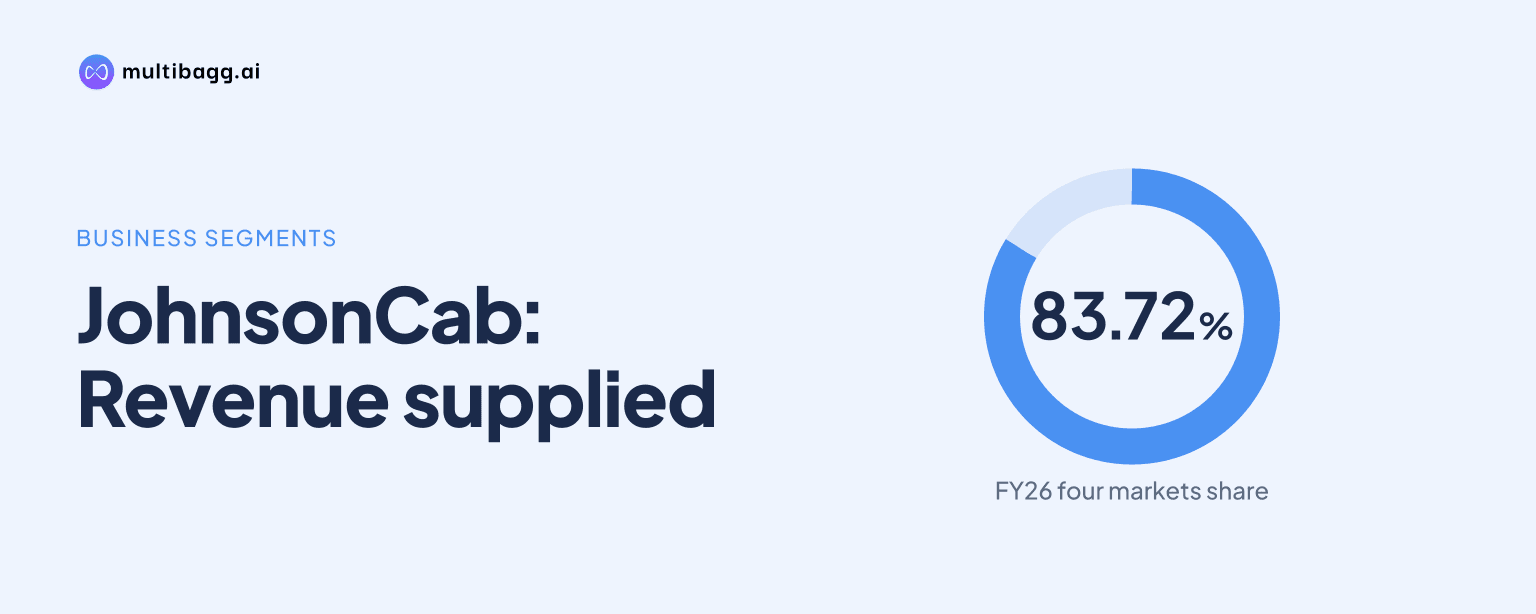
JohnsonCab Electricals Limited derived 83.72% of FY26 revenue from distributors, renewable energy, railways and residential/commercial construction, while renewable energy and railways contributed 42.12% combined. The four categories dominated the cable maker’s 10 disclosed end-use industries in FY26, when revenue reached Rs 210.47 crore.
Know Johnsoncab Electricals inside out
Results, valuation, peers and who's buying, in one view.
What were JohnsonCab’s largest FY26 end markets?
JohnsonCab’s largest FY26 end markets were distributors at 24.33%, renewable energy at 23.24%, railways at 18.88% and residential/commercial construction at 17.27%. The four categories totalled 83.72%, leaving 16.28% for the other six disclosed industries. Distributors exceeded renewable energy, the second-largest category, by 1.09 percentage points.
JohnsonCab’s remaining end markets were power transmission and distribution at 4.49%, agriculture at 4.09%, chemical at 3.05%, others at 2.81%, infrastructure at 1.74% and oil and gas at 0.11%. The top four industries therefore accounted for more than five times the revenue share of these six categories combined.
JohnsonCab also reported that government and public-sector customers generated 18.89% of FY26 revenue. This is a customer-type disclosure rather than an end-use category, and the presentation does not allocate railway, utility or infrastructure sales between public and private customers.
How significant were renewable energy and railways for JohnsonCab?
Renewable energy and railways supplied 42.12% of JohnsonCab’s FY26 revenue, consisting of 23.24% from renewable energy and 18.88% from railways. Renewable energy was 4.36 percentage points larger than railways, while the two segments together exceeded distributors and construction combined, which represented 41.60%.
JohnsonCab identifies solar or photovoltaic cables and aluminium earthing wires as products used in renewable and power projects. Solar or photovoltaic cables represented 9.01% of FY26 product revenue, but the presentation does not state that this product category represents all revenue from renewable-energy end users.
JohnsonCab lists Indian Railways among its key customer or utility approvals and marquee customers. The presentation does not disclose the value of railway contracts, order backlog, approval-linked revenue or a railway revenue target, so the reported 18.88% is a historical FY26 end-use share rather than a forward projection.
Which products made up JohnsonCab’s FY26 revenue?
Power cables and housing or building wires generated 62.62% of JohnsonCab’s FY26 revenue. Power cables accounted for 32.58% and housing or building wires for 30.04%, a difference of 2.54 percentage points. These were the leading two categories among seven reported product segments.
Submersible flat cables contributed 13.75%, solar or photovoltaic cables 9.01%, industrial single and multicore control cables 7.18% and welding cables 0.38%. The other 7.06% included scrap, raw-material sales and other residual products, according to the presentation.
The product and end-use disclosures measure different aspects of sales. A power cable may be sold into railways, construction or power transmission and distribution, while distributors may sell multiple product types. JohnsonCab’s product breadth therefore does not alter the reported concentration of 83.72% in four end-use markets.
Got a follow-up? Ask IRIS
What approvals support JohnsonCab’s market access?
JohnsonCab lists seven Bureau of Indian Standards certifications, including standards IS 694:2010, IS 7098 Part 1, IS 7098 Part 2 and IS 1554 Part 1. It also reports compliance with Registration, Evaluation, Authorisation and Restriction of Chemicals requirements and Restriction of Hazardous Substances requirements.
JohnsonCab identifies Uttar Gujarat Vij Company Limited, Gujarat Energy Transmission Corporation Limited, Maharashtra State Electricity Distribution Company Limited and the Road and Buildings Department of the Government of Gujarat among its other approvals or compliances. Its key customer or utility approvals also include Jaipur Vidyut Vitran Nigam Limited, Oil and Natural Gas Corporation, the Indian Space Research Organisation and Indian Railways.
These disclosed approvals correspond with end markets such as railways, power transmission and distribution, infrastructure and oil and gas. However, the presentation gives no approval-by-approval sales figures: power transmission and distribution contributed 4.49% of FY26 revenue, while oil and gas contributed 0.11%.
How is JohnsonCab planning to support sales growth?
JohnsonCab plans to increase Unit II capacity from 9,950 kilometres to 1,77,530 kilometres per annum through additional machinery. The planned addition of 1,67,580 kilometres is intended to support higher demand and operating scale, according to the presentation.
The recently closed initial public offering earmarked Rs 28.40 crore for capital expenditure and Rs 14 crore for additional working capital. Capital expenditure includes Rs 8.46 crore for an additional factory shed, Rs 9.38 crore for plant and machinery, Rs 7.33 crore for paper-insulated copper or aluminium conductor machinery and Rs 3.23 crore for a rooftop solar plant.
JohnsonCab’s strategy also includes paper-covered copper and aluminium conductors for transformers, motors and generators, alongside solar cables and aluminium earthing wires. Revenue increased from Rs 88.34 crore in FY24 to Rs 210.47 crore in FY26, and H1 FY27 revenue was Rs 139.56 crore; cost of goods sold as a share of revenue declined from 90.50% in FY24 to 85.12% in FY26.
What does the FY26 mix indicate about JohnsonCab’s concentration?
JohnsonCab’s FY26 revenue was more concentrated by end market than by its two largest product categories. The four leading end-use industries accounted for 83.72% of sales, compared with 62.62% from power cables and housing or building wires, the two largest product categories.
Smaller end markets included infrastructure and oil and gas, which together represented 1.85% of FY26 revenue, and agriculture and chemical, which together represented 7.14%. JohnsonCab cites power transmission and distribution build-out, railway modernisation, reconductoring and premiumisation as industry drivers, but it does not disclose FY27 targets for any individual end market.
Conclusion
JohnsonCab’s FY26 sales profile was led by distributors, renewable energy, railways and construction, with those four categories producing 83.72% of revenue. Renewable energy and railways alone represented 42.12%, while power cables and housing or building wires remained the principal products at 62.62% of FY26 sales.
The next disclosed items to watch are the Unit II expansion from 9,950 kilometres to 1,77,530 kilometres per annum and deployment of Rs 28.40 crore of planned capital expenditure. JohnsonCab reported Rs 139.56 crore of H1 FY27 revenue, but has not disclosed the timing of added-capacity commissioning or future end-market revenue targets.

