










JSW Infrastructure Fujairah restart hinges on storage demand
Key highlights
- JSW Infrastructure plans to commission and operate 8 Fujairah tanks in the first week of November, but utilisation will depend on storage demand in November and December.
- International operations posted an EBITDA loss of about Rs 16 crore in H1 FY27, compared with Fujairah EBITDA of Rs 134 crore in H1 FY26.
- JSW Infrastructure is targeting FY27 EBITDA of Rs 2,950 crore to Rs 3,000 crore, including port EBITDA of Rs 2,550 crore to Rs 2,560 crore.
- The company plans to increase its logistics rake fleet from 78 to 110 over the next 6 months and expects domestic cargo growth of 8% to 10% in H2.
powered by IRIS
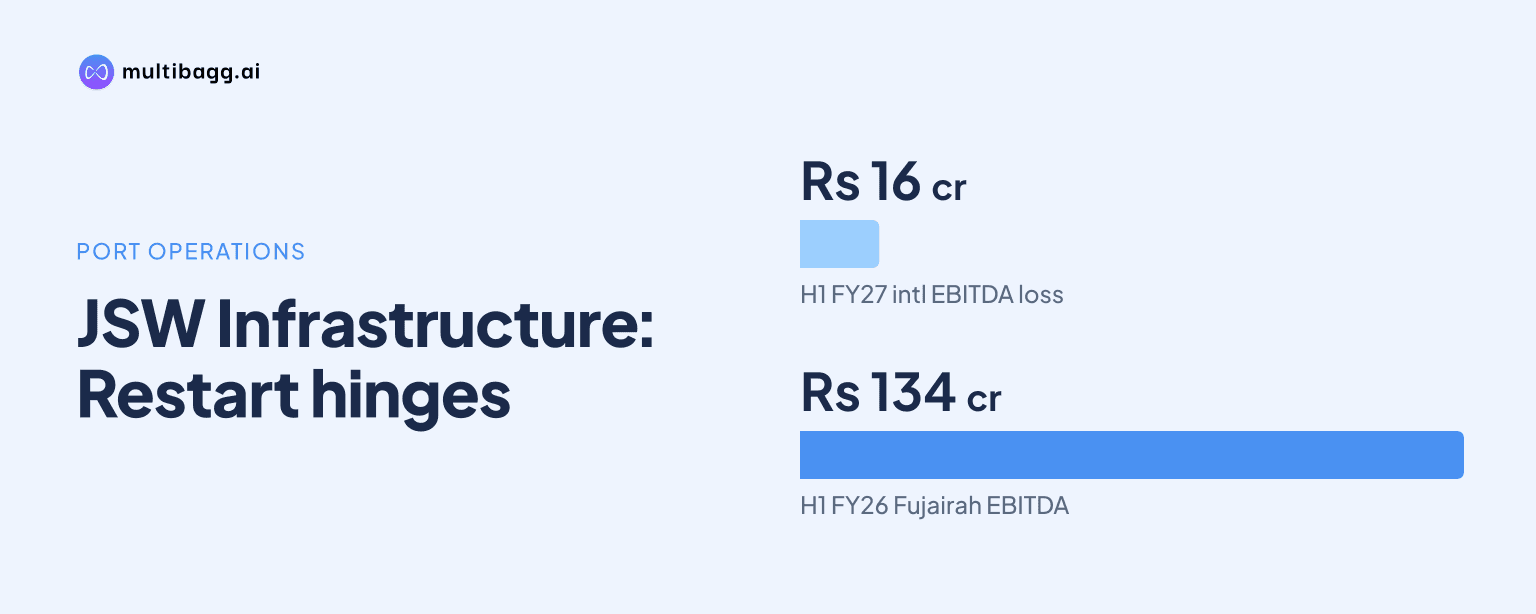
JSW Infrastructure Limited plans to commission eight tanks at its Fujairah liquid terminal in the first week of November, but management said volumes will depend on product-storage demand in November and December. International operations posted an EBITDA loss of about Rs 16 crore in H1 FY27, compared with Rs 134 crore of Fujairah EBITDA in H1 FY26.
Know JSW Infrastructure inside out
Results, valuation, peers and who's buying, in one view.
When will JSW Infrastructure restart Fujairah tanks?
JSW Infrastructure plans to officially commission and begin operating eight Fujairah tanks in the first week of November. Management said the tanks were under testing at the time of the call, following continued disruption at the liquid terminal. The immediate plan is to complete physical commissioning rather than commit to a throughput or earnings-recovery date.
The restart will not by itself assure a return of volumes because demand for stored products in November and December will determine tank utilisation, management said. It described the near-term situation as fluid, distinguishing between having tanks available and securing customer demand. That distinction follows the shift from positive Fujairah earnings in FY26 to an international-operations loss in H1 FY27.
Management continues to view Fujairah as a strategic location because it sits outside the Straits of Hormuz. It cited cargo shifts towards Fujairah, pipeline connections from the Abu Dhabi area and a train line as mechanisms that could support longer-term cargo potential. These are management views on the location's prospects rather than a forecast of near-term utilisation.
How did Fujairah affect JSW Infrastructure EBITDA?
JSW Infrastructure's international operations recorded about Rs 16 crore of negative EBITDA in H1 FY27, primarily because fixed overheads continued during the disruption. Fujairah generated Rs 134 crore of EBITDA in H1 FY26, creating a Rs 150 crore change between the two half-year periods.
The Rs 250 crore Fujairah EBITDA in FY26 reflected about 11 months of full operations, management said. Operations began declining from March, when the terminal was temporarily down. The Rs 134 crore reported for H1 FY26 represents more than half of the full-year FY26 contribution before the disruption changed operating conditions.
JSW Infrastructure also received around Rs 4 crore in H1 FY27 from operating and maintenance contracts at Dibba Port and Fujairah Port. That income did not offset the fixed overheads in international operations. Management therefore said Fujairah had contributed virtually no EBITDA during the period used in its broader FY27 guidance discussion.
Will insurance cover JSW Infrastructure's Fujairah losses?
JSW Infrastructure said insurance claims remain under assessment, with no disclosed settlement amount or payment timetable. Management said a forensic study had been completed, but insurers were awaiting a state determination on whether the event would be classified as war before deciding how the claim would be put forward.
Management said its first insurance priority is recovering capital expenditure required to construct or reconstruct the storage facility. It said this would take precedence over pursuing a loss-of-profit claim. The company has therefore not indicated that insurance proceeds would replace the about Rs 16 crore H1 FY27 EBITDA loss or the Rs 134 crore Fujairah EBITDA reported in H1 FY26.
Two matters consequently remain unresolved: the funding of reconstruction and recovery of earnings forgone during the disruption. The planned November restart applies to the eight tanks under testing, while the insurance process depends on the event classification and the form of the final claim. Management gave neither a final claim value nor a decision date.
Got a follow-up? Ask IRIS
What does Fujairah mean for JSW Infrastructure's FY27 target?
JSW Infrastructure is targeting FY27 EBITDA of about Rs 2,950 crore to Rs 3,000 crore, after outlining around Rs 3,000 crore in January. Management said the operating environment had changed because of Middle East escalation and Fujairah's lack of EBITDA contribution. Its port EBITDA expectation is now Rs 2,550 crore to Rs 2,560 crore, rather than Rs 2,600 crore.
The logistics business delivered Rs 153 crore of EBITDA in H1 FY27, but management expects a fuller H2 contribution after additional rakes arrived only toward the end of September. It plans to increase its rake fleet from 78 to 110 over the next six months, with revenue beginning as the rakes enter service. This is the mechanism management cited for expecting logistics EBITDA slightly above Rs 400 crore.
Fujairah's recovery is not presented as the principal bridge to the group target. Management instead relies on rakes operating through a full half-year and on ports delivering near the revised range. The port outlook of Rs 2,550 crore to Rs 2,560 crore is Rs 40 crore to Rs 50 crore below the earlier Rs 2,600 crore figure.
What other operations could offset Fujairah disruption?
JSW Infrastructure expects domestic cargo growth of 8% to 10% year on year in H2, broadly the same range as H1, despite a planned roughly 30-day Tuticorin shutdown to commission a berth. Management cited growth at the Paradip coal terminal and Ennore bulk terminal, alongside the July start of Kolkata operations, as contributors to third-party cargo growth.
At the Paradip iron ore terminal, Q2 volumes declined after a vessel carrying iron ore sank about 240 nautical miles off Paradip on August 22. Regulators restricted exporter clearances during the rainy season under transportation moisture-limit requirements. By the end of September, the terminal held nearly 8 lakh tonnes of stock and had to refuse traffic, management said.
JSW Infrastructure is orienting future port bids towards containers and liquids, particularly at major ports in southern India. Management said it would participate less aggressively in bulk opportunities unless they made strategic sense. Its capacity plan remains 300 million tonnes per annum by FY28, while FY27-FY28 capital expenditure guidance remains Rs 16,500 crore after Rs 2,100 crore of spending in the current financial year.
Conclusion
JSW Infrastructure's Fujairah position combines a defined operational milestone with an uncertain commercial outcome. Eight tanks are planned to begin operating in the first week of November, but management has said demand in November and December will determine whether the restart translates into volumes. The financial reversal is material, from Rs 134 crore of Fujairah EBITDA in H1 FY26 to an about Rs 16 crore international-operations loss in H1 FY27.
The next disclosed milestones are the commissioning of the eight tanks, storage demand through December and progress in the unresolved insurance assessment. Management is also targeting FY27 EBITDA of Rs 2,950 crore to Rs 3,000 crore, supported by plans to increase the rake fleet from 78 to 110 over the next six months and to maintain domestic cargo growth of 8% to 10% in H2.