










JSW Infrastructure targets 110 rail rakes by March 2027
Key highlights
- JSW Infrastructure plans to increase its rail-rake fleet from 78 at the end of Q2 FY27 to at least 110 by March 2027.
- Logistics EBITDA rose 3.3 times year-on-year to Rs 81 crore in Q2 FY27 from Rs 25 crore, while the margin increased to 29% from 15%.
- The company’s logistics network expanded from 3 to 8 locations, and its domestic container fleet grew from about 2,400 to nearly 5,000.
- JSW Infrastructure retained its FY27 logistics EBITDA target of Rs 400 crore while raising logistics-margin guidance to 28% from 24%.
powered by IRIS
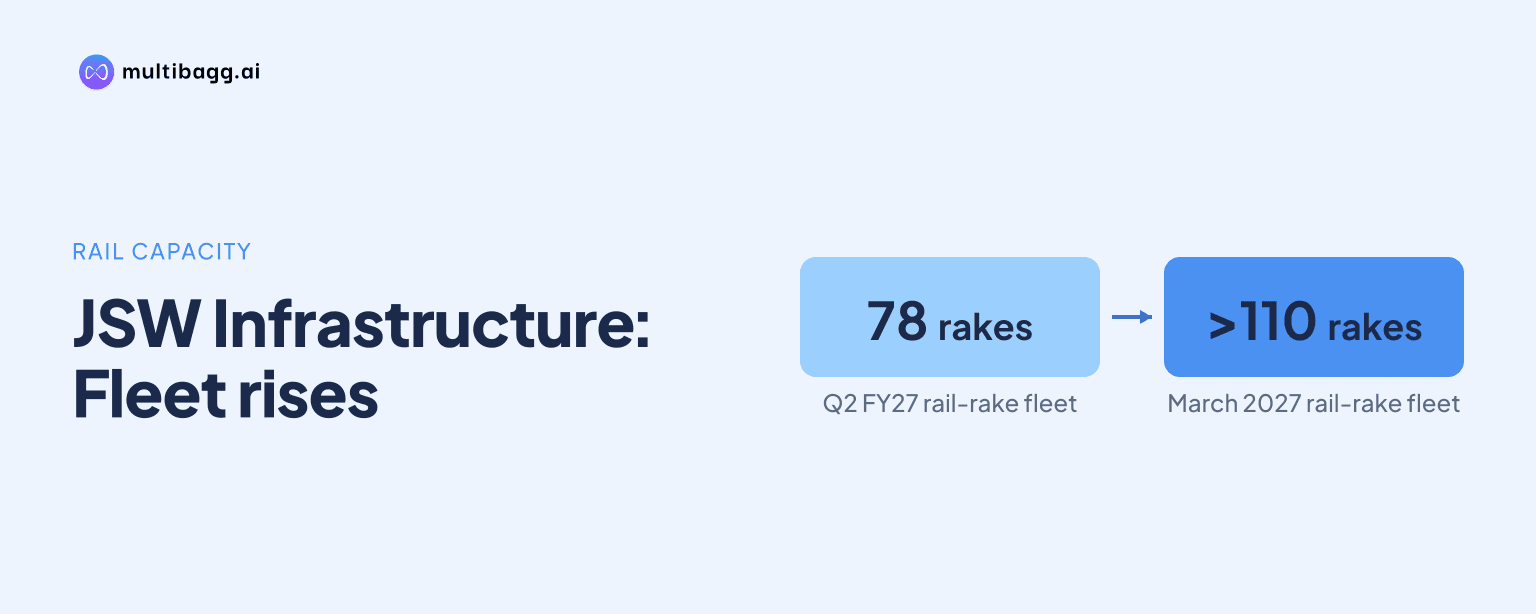
JSW Infrastructure Limited plans to operate at least 110 rail rakes by March 2027, up from 78 at the end of the second quarter of financial year 2027 (Q2 FY27). Management said the expansion follows a 3.3-times year-on-year rise in logistics operating earnings before interest, tax, depreciation and amortisation (EBITDA) to Rs 81 crore in Q2 FY27.
Know JSW Infrastructure inside out
Results, valuation, peers and who's buying, in one view.
Why is JSW Infrastructure expanding its rail-rake fleet?
JSW Infrastructure is expanding its fleet because rail logistics is contributing to higher network utilisation and logistics earnings. The fleet rose from 42 rakes at the beginning of Q2 FY27 to 78 by quarter-end, a 36-rake increase. Management said the business benefited from customer additions and greater utilisation across its growing logistics network.
The wider logistics platform has expanded since JSW Infrastructure entered the segment in October 2024. Its network grew from three locations to eight, while the domestic container fleet increased from about 2,400 containers to nearly 5,000. The company described the rail expansion as part of its plan to build an integrated national logistics network alongside its port operations.
The planned March 2027 fleet would be 68 rakes larger than the Q2 FY27 opening base and 32 above the quarter-end level. Management said 72 rakes had been operational since October 2026, with the remaining six from the 78-rake fleet expected to be operationalised in November and December 2026. It expects another 32 rakes to be delivered in the second half of FY27.
How did JSW Infrastructure logistics earnings change in Q2 FY27?
JSW Infrastructure’s logistics EBITDA rose to Rs 81 crore in Q2 FY27 from Rs 25 crore a year earlier, a 3.3-times increase. The logistics EBITDA margin increased to 29% from 15%, which management attributed to the growing contribution of rail logistics. This was a sharper earnings change than in ports, where EBITDA increased to Rs 594 crore from Rs 585 crore.
Logistics operating revenue was close to Rs 279 crore in Q2 FY27, according to management’s response to an analyst question. Management identified Rs 223 crore as Navkar Corporation revenue and said the balance was rail-freight revenue. It also said rake-business margins were about 90% because reported revenue includes only the premium and rebate, while haulage charges are netted off.
Domestic cargo at Navkar Corporation rose 16% year-on-year to 459,000 metric tonnes in Q2 FY27, while export-import cargo reached 88,000 twenty-foot equivalent units (TEUs), up 12%. For the first half of FY27, Navkar Corporation’s domestic cargo grew 26% and export-import cargo rose 7%. These volume gains accompanied the expansion in rail capacity but do not establish that each added rake produces the same revenue.
Got a follow-up? Ask IRIS
What does the fleet plan mean for JSW Infrastructure’s wider logistics network?
JSW Infrastructure’s 110-rake target is intended to extend links between its ports, rail assets and inland logistics locations. During Q2 FY27, the company acquired NCR Rail Infrastructure Limited, received approval to develop an inland container depot at Kudathini in Ballari, and won a Gati Shakti Cargo Terminal at Kulipalaiyam in Tamil Nadu. Management said these steps expanded its rail-linked logistics footprint.
The company also has a logistics earnings target for FY27. Management retained its overall logistics EBITDA target of Rs 400 crore while revising logistics EBITDA-margin guidance to 28% from 24%. The stated reason for the margin revision was accounting treatment for the specialised-rakes business, not a change to the annual EBITDA target.
Management differentiated between container rakes and another rake category when asked whether revenue could be extrapolated in line with fleet additions. It said container-rake revenue primarily depends on volumes, while revenue from the other category is typically linear. That distinction means the planned increase from 78 to 110 rakes is a capacity expansion, while actual revenue will also depend on cargo movement and the rake mix.
How does the rail expansion sit alongside JSW Infrastructure’s port business?
JSW Infrastructure is scaling rail logistics while pursuing port-capacity expansion from 186 million tonnes per annum currently to 300 million tonnes per annum by FY28 and 400 million tonnes per annum by FY30. Management’s stated objective is for logistics integration to increase cargo stickiness and deepen customer engagement across the ports and logistics platform.
Port cargo volume reached 29.4 million tonnes in Q2 FY27, compared with 28.9 million tonnes in Q2 FY26, a 2% increase. India operations grew 8%, aided by capacity use at Paradip Coal Terminal, Ennore Bulk and Mangalore Coal terminals, plus interim operations at Tuticorin and Kolkata. Total growth was held back by no contribution from Fujairah Liquid Terminal and lower volumes at Jaigarh and Paradip Iron Ore Terminal.
For the first half of FY27, consolidated operating revenue increased 18% year-on-year to Rs 2,926 crore and operating EBITDA increased 13% to Rs 1,348 crore. Net profit was Rs 686 crore. In Q2 FY27, consolidated revenue was Rs 1,481 crore and EBITDA was Rs 674 crore, up 17% and 11%, respectively, while profit after tax fell to Rs 328 crore from Rs 369 crore.
The profit decline reflected lower profit before tax, a higher effective tax rate and the absence of tax-exempt earnings from Fujairah Oil Terminal, management said. Profit before tax declined to Rs 431 crore from Rs 463 crore, with unrealised foreign-exchange losses, a shift in the yield curve and higher depreciation also cited. These factors show that the logistics expansion is occurring alongside changes in portfolio mix and financing-related costs.
Conclusion
JSW Infrastructure’s disclosed plan is to add 32 rakes after the 78-rake Q2 FY27 fleet, taking the total to at least 110 by March 2027. The operational case rests on increased network utilisation, customer additions and a higher rail-logistics contribution, which helped lift quarterly logistics EBITDA to Rs 81 crore and the segment margin to 29%.
The next measures to watch are the operationalisation of six rakes in November and December 2026, delivery of 32 more during the second half of FY27, and progress toward management’s Rs 400 crore logistics EBITDA target. Management also expects its slurry-pipeline project to be commissioned by March 2027, while port projects at Jaigarh and Dharamtar have later completion schedules.