










JSW Infrastructure Wins ₹60 Crore New Shambhu Cargo Terminal
Key highlights
- JSW Infrastructure received a ₹60 crore LOA for a Gati Shakti cargo terminal at New Shambhu, Punjab.
- The New Shambhu terminal contract runs for 35 years from the LOA date, including construction and extensions.
- Construction must start within 3 months and finish within 18 months of the later of ESP approval or railway-land handover.
- JSW Infrastructure started commercial operations at its Arakkonam GCT on April 14, 2026.
powered by IRIS
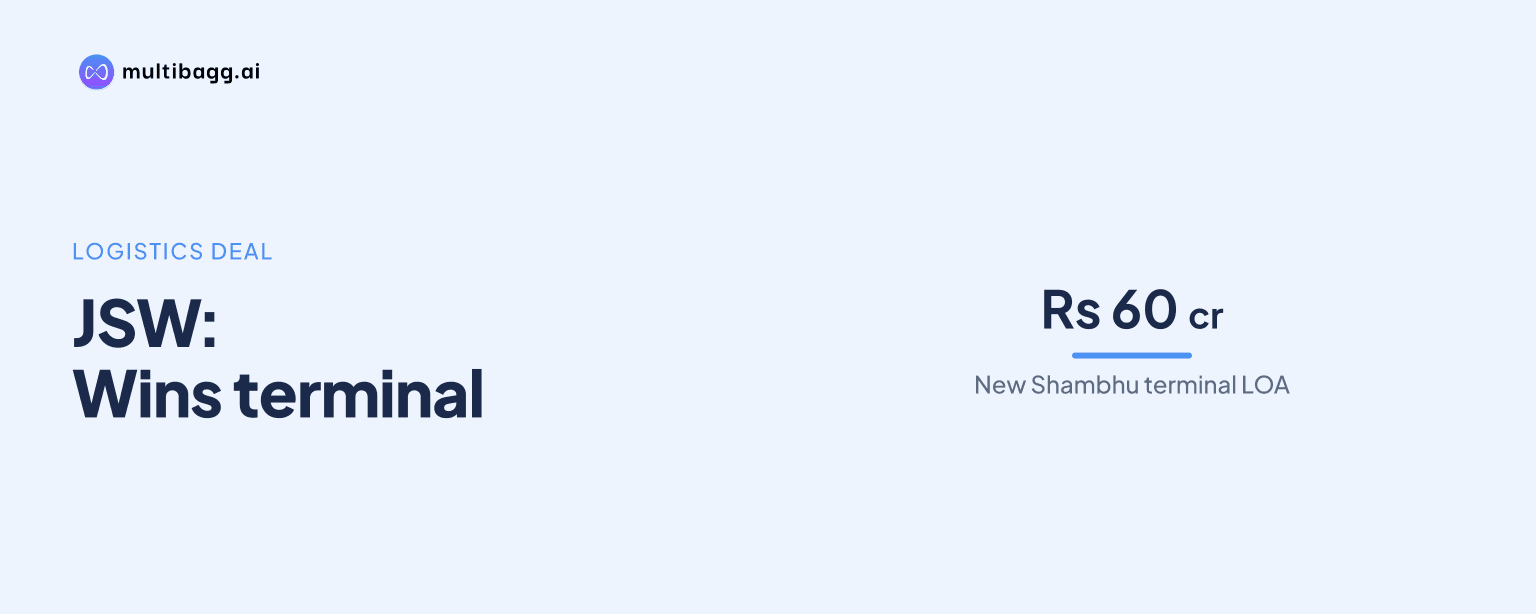
JSW Infrastructure Limited has received a ₹60 crore Letter of Allotment for a Gati Shakti Multi-Modal Cargo Terminal at New Shambhu station in Punjab, where its subsidiary will develop and operate the facility under a 35-year contract.
Know JSW Infrastructure inside out
Results, valuation, peers and who's buying, in one view.
What has JSW Infrastructure been awarded at New Shambhu?
JSW Infrastructure has been awarded a Letter of Allotment, or LOA, by the Dedicated Freight Corridor Corporation of India Limited for a cargo-terminal project at New Shambhu station near Rajpura, Punjab. The LOA was awarded to JSW Minerals Rail Logistics Private Limited, a step-down wholly owned subsidiary of JSW Infrastructure.
The project requires the subsidiary to plan, construct, develop and operate a Gati Shakti Multi-Modal Cargo Terminal, or GCT. The facility is to be developed on goods line no. 4 towards the Ambala end of New Shambhu station, on land owned by DFCCIL or Indian Railways.
The company was informed of the LOA on November 13, 2026, at about 3:00 p.m. The allotment adds a rail-linked cargo facility to JSW Infrastructure's logistics-related project pipeline. The stated purpose of the terminal is to enhance freight movement and terminal capacity.
What are the New Shambhu project’s contract terms and deadlines?
The New Shambhu terminal has an approximate consideration of ₹60 crore and a contract period of 35 years from the LOA date, including the construction period and any extension. Construction must start within three months of approval of the Engineering Scale Plan, or ESP, or the handover of railway land, whichever occurs later.
The project must be completed within 18 months of ESP approval or land handover, whichever is later. These dependencies make the approval of the engineering plan and the transfer of access to railway land important milestones for the project schedule.
The LOA is the formal project allotment, while the detailed agreement and implementation activities will follow the applicable approval process. The disclosed terms do not provide a break-up of construction spending, cargo volumes, revenue projections or expected annual operating income.
How does New Shambhu fit JSW Infrastructure’s GCT portfolio?
New Shambhu extends JSW Infrastructure's reported presence in Gati Shakti cargo-terminal projects beyond its existing and previously disclosed rail-logistics initiatives. The company provides port and maritime services including cargo handling, storage and logistics, and operates port terminals in India and the UAE.
In April 2026, JSW Infrastructure commenced commercial operations at its Gati Shakti Multi-Modal Cargo Terminal at Arakkonam near Chennai after receiving approval from Southern Railway's Chennai Division. The Arakkonam project had been awarded in June 2024 for construction and operation on railway land.
The company has also disclosed a GCT project at Somathane, Maharashtra, through subsidiary Navkar Corporation Limited. That project was awarded by Central Railway's Mumbai division and was reported with an estimated contract value of about ₹63.21 crore, subject to the final agreement terms.
Got a follow-up? Ask IRIS
What does the terminal mean for operations and investors?
The New Shambhu project is intended to add cargo-handling capacity at a rail-linked location near Rajpura. For JSW Infrastructure, the award broadens its disclosed work in rail-based logistics and multi-modal cargo terminals, alongside its port, storage and logistics operations.
The 35-year contract term provides a long operating framework, but the source does not disclose expected cargo throughput, tariffs, profitability, funding arrangements or the contribution the terminal may make to consolidated financial performance. As a result, the ₹60 crore figure should be read as the approximate project consideration rather than as revenue or profit.
For investors, the next operational markers are ESP approval, railway-land handover, construction commencement and completion within the stated timetable. The disclosure does not provide a share-price reaction or any revised financial guidance linked to the project.
Why are Gati Shakti cargo terminals relevant to freight logistics?
Gati Shakti Multi-Modal Cargo Terminals are rail-linked facilities intended to support cargo handling and freight movement. Their relevance for logistics operators lies in connecting rail infrastructure with storage, handling and other cargo-management activities at designated terminal locations.
The New Shambhu award comes from DFCCIL, while the Arakkonam and Somathane projects cited by JSW Infrastructure involve railway authorities. This shows that the company is pursuing terminals through different railway-linked agencies and locations, rather than relying only on its port assets.
The practical importance of each terminal will depend on commissioning, local cargo demand and the operating terms that follow project approvals. None of these factors, beyond the disclosed construction schedule and contract tenure, has been quantified for New Shambhu.
Conclusion
The ₹60 crore New Shambhu award gives JSW Infrastructure another disclosed Gati Shakti cargo-terminal project and assigns its subsidiary responsibility for planning, constructing, developing and operating the facility. The project supports the company’s stated logistics and cargo-handling footprint, while its financial contribution cannot yet be measured from the available disclosure.
Investors should watch for ESP approval or railway-land handover, which will determine when the three-month construction-start clock begins. Completion is due within 18 months of the later of those two events, while the terminal’s operating arrangement runs for 35 years from the LOA date.