










Jyoti Resins sees FY28 revenue of Rs 450-500 crore range
Key highlights
- Jyoti Resins said Rs 450 crore to Rs 500 crore of FY28 revenue could be achievable.
- Jyoti Resins increased annual adhesive capacity from 24,000 tonnes to 42,000 tonnes.
- Jyoti Resins reported Q2 FY27 EBITDA margin of 23%, compared with 14.4% in Q1 FY27.
- Jyoti Resins is evaluating a Gujarat plant with 1,500 tonnes monthly capacity and Rs 45 crore to Rs 50 crore of estimated investment.
powered by IRIS
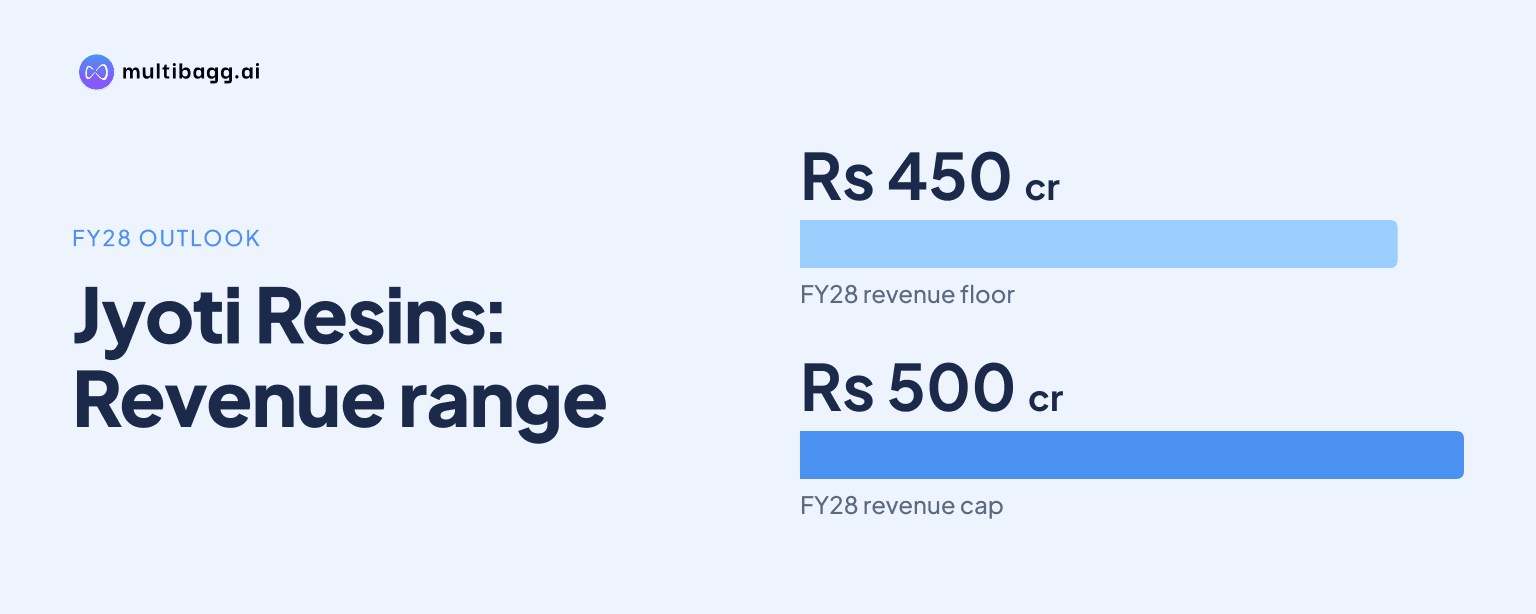
Jyoti Resins and Adhesives Limited said on November 6, 2026 that it could reach Rs 450 crore to Rs 500 crore in revenue in financial year 2028 (FY28), following a completed brownfield expansion to 42,000 tonnes a year. Management had previously placed the Rs 500 crore revenue milestone in FY29.
Know Jyoti Resins and Adhesives inside out
Results, valuation, peers and who's buying, in one view.
What adhesive capacity has Jyoti Resins added?
Jyoti Resins has completed a brownfield expansion that raised manufacturing capacity to 3,500 tonnes a month, or 42,000 tonnes annually, from 2,000 tonnes a month, or 24,000 tonnes annually. Management said the additional capacity provides room to serve existing markets and states entered more recently, including Odisha.
The expanded facility was operating at about 70% to 75% utilisation at the time of the November 2026 call. Management therefore described the brownfield plant as having enough headroom for further volume growth before another immediate expansion at the same site is required.
Jyoti Resins said the completed brownfield project required capital expenditure of Rs 6 crore to Rs 7 crore. Management estimated that the 3,500-tonne monthly plant could support Rs 600 crore to Rs 700 crore of revenue, exceeding the stated FY28 ambition of Rs 450 crore to Rs 500 crore.
Can Jyoti Resins reach Rs 500 crore of revenue in FY28?
Jyoti Resins said revenue of Rs 450 crore to Rs 500 crore in FY28 can be achieved if volume growth continues, although management retained Rs 500 crore in FY29 as its earlier stated benchmark. The potential acceleration follows management’s expectation that FY27 revenue will close at about Rs 375 crore to Rs 400 crore.
Management is targeting annual volume growth of 20%, while it expects FY27 volume growth of at least 15% to 17%. It reported approximately 15% volume growth in Q2 FY27, compared with management’s description of around 9% to 10% in Q1 FY27, showing an increase in the quarterly rate despite the rainy and festive period.
The FY28 outcome remains dependent on conditions identified by management rather than solely on installed capacity. Management cited geopolitical developments, raw-material price fluctuations and slower real-estate activity in Q1 FY27 as factors that could affect buying behaviour and the growth pace.
Jyoti Resins had expanded into 16 states after entering Odisha, and management said it was working market by market at the pin-code level. The plan includes deeper coverage of tier-two and tier-three locations and hardware trade outlets, alongside the company’s established plywood and laminates presence.
Got a follow-up? Ask IRIS
How will Jyoti Resins seek higher volumes and wider distribution?
Jyoti Resins plans to pursue volume growth through dealer additions, carpenter engagement, new geographies and original equipment manufacturer (OEM) sales. Its dealer base rose to 14,000 from 10,000 a year earlier, while management said roughly 50% of placements generate repeat orders within one year.
The company conducted nearly five times as many carpenter meets in H1 FY27 as in the corresponding period a year earlier. Management said its Euro Adhesives strategy centres on carpenter and dealer engagement, supported by brand communication, as it seeks deeper distribution rather than a margin outcome at the expense of market expansion.
For the OEM channel, Jyoti Resins has introduced four products for furniture and modular-furniture makers. Management said it hired 150 people in the preceding four months to extend sales coverage, add dealers and support its 20% annual volume-growth target.
Management also said it aims for a 20% market share in each state, while noting that it has achieved deeper presence in only five states so far. This leaves distribution execution, repeat orders and penetration in the remaining states as the commercial mechanisms behind the FY28 revenue range.
How do margins, cash flow and future capital spending affect the plan?
Jyoti Resins expects earnings before interest, tax, depreciation and amortisation (EBITDA) margin of 24% to 25% in H2 FY27, subject to no further sharp rise in raw-material prices. EBITDA margin recovered to 23% in Q2 FY27 from 14.4% in Q1 FY27 after Q1 price increases began to take effect.
Vinyl acetate monomer (VAM), the company’s key raw material, rose from about Rs 100 per kg to Rs 115 per kg during the preceding month, management said. It added that 90 days of inventory and procurement contracts near Rs 100 per kg helped contain the effect on Q2 profitability.
Jyoti Resins and the market leader increased prices by around 6% to 7% in May 2026, according to management. Management said it was targeting at least 65% gross margin through pricing and premiumisation, while maintaining its broader EBITDA margin range of 22% to 25% and using discounts or promotions if VAM prices decline.
Marketing and brand-communication spending reached about 7% of revenue in H1 FY27, compared with about 3.5% in the prior year, yet Q2 EBITDA margin was 23%. Management said completed brownfield spending supports its expectation that cash generation can be maintained through March 2027, although receivable days remain above its FY23 and FY24 target of around 120 days.
Jyoti Resins is also working towards a Gujarat greenfield facility with initial capacity of 1,500 tonnes a month and estimated investment of Rs 45 crore to Rs 50 crore. Management did not provide a commissioning date, and said it is exploring channel financing for smaller markets within one or two quarters to help manage receivables.
Conclusion
Jyoti Resins has linked a possible FY28 revenue range of Rs 450 crore to Rs 500 crore to its completed increase in annual capacity from 24,000 tonnes to 42,000 tonnes. The plan combines higher utilisation, a 15% to 20% volume-growth path, dealer expansion from 10,000 to 14,000, and broader reach across 16 states, OEM customers and hardware trade.
The next measures to watch are whether FY27 revenue closes within management’s Rs 375 crore to Rs 400 crore expectation and whether H2 FY27 EBITDA margin reaches 24% to 25%. Management’s planned Gujarat facility, its effort to return receivable days toward 120 days, and the proposed rollout of channel financing within one or two quarters remain unresolved execution points.