










Jyoti Resins will trade VAM savings for faster volume growth
Key highlights
- Jyoti Resins said lower VAM costs may be used for dealer and carpenter promotions while EBITDA remains within a 22% to 25% range.
- Q2 FY27 EBITDA margin recovered to 23% from 14.4% in Q1 FY27.
- Jyoti Resins expects at least 15% to 17% volume growth in FY27 after about 15% growth in Q2.
- Manufacturing capacity rose to 3,500 tonnes per month, with utilisation at about 70% to 75%.
powered by IRIS
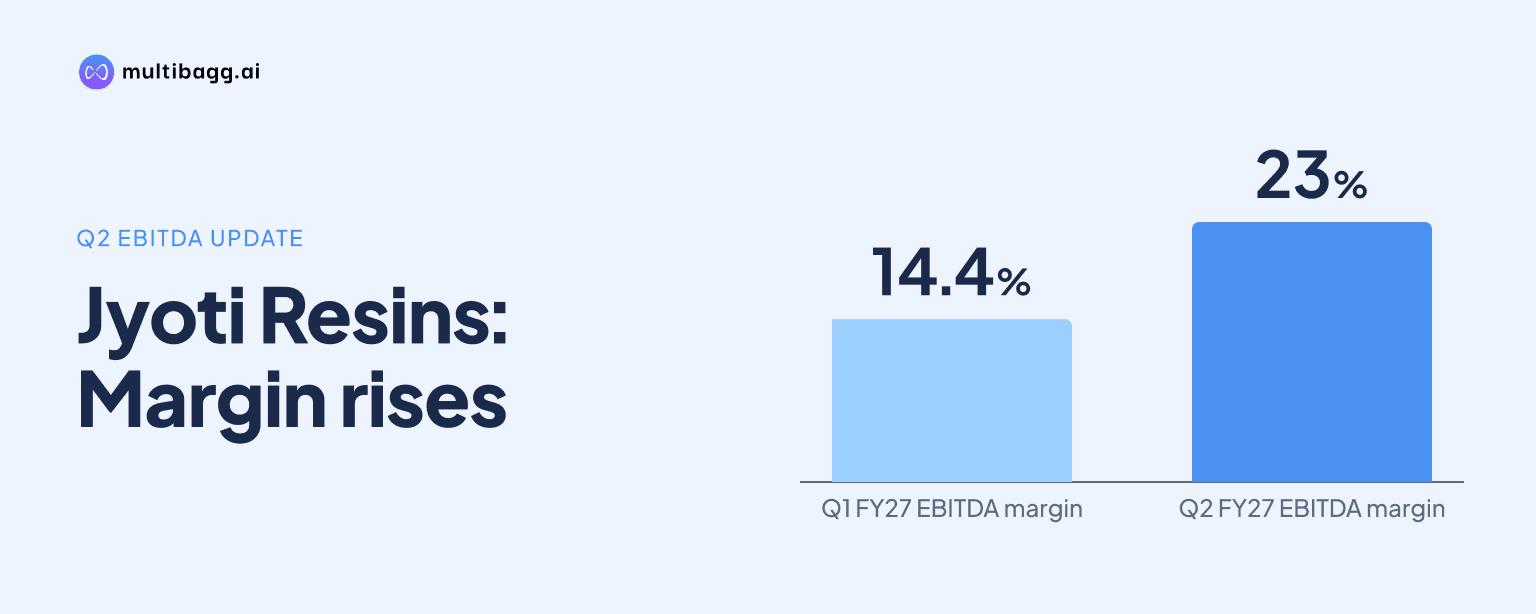
Jyoti Resins & Adhesives Limited said in its Q2 FY27 call that it may use lower vinyl acetate monomer costs for dealer discounts and carpenter promotions to support volume growth, rather than retain all of the margin upside. Management’s stated acceptable earnings before interest, tax, depreciation and amortisation (EBITDA) range is 22% to 25%, after Q2 margin recovered to 23% from 14.4% in Q1.
Know Jyoti Resins and Adhesives inside out
Results, valuation, peers and who's buying, in one view.
How will Jyoti Resins use lower VAM prices?
Jyoti Resins said it would pass on a further decline in vinyl acetate monomer, or VAM, through more discounts and promotional offers to dealers and carpenters if market conditions warrant it. Management said the approach would be reviewed quarter by quarter because competitors’ strategies also determine pricing decisions. Its stated objective is to add customers and build deeper market coverage, while keeping EBITDA within a 22% to 25% range.
Management said it is not focused on preserving an extra 2% to 3% of EBITDA margin if the alternative is to use raw-material relief to gain volume. Jyoti Resins is targeting about 20% annual volume growth and expects at least 15% to 17% growth in FY27. Q2 volume growth was about 15%, supported by improved realisations and expansion activity across its distribution network.
The potential use of promotions differs from the pricing action taken in May, when Jyoti Resins and the market leader raised prices by around 6% to 7% in response to raw-material pressure. Management said VAM had eased after Q1, helping Q2 profitability. It also said VAM had risen from about Rs 100 per kg to Rs 115 per kg during the prior month, but contracts and inventory procured near Rs 100 per kg limited the immediate effect.
What changed in Jyoti Resins’ margins during Q2 FY27?
Jyoti Resins’ EBITDA margin rose to 23% in Q2 FY27 from 14.4% in Q1 FY27, as earlier price increases and raw-material procurement measures took effect. Management said it had begun procuring raw materials differently from Q1, when Middle East developments affected VAM and freight conditions. It maintained contracts covering about 60 to 90 days, which reduced exposure to the latest VAM price movement.
Management expects EBITDA margin of 24% to 25% in H2 FY27, subject to no further sharp increase in raw-material prices. It said Q3 gross margin should remain flat at the Q2 level of 63% to 64%, while describing 65% as an achievable gross-margin target. That guidance shows that the anticipated profitability improvement is conditional on VAM and freight costs, rather than a commitment to keep every raw-material saving.
Marketing and brand spending increased while margin recovered. Jyoti Resins said it spent almost 7% of H1 FY27 revenue on marketing and brand communication, compared with around 3.5% in the prior year. Management said Q2’s 23% EBITDA margin was achieved despite this spending, which included dealer activity, carpenter engagement and advertising associated with actor Pankaj Tripathi.
Got a follow-up? Ask IRIS
Why is Jyoti Resins prioritising volumes over incremental margin?
Jyoti Resins is prioritising volume because it is expanding distribution across 16 states and sees further room to penetrate existing territories. The company entered Odisha and is pursuing pin-code-level coverage in tier-two and tier-three markets, as well as hardware trade. It added 150 employees in the preceding four months to extend sales coverage and support its FY27 volume-growth goal of at least 15% to 17%.
The dealer base rose to 14,000 from 10,000 in the previous year. Management said that when it places products with 100 dealers in a tier-two or tier-three market, it typically receives repeat orders from around 50 dealers within six months. It then aims to reach a repeat-order ratio of at least 75% in the following year, with a territory targeted to reach a satisfactory break-even volume within two to three years.
Carpenter and dealer activity is part of this customer-acquisition plan. Jyoti Resins held nearly 3,500 carpenter meets in H1 FY27, versus around 2,500 in the full prior year, and conducted 54 dealer meets in Q1 FY27 compared with 30 in the previous year’s Q1. Management also said it hired about 9,200 Mumbai cinema screens for advertising linked to the Mirzapur movie during the prior quarter.
Does Jyoti Resins have capacity and products for higher volumes?
Jyoti Resins completed a brownfield expansion that increased manufacturing capacity to 3,500 tonnes a month from 2,000 tonnes a month, equal to 42,000 tonnes annually. Management put current utilisation at about 70% to 75%, leaving capacity headroom for the volume strategy. It said the expanded plant could support Rs 600 crore to Rs 700 crore of revenue and that the brownfield project required Rs 6 crore to Rs 7 crore of capital expenditure.
The company is also working towards a greenfield facility in Gujarat with initial capacity of 1,500 tonnes a month and estimated investment of Rs 45 crore to Rs 50 crore. Management did not give a commissioning date. It said the completed brownfield project means it does not face immediate additional expansion spending, allowing it to focus on distribution, trade marketing and brand communication.
Jyoti Resins is also developing its original equipment manufacturer, or OEM, business, including furniture and modular-furniture makers. It has introduced four OEM products and said the segment represents 6% of revenue currently. Management is targeting 10% to 15% of revenue from OEMs over the longer term, potentially in two to three years, rather than setting an FY27 exit target.
Conclusion
Jyoti Resins has described a deliberate trade-off between margin retention and customer acquisition. Following a recovery to 23% EBITDA margin in Q2 FY27 from 14.4% in Q1, management said it is prepared to direct lower VAM costs into dealer and carpenter promotions if that supports volume growth. The approach combines a 22% to 25% EBITDA operating range with a stated goal of about 20% annual volume growth.
The next measures to watch are the management target of 24% to 25% EBITDA margin in H2 FY27, its expectation of flat Q3 gross margin at 63% to 64%, and progress toward at least 15% to 17% FY27 volume growth. Management’s 60-to-90-day raw-material contract cover, 16-state distribution footprint, 3,500-tonnes-a-month capacity and longer-term OEM target of 10% to 15% of revenue will shape whether promotional spending produces repeat demand.