










Nath Bio-Genes says trade incentives cut H1 margin to 11.4%
Key highlights
- Nath Bio-Genes said H1 FY27 EBITDA margin declined to 11.4% from 14.4% a year earlier.
- Management said at least Rs 5 crore of additional trade support was used to defend H1 FY27 sales.
- Nath Bio-Genes said its Rs 100 crore ambition is net profit and may require revenue of around Rs 750 crore.
- Trade receivables rose to Rs 264.40 crore at September 2026 from Rs 83.80 crore at March 2026.
powered by IRIS
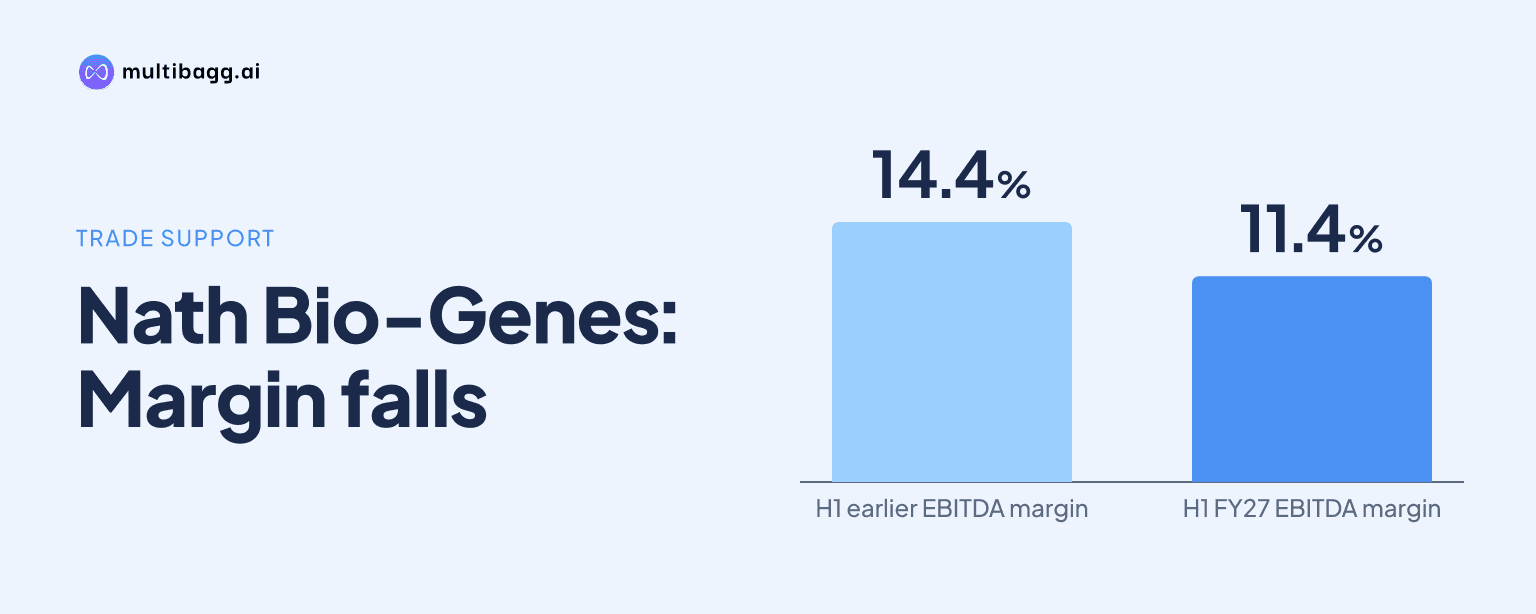
Nath Bio-Genes said its H1 FY27 earnings before interest, tax, depreciation and amortisation margin fell to 11.4% from 14.4% a year earlier after it provided at least Rs 5 crore of additional trade incentives to defend sales amid distribution-channel liquidity pressures. Revenue grew 12.6%, but EBITDA declined 11%, according to the discussion.
Know Nath Bio-Genes (India) inside out
Results, valuation, peers and who's buying, in one view.
Why did Nath Bio-Genes' H1 EBITDA margin fall to 11.4%?
Nath Bio-Genes said the margin decline resulted mainly from its decision to pass additional margins to the trade through sales schemes and other measures. Management said difficult market conditions, including liquidity constraints in agricultural distribution and disruption it linked partly to war, required support to protect the top line during H1 FY27.
Management quantified the incremental market support at at least Rs 5 crore. The company said it accepted the cost because reducing trade margins could put sales at risk, while preserving distribution reach and sales could support profit in a subsequent period. EBITDA margin declined by 3 percentage points, to 11.4% from 14.4%, while revenue rose 12.6%.
Nath Bio-Genes did not disclose how the Rs 5 crore was divided by crop, distributor, geography or individual scheme. It also did not identify a change in manufacturing cost or selling price as the direct explanation for the EBITDA movement, instead attributing the divergence between revenue and profit to deliberate distributor incentives.
When does Nath Bio-Genes expect EBITDA margin to recover?
Nath Bio-Genes said it expects EBITDA margin to recover by the end of FY27, citing reasonably strong Rabi crops, but management gave no numerical margin target or quarterly timetable. It described H1 FY27 as a specific year rather than a permanent condition in which lower trade margins would continue.
Management’s recovery argument depends first on maintaining sales growth. It said the bottom line should follow if the top line is maintained, although it acknowledged that EBITDA and entry margins can fluctuate. That statement is an expectation from management, not formal guidance that the at least Rs 5 crore of added schemes will reverse in a defined period.
A second part of the plan is crop mix. Management said hybrid vegetables, maize and plant nutrient supplements, or PNS, provide better margins. It expects product-demand creation, new territories and a larger contribution from these categories to support revenue and profitability alongside its established cotton and paddy businesses.
Management also said trade schemes could decline to around 26%, 27% or 28% in the following year, which it said could save 4%. The transcript does not define the comparison base for those percentages or the calculation of the stated saving, so the comment provides directional context rather than a reported financial forecast.
What does Nath Bio-Genes mean by its Rs 100 crore profit ambition?
Nath Bio-Genes clarified that its Rs 100 crore ambition refers to net profit, not EBITDA, and management said it may be achievable once revenue exceeds around Rs 750 crore. The clarification followed an investor’s reference to a Rs 500 crore sales target and an assumed Rs 100 crore EBITDA target.
Management said Rs 100 crore of net profit on Rs 500 crore of net sales would require a 20% net margin, which it said is not currently available in the seed and agriculture market. It cited higher production costs, reduced land available for seed production in various states, and trade expectations for better margins.
The company said a revenue base of around Rs 750 crore would imply a 14% net margin for Rs 100 crore of net profit, which management described as achievable. It did not provide a date for that objective and explicitly declined to commit to whether it could be reached in six months, one year or several years.
The distinction is material because H1 FY27’s 11.4% measure is EBITDA margin, while the Rs 100 crore objective is net profit. Nath Bio-Genes presented the latter as a longer-term aspiration tied to larger revenue and improved product mix, rather than an outcome that can be calculated directly from the H1 EBITDA result.
Got a follow-up? Ask IRIS
Which crops and products could support Nath Bio-Genes' plan?
Nath Bio-Genes is increasing its focus on non-cotton, non-paddy crops, including maize, Bajra, jowar, wheat, mustard, vegetables and PNS. Management said maize delivered a good uplift in the current year, while Bajra has provided uplift for two to three years, helping support the top line when cotton sales softened.
Management said corn prices increased from around Rs 1,600 to Rs 1,700 per quintal a year earlier to Rs 2,700 to Rs 3,000 per quintal. It expects at least 20% corn growth in 2027-28 over 2026-27, supported by higher commercial prices, appointment of larger distributors in corn markets and hiring focused on corn, hybrid paddy and Bajra.
The product pipeline includes cotton hybrids Sanket and Rana, hybrid-paddy products Tata, Tata Gold and Gurukripa, and pearl millet product Super Surprise. Management said Tata Gold volumes are increasing, two more pearl millet hybrids are entering volume-building phases, and one mustard hybrid has been identified for production next season.
Cotton remains relevant to the portfolio despite the diversification plan. Management attributed a 2.23% H1 FY27 decline in cotton to monsoonal conditions in Maharashtra and parts of Gujarat, rather than competition, and said it expects cotton to grow 20% to 30% next year on commercial prices of about Rs 9,500 to Rs 10,500, compared with about Rs 7,500 last year.
How could working capital affect Nath Bio-Genes' recovery?
Nath Bio-Genes reported inventory of Rs 406.20 crore at September 2026, down from Rs 444.60 crore at March 2026, but said cotton-seed stock remained elevated. Management attributed the position to higher production of certain key hybrids and lower-than-anticipated Kharif sales, and plans to rationalise cotton production.
The company expects to liquidate excess cotton inventory gradually over two to three years and said it does not expect quality issues because cotton seed is sturdy in nature. The inventory decline of Rs 38.40 crore between March and September shows some moderation, but the stated liquidation period indicates that stock normalisation will extend beyond one season.
Trade receivables rose to Rs 264.40 crore at September 2026 from Rs 83.80 crore at March 2026, reflecting seasonal business patterns and liquidity constraints across agricultural distribution. The higher receivables and remaining elevated inventory resulted in negative net cash flow from operating activities at the end of the first half; management did not disclose the cash-flow amount in the call.
Management said it is monitoring collections and expects working capital to improve gradually as receivables are recovered and inventory normalises. Its stated priorities include inventory management, collections, cost discipline and support for premium and diversified seed products, making cash conversion an additional variable in the planned margin recovery.
Conclusion
Nath Bio-Genes’ H1 FY27 result shows a clear management trade-off: at least Rs 5 crore of additional distributor support helped defend revenue growth but contributed to EBITDA margin falling to 11.4% from 14.4%. The company is seeking to improve the earnings mix through maize, vegetables and PNS while retaining cotton and paddy sales.
The next milestones are management’s expectation of recovery by the end of FY27, the planned reduction of cotton inventory over two to three years and collection of Rs 264.40 crore of September 2026 receivables. The longer-term Rs 100 crore net-profit ambition remains linked by management to revenue of around Rs 750 crore, without a scheduled achievement date.